NVIDIA GeForce Go 6800 Ultra: Gaming On Dell's Inspiron XPS Gen 2


To give you an idea as to how the GeForce Go 6800 Ultra compares to some of today's high-end desktop GPUs, we've put together a simple chart that lists their theoretical peak fillrates and memory bandwidth.

The GeForce Go 6800 Ultra falls somewhere between the GeForce 6800 and GeForce 6800 Ultra. The GeForce Go 6800 Ultra is "only" a 12-pixel pipeline part, but because its core is clocked at 450MHz its peak pixel and texel fillrates are much higher than a standard GeForce 6800, which is also a 12-pixel pipeline GPU. In fact, the GeForce Go 6800 Ultra is only 1GP/s behind a 16-pipe GeForce 6800 GT. But because the Go 6800 Ultra's memory is clocked 100MHz faster then a GT, its got 3.2GB/s more memory bandwidth available; the same peak 35.3GB/s as a desktop GeForce 6800 Ultra.
 |
|
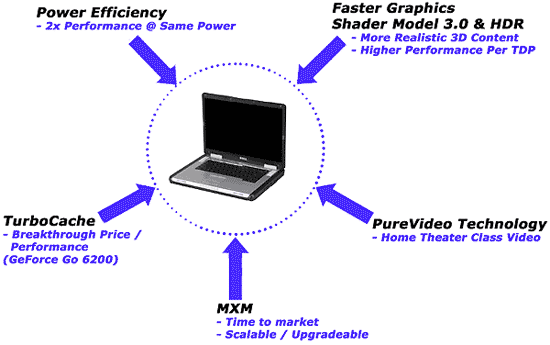
NVIDIA's mobile GPU technology has evolved to the point where their mobile products now have feature parity with their desktop counterparts. And NVIDIA's mobile GPUs also incorporate some technologies specifically designed to address the limitations of a mobile platform. PowerMizer for example, is a feature that allows NVIDIA's mobile GPUs to down-clock and disable unused portions of the chip when the workload is light, and NVIDIA's MXM modules (discussed here) help notebook ODMs bring new designs to market much faster. NVIDIA's current GPUs also offer twice the performance of the previous generation, while consuming the same amount of power. Unfortunately, we don't have specific power requirements for the GeForce Go 6800 Ultra, but the Dell Inspiron XPS Gen 2 is definitely thinner and lighter then the original version. Throughout our testing the unit's cooling fans remained very quiet, which bodes well for the GeForce Go 6800 Ultra's power consumption and thermal design power (TDP).