Moto Razr Fold Review: The Folding Phone That Puts Samsung On Notice

Moto Razr Fold Reception And Sound Quality

The Razr Fold packs Bose-tuned stereo speakers with Dolby Atmos that sound fantastic. It delivers the best sounding audio I’ve heard on a handset since the Bose-tuned 2.1 speaker system on the Poco F8 Ultra: loud, clear, and with some actual bass. The Razr Fold also supports aptX HD, LDAC, and LHDC for high-quality wireless audio playback over Bluetooth, and digital accessories for wired listening via USB Type-C.
Moto Razr Fold Performance And Benchmark Results
Under the hood, the Razr Fold uses Qualcomm’s 3nm Snapdragon 8 Gen 5 SoC, and delivers solid performance to match. It juggled my standard assortment of productivity, communication, social media, entertainment, and gaming apps without skipping a beat. A single memory configuration is available, with 16GB of LPDDR5X RAM and 512GB of UFS 4.1 storage. As you’d expect, there’s no microSD support.
While the Razr Fold feels perfectly smooth and responsive day-to-day, it seems odd that Motorola chose to equip its flagship – a book-style folding phone designed to maximize productivity and multitasking – with the Snapdragon 8 Gen 5 instead of following in Oppo and Honor’s footsteps by using Qualcomm’s top-tier Snapdragon 8 Elite Gen 5 (or even last year’s Snapdragon 8 Elite found in Samsung's Galaxy Z Fold7).
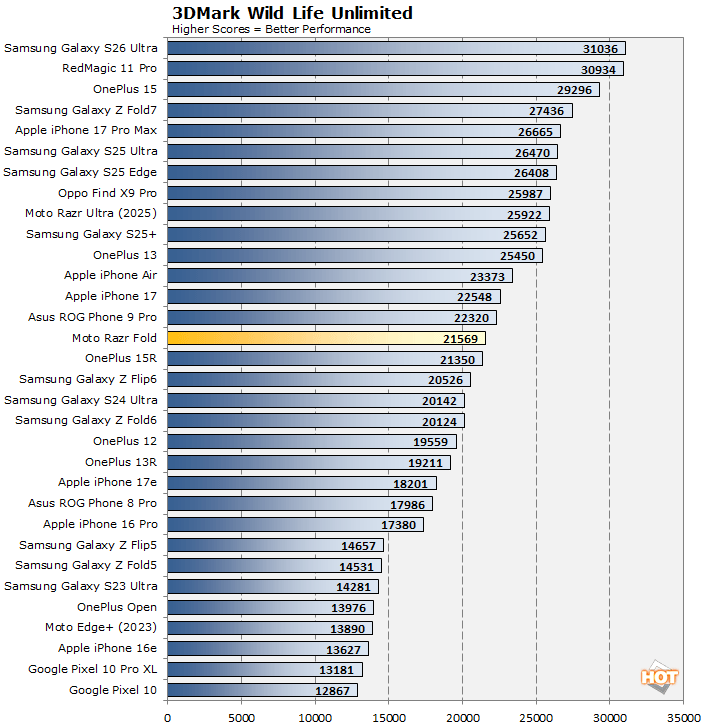
Subjective performance is one thing, but in our benchmarks the Razr Fold’s Snapdragon 8 Gen 5 generally lands in Snapdragon 8 Gen 3 territory for GPU-heavy workloads, and basically matches the Snapdragon 8 Elite for CPU-heavy workloads. But the reason Motorola might have picked this chip is better thermals. The Razr Fold throttles significantly less in 3DMark’s Wild Life stress tests than the Snapdragon 8 Elite-powered Galaxy Z Fold7.
Moto Razr Fold Geekbench Results
Geekbench is a cross-platform benchmark that simulates real-world processing workloads in image processing and particle physics calculation scenarios. We tested all of the smartphones featured here with GeekBench 6's single and multi-core workloads, as well as Geekbench AI's NPU workloads.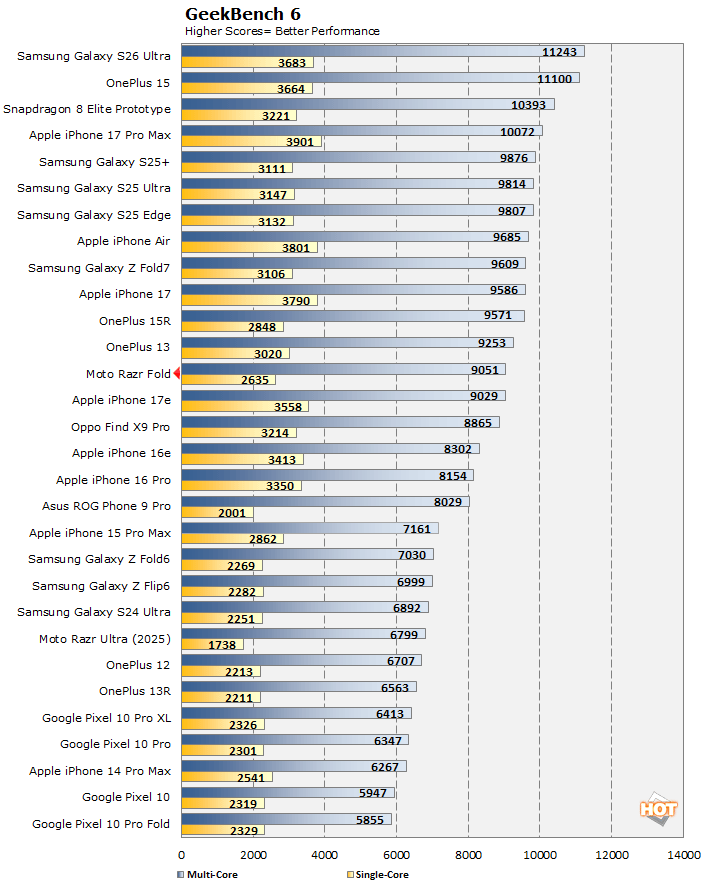
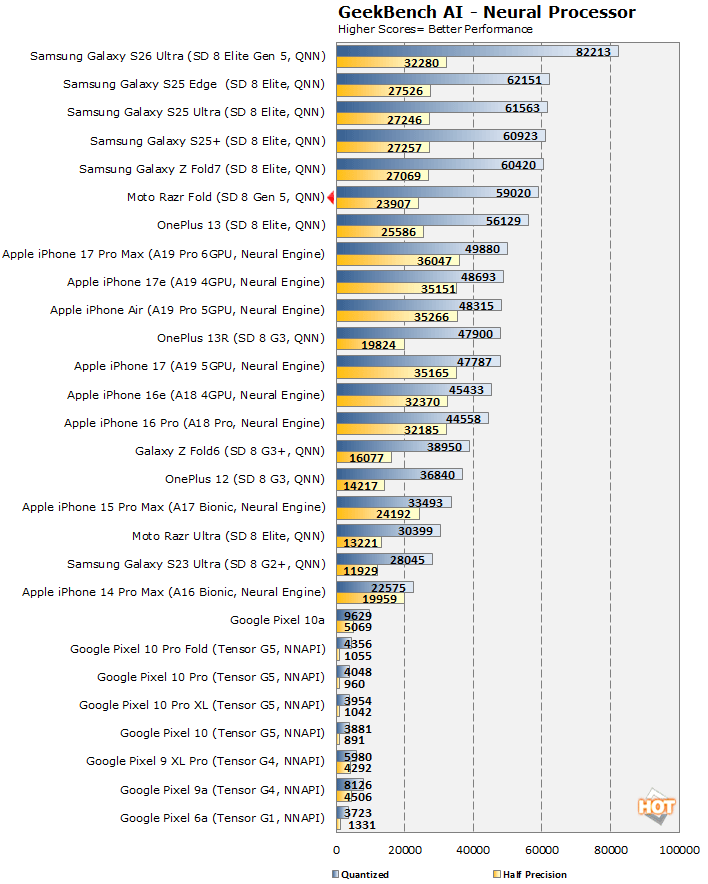
As you can see, the Razr Fold performed quite well in these tests, with scores almost matching Snapdragon 8 Elite-equipped devices like the OnePlus 13.
Moto Razr Fold PCMark Results
UL's PCMark for Android is an excellent suite of tests if you want to benchmark a wide range of tasks on any handset -- things like image and video editing, as well as lighter-duty, everyday workloads such as email and web browsing. When you see the test running live, it's clear the scripted application tests are carefully selected and tuned to make use of the each mobile platform in a very controlled way...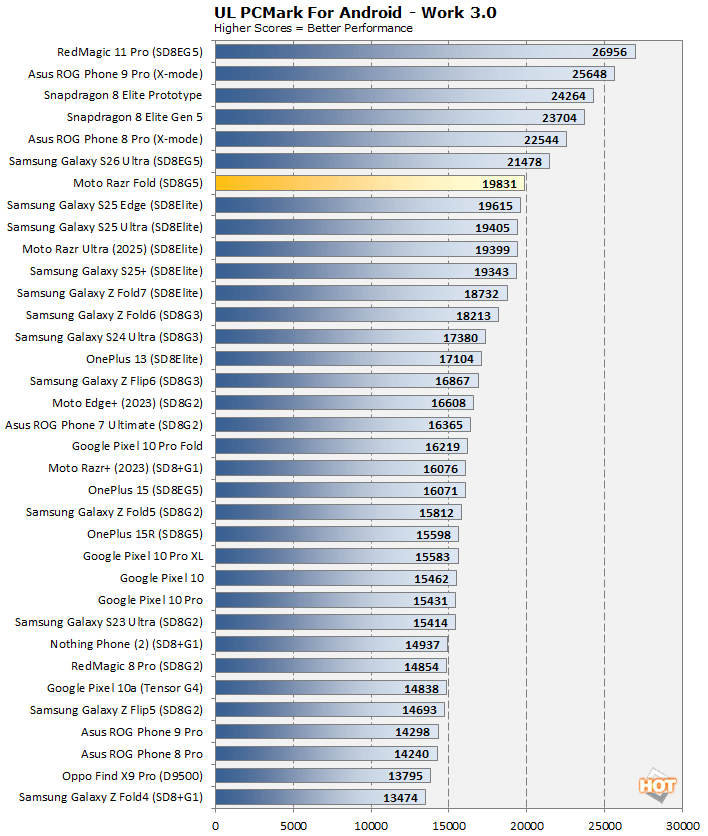
Here Motorola's book-style folding phone shows similar performance to last year's Snapdragon 8 Elite-powered flagships, slotting just above Samsung's Galaxy S25 Edge.
Moto Razr Fold AnTuTu Results
AnTuTu’s latest benchmark returns a number of metrics ranked with somewhat nebulous scores, rather than frame rates or time to complete. Here we're running the latest version of AnTuTu across multiple Android devices. AnTuTu returns four top level performance results which are all included here: CPU, RAM, 3D, UX (or User Experience), along with a total score.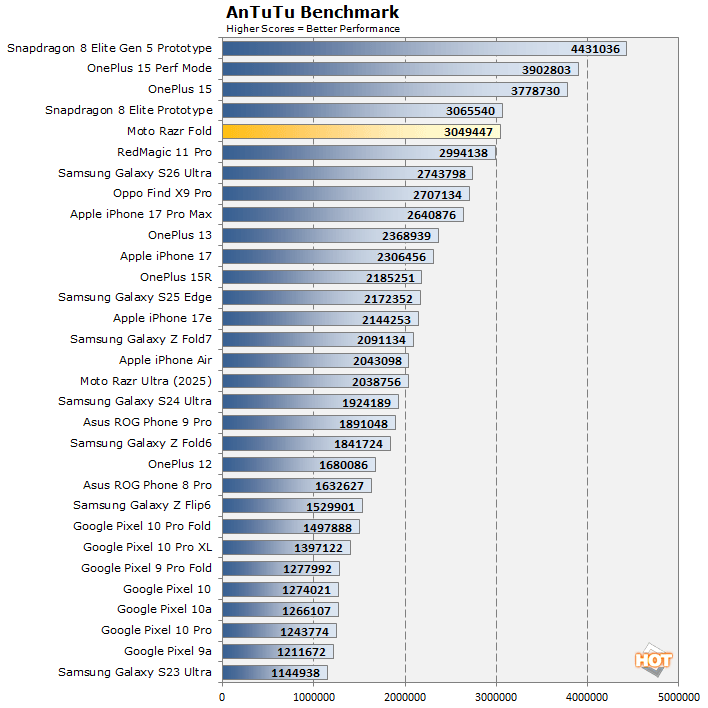
According to AnTuTu, the Razr Fold beats Snapdragon 8 Elite Gen 5-equipped devices like the RedMagic 11 Pro and Samsung Galaxy S26 Ultra in terms of overall score.
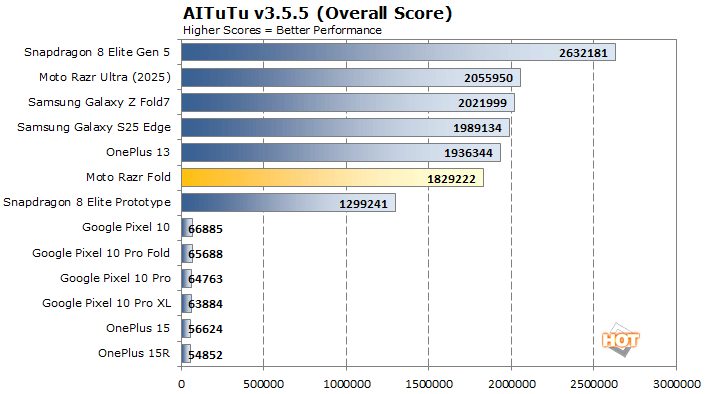
The Moto Razr Fold is right in the mix with last year's flagship devices according to AiTuTu, though it trails by a few percentage points.
Moto Razr Fold 3DMark Results
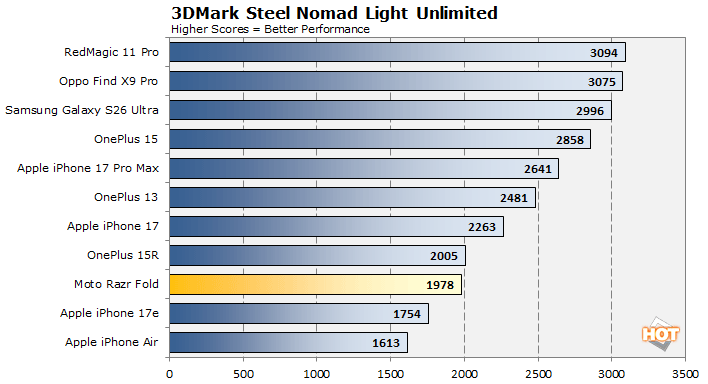
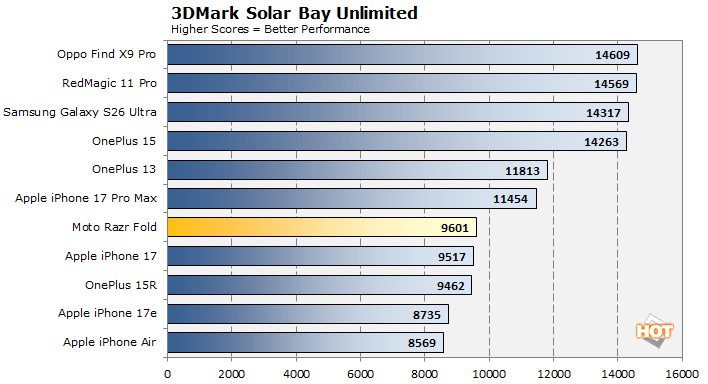
3DMark is the latest cross-platform graphics benchmark from UL. Its primary purpose is to measure GPU performance across platforms, and two distinct tests are available. The standard 3DMark tests are designed to give feedback on how a game performs over a short period of time. With mobile games, people typically play in brief spurts when they find some free time; be it on the bus, on the subway, or a quick battle royale session over lunch break. The 3DMark stress tests, on the other hand, show how a device performs over a longer stretch of time, and take note of performance degradation that might occur due to increased heat levels and throttling.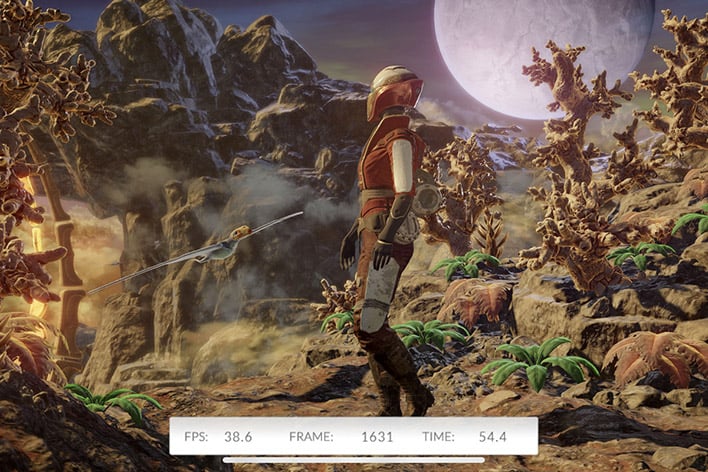
Moto Razr Fold Sustained Performance


The Razr Fold does exhibit some throttling in the Wild Life stress test, but still achieves a stability score of 71% -- a significant improvement over the Galaxy Z Fold7's score of 45.4%. It also fares pretty well in the Solar Bay Stress test, managing a stability score of 75.5%, and in the Steel Nomad Light stress test, with a stability score of 78%.
Moto Razr Fold Additional Features And Battery Life
The rest of the specs include sub-6GHz 5G (SA / NSA), CAT 22 LTE, eSIM support, tri-band WiFi 7 (802.11be), Bluetooth 6.0 (LE), NFC, and dual-band A-GPS/ GLONASS / Galileo / BeiDou / QZSS / NavIC positioning. In addition, the Razr Fold comes with the usual array of sensors, a quality linear vibration motor for superior haptics, and a side-mounted capacitive fingerprint sensor that’s fast and reliable. So is face unlock.
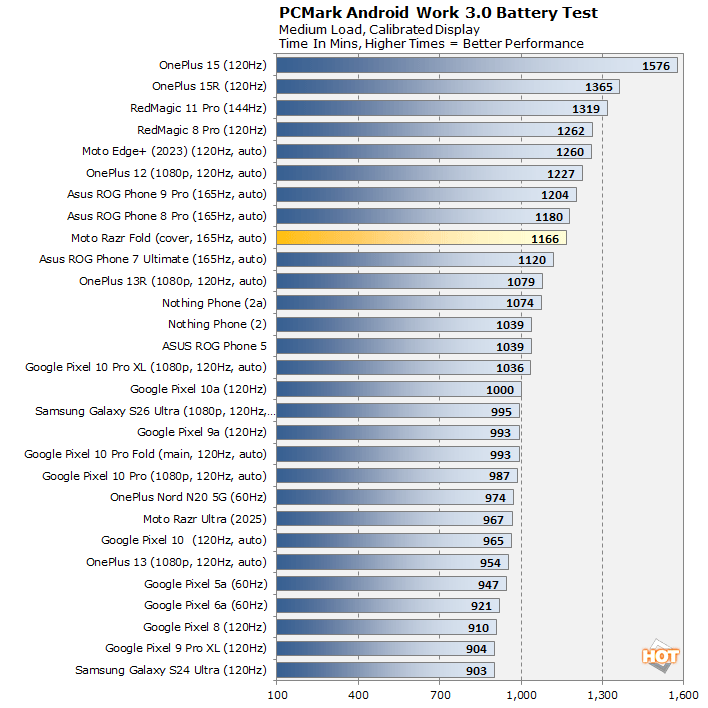
On the charging front, the Razr Fold supports 80W wired fast charging (USB-PPS), 50W wireless fast charging (Qi compatible), and 5W reverse wireless charging. This basically matches Oppo and Honor’s latest folding phones, and puts the Galaxy Z Fold7’s 25W wired and 15W wireless charging to shame. Unfortunately, the Razr Fold lacks Qi2 magnetic accessory support, and ships without a charger in the box.
Next up: software, AI, and review verdict...