Samsung Galaxy Z Fold8 And Fold8 Ultra Review: A Wide Winning Formula


| Samsung Galaxy Z Fold8 and Z Fold8 Ultra - Starting At $1,899 Samsung’s new Galaxy Z Fold8 ($1,899) and Z Fold8 Ultra ($2,099) are both excellent, premium folding phones, but the Z Fold8’s passport-style form-factor delivers the ideal experience.
|
|||

|

|
||

On July 22, 2026 in London, Samsung launched two book-style folding phones, the Galaxy Z Fold8 Ultra ($2,099), the successor to last year’s Z Fold7, and the Galaxy Z Fold8 ($1,899), a new passport-style wide form-factor handset with a 4:3 aspect ratio. As I mentioned in my hands-on article and video (below), the Z Fold8 Ultra delivers meaningful but incremental updates over its predecessor while the Z Fold8 offers an exciting new design language.
Both phones benefit from the latest Qualcomm Snapdragon 8 Elite Gen 5 for Galaxy SoC, an improved ultrawide camera, brighter displays with less crease, larger capacity silicon-carbon batteries, and faster charging. And while the Z Fold8 Ultra’s overall design remains basically the same as before, the Z Fold8 stands out for being the first passport-style, wide form-factor folding phone in the US since Google’s original Pixel Fold.
The market for folding handsets has changed considerably over the last few years. Right now, the Z Fold8 Ultra must contend with Moto’s excellent Razr Fold ($1,799), and the Z Fold8 will soon go head-to-head with Apple’s rumored iPhone Ultra. So, are Samsung’s latest book-style folding handsets competitive? Are they worth the premium price? Does the Z Fold8’s 4:3 aspect ratio make a difference? I’ve been using these devices for a couple weeks now and will answer all of these questions and more on the pages ahead in my full review...
Galaxy Z Fold8 and Z Fold8 Ultra Hardware And Design
The Galaxy Z Fold8 Ultra is a dead ringer of its predecessor, the Galaxy Z Fold7. Put them side-by-side, and colorways notwithstanding, you'd be hard-pressed to tell them apart. They look virtually identical, with the exact same buttons, ports, openings, and antenna bands in the exact same locations. In fact, Z Fold7 cases fit the Z Fold8 Ultra perfectly. Weight is the same (215g) too, and so are dimensions, except for one.
Samsung also refined the Z Fold8 Ultra’s hinge, which feels even nicer and more refined than the Z Fold7’s. Like before, the phone can be opened at almost any angle, enabling Flex Mode (more on this later). The Z Fold8 Ultra’s inner and outer screens are the same size and aspect ratio as the Z Fold7’s (8 inches at 1:1 and 6.5 inches at 21:9, respectively). As such, the Z Fold8 Ultra’s form factor looks and feels familiar.

What sets the Z Fold8 apart from its precursors is its weight (201g, the lightest book-style folding phone yet), and thickness (just 4.5mm open, 9.7mm closed). Combine that with Samsung’s attractive angular design language, and this handset is a game changer. When closed, the Z Fold8 shape makes it more pocketable than even bar-style phones and gives you a wider, more comfortable on-screen keyboard experience.

This handset's downsides are few, and are the result of Samsung's design decisions. Compared to the Z Fold8 Ultra, the Z Fold8 packs a smaller battery (4,800 vs 5,000 mAh), fewer, lower resolution cameras (50MP main and 50MP ultrawide vs. 200MP main, 50MP ultrawide and 10MP 3x telephoto), and a hinge that, while it feels just as smooth and polished, snaps fully open past 90-degrees, eschewing Flex Mode.

As you’d expect, the layout of the buttons, ports, and openings follow in the Z Fold7’s footsteps. When open, both handsets feature a volume rocker and power/lock key (which doubles a capacitive fingerprint sensor) on the right side; a speaker grille, USB Type-C port (USB 3.2), and mics along the bottom edge; nothing but antenna bands on the left; plus another speaker grille, a SIM tray, and additional mics on top.


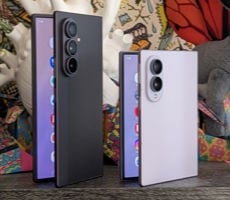
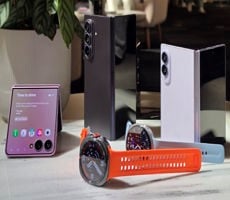
The Z Flip8 Ultra comes in Violet Shadow (the review unit pictured here), Cream, Graphite, and Green Shadow (Samsung exclusive). Meanwhile, the Z Fold8 is available in Lavender (pictured here), Graphite, Cream, and Pistachio (Samsung exclusive).
Galaxy Z Fold8 Ultra Specs And Features
| Processor & 5G Platform |
Qualcomm Snapdragon 8 Elite Gen 5 for Galaxy |
| Display | 8.0" 1:1 LTPO Dynamic AMOLED 2x, 2504x2256 res, 1-120Hz + 6.5" 21:9 1080p LTPO Dynamic AMOLED 2x, 2520x1080 res, 1-120Hz |
| Memory | 12/16GB |
| Storage | 256GB/512GB/1TB UFS 4.0 |
| Rear-Facing Cameras | 200MP 1/1.3” f/1.7 Main OIS, Omni-Directional PDAF - 50MP 1/2.5" f/1.9 120º Ultrawide Omini-Directional PDAF - 10MP f/2.4 3x Telephoto OIS, PDAF |
| Front-Facing Cameras | 10MP f/2.2 18mm (inner) - 10MP f/2.2 24mm (outer) |
| Video Recording | Up
to 8K @ 30fps, 4K @ 60fps, 1080p @ 120fps, 1080p slow-mo |
| Battery | 5,000mAh silicon-carbon, 45W wired charging, 25W wireless charging, 4.5W reverse wireless |
| OS | Android 17 with One UI 9 |
| Dimensions | Unfolded: 158.4 x 143.2 x 4.1mm - Folded: 158.4 x 72.8 x 8.9mm |
| Weight | 215 grams |
| Connectivity | 802.11be Wi-Fi 7, Bluetooth 6.0+LE, NFC, UWB, USB-C, LTE, 5G (sub-6GHz and mmWave) |
| Colors | Violet Shadow, Cream, Graphite, Green Shadow |
| Pricing | Starting At $2,099 - Find It On Amazon.com |
Galaxy Z Fold8 Specs And Features
| Processor & 5G Platform |
Qualcomm Snapdragon 8 Elite Gen 5 for Galaxy |
| Display | 7.6" 4:3 LTPO Dynamic AMOLED 2x, 2448 x 1828 res, 1-120Hz + 5.5" 16:10 LTPO Dynamic AMOLED 2x, 1972x1248 res, 1-120Hz |
| Memory | 12/16GB |
| Storage | 256GB/512GB/1TB UFS 4.0 |
| Rear-Facing Cameras | 50MP 1/1.56” f/1.8 Main OIS, Dual-Pixel PDAF - 50MP 1/2.5" f/1.9 120º Ultrawide Omni-Directional PDAF |
| Front-Facing Cameras | 10MP f/2.2 18mm (inner) - 10MP f/2.2 24mm (outer) |
| Video Recording | Up
to 8K @ 30fps, 4K @ 60fps, 1080p @ 120fps, 1080p slow-mo |
| Battery | 4,800mAh silicon-carbon, 45W wired charging, 25W wireless charging, 4.5W reverse wireless |
| OS | Android 17 with One UI 9 |
| Dimensions | Unfolded: 161.4 x 123.9 x 4.5mm - Folded: 81.9 x 123.9 x 9.7mm |
| Weight | 201 grams |
| Connectivity | 802.11be Wi-Fi 7, Bluetooth 6.0+LE, NFC, UWB, USB-C, LTE, 5G (sub-6GHz and mmWave) |
| Colors | Lavender, Graphite, Cream, Pistachio |
| Pricing | Starting At $1,899 - Find It On Amazon.com |
Galaxy Z Fold8 and Z Fold8 Ultra Display Quality
The Z Fold8 Ultra’s 6.5-inch outer screen is pretty much identical to the Z Fold7’s. It consists of a FHD+ 1-120Hz Dynamic LTPO AMOLED 2x panel (2520x1080 pixels, 422ppi, HDR10+) with a standard 21:9 aspect ratio. The 8-inch inner display is similar to its predecessor’s but higher resolution (2504x2256 vs. 2184x1968 pixels, 422 vs. 368 ppi, HDR10+). It’s a 1-120Hz folding Dynamic LTPO AMOLED 2x panel that’s almost square.


Galaxy Z Fold8 and Z Fold8 Ultra Camera Performance And Image Quality
On the camera front, the Galaxy Z Fold 8 Ultra inherits the 200MP f/1.7 0.6-micron main shooter with omni-directional PDAF and OIS (1/1.3-inch Samsung ISOCELL HP2), and 10MP f/2.4 1.0-micron 3x telephoto with PDAF and OIS from the Galaxy Z Fold 7. Last year’s 12MP f/2.2 ultrawide gets replaced with the Galaxy S26 Ultra’s 50MP f/1.9 0.7-micron 120-degree ultrawide with omni-directional PDAF (1/2.5-inch Samsung ISOCELL JN3).


Video is recorded at up to 8k 30fps (main, ultrawide) and 4k 60fps (all cameras) stabilized, with 10-bit HDR, LOG, and APV support, plus stereo or 360-degree audio (using compatible earbuds). Like with Samsung’s other flagships, the Camera Assistant app allows you to fine tune image settings, and the Expert RAW app enables additional shooting features, including RAW support, a 24MP mode, astrophotography, and multiple exposure.
Next up: audio, performance, and battery life...