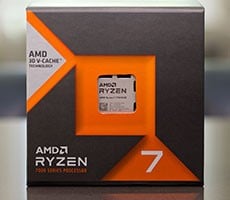
AMD Ryzen 7 7700X3D Review: 3D V-Cache Gaming Performance For Less


| AMD Ryzen 7 7700X3D: $329 MSRP (Currently $279 On Sale) The new AMD Ryzen 7 7700X3D's configuration is similar to the existing 8-core Ryzen 7 7800X3D, but with lower base and boost clocks and a lower price that should make it more accessible to gamers.
|
|||

|

|
||
During Computex last month, AMD made a couple of CPU related announcements. The first was that the popular Ryzen 7 5800X3D had been updated and re-introduced in a 10th Anniversary Edition for gamers still rocking a socket AM4 motherboard. The second introduced the new Ryzen 7 7700X3D we’ll be showing you here today. The Ryzen 7 7700X3D shares a similar single-CCD, 8-core design to the Ryzen 7 7800X3D, but with a tweaked voltage and frequency curve and a somewhat lower price point, which should bode well in the market conditions we're in currently.
The Ryzen 7 7700X3D is ultimately one of the more affordable ways for gamers to experience an AMD “X3D” processor with 3D V-Cache on the current socket AM5 platform. That’s an important consideration, because socket AM5 will continue on for at least another generation—the Ryzen 7 7700X3D would allow someone to build (or upgrade) a socket AM5 system now, and be ready for next-generation Zen 6-based processors in the future.
But that’s only if the Ryzen 7 7700X3D is a good fit for someone’s build and budget. Let’s get to some particulars and then take the chip for a spin through some benchmarks to see if AMD's new Ryzen 7 7700X3D makes sense...

AMD Ryzen 7 7700X3D Specifications And Feature Comparison


Find The AMD Ryzen 7 7700X3D @ NewEgg
Here’s a quick feature and spec comparison between the Ryzen 7 7700X3D and 7800X3D. As you can see, the two chips are basically the same—they share the same core and cache configurations, voltages, TDP, etc. The only differences are a 200MHz drop in the base clock and a more substantial 500MHz reduction to the max boost clock. That 500MHz drop will definitely decrease performance in most circumstances, including games, but especially in lightly threaded workloads where the chip is most likely to achieve is max boost clock most often. For heavily multi-threaded workloads, the delta separating the Ryzen 7 7700X3D and 7800X3D should be somewhat smaller.

As you'd expect, the Ryzen 7 770X3D also looks just like any other Socket AM5 Ryzen 7000 series processor, save for the unique branding on its heatspeader. The processor uses the same socket, coolers and motherboards, etc., though you’ll have to install a BIOS / UEFI update with support for the chip for your particular motherboard, to ensure compatibility. Just about every board manufacturer will have posted updates at this point, though.

AMD Ryzen 7 7700X3D CPU-Z Details
The Ryzen 7 7700X3D’s details as reported by CPU-Z are laid out in the images below. The family, stepping and other details are the same as other Ryzen 7000X3D series processors. The only differences are in regard to total core / thread counts, total cache, and clocks.


Idle clocks (left), 100% MT load clocks (right)
There’s 64K of L1 per core (32K D-Cache [8-way] + 32K I-Cache [8-way]), along with 1MB of 8-way set associative L2 cache per core. Ryzen 7000 series processors also feature 32MB of L3 cache per compute die (and there's only one die on this CPU). However, with AMD's Ryzen 7 7700X3D -- like other 3D V-Cache enabled Ryzen processors -- that compute die is outfitted with an additional 64MB of 3D V-Cache, bringing the total L3 up to 96MB (for 104MB total cache).
It’s that chunky 96MB of L3 cache that allows the Ryzen 7 7700X3D to keep lots of data close to the CPU cores and boost game performance. But how do its lower base and boost clocks affect overall performance? Let's find out...