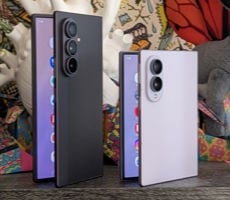
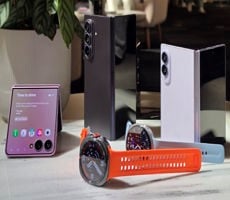
Samsung Galaxy Z Fold8 And Fold8 Ultra Review: A Wide Winning Formula

Galaxy Z Fold8 and Z Fold8 Ultra Reception And Sound Quality

The Z Fold8 Ultra and Z Fold8 feature stereo speakers with spatial audio (Dolby Atmos). Sound quality is pretty good considering how thin these handsets are, but the Z Fold8 Ultra’s speakers sound slightly fuller and louder than the Z Fold8’s. Both also support aptX HD, LDAC, and SSC UHQ (Samsung Seamless Codec Ultra High Quality) for high-quality wireless audio over Bluetooth, plus digital USB Type-C devices for wired audio.
Galaxy Z Fold8 and Z Fold8 Ultra Performance And Benchmark Results
As I mentioned above, the Galaxy Z Fold8 Ultra and Z Fold8 are powered by a binned version of Qualcomm’s flagship 3nm SoC – the Snapdragon 8 Elite Gen 5 for Galaxy (SM8850-1-AD) – that’s capable of higher peak clock speeds (4.74GHz vs. 4.61GHz) on the Oryon cores. Both are paired with either 12GB of RAM and 256/512GB of UFS 4.0 storage or 16GB of RAM and 1TB of UFS 4.0 storage. There’s no microSD support.Day-to-day, these phones feel quick, juggling everything from communication, social media, productivity, and entertainment apps without skipping a beat. In fact, I didn’t notice any significant difference in speed or responsiveness compared to Samsung’s flagship Galaxy S26 Ultra, which uses the same binned chip. But while subjective performance is excellent, our benchmarks (see below) tell a more nuanced story.
Generally speaking, the Z Fold8 Ultra and Z Fold8’s test results match other Snapdragon Elite 8 Gen 5-equipped handsets. But there’s one area of concern, especially for gamers, and that’s with sustained workloads. Here the Z Fold8 (in particular) and the Z Fold8 Ultra exhibit significant thermal throttling, dropping to 43.5% and 51.8% (respectively) of their initial score during 3DMark’s Wild Life Unlimited stress test.
Obviously, this isn’t a deal breaker for most everyday tasks; after all, neither phone is marketed to hard-core gamers. It’s just something to keep in mind if you’re looking to extract maximum performance from Qualcomm’s flagship processor in one of these devices.
Galaxy Z Fold8 and Z Fold8 Ultra Geekbench Results
Geekbench is a cross-platform benchmark that simulates real-world processing workloads in image processing and particle physics calculation scenarios. We tested all of the smartphones featured here with GeekBench 6's single and multi-core workloads, as well as Geekbench AI's NPU workloads.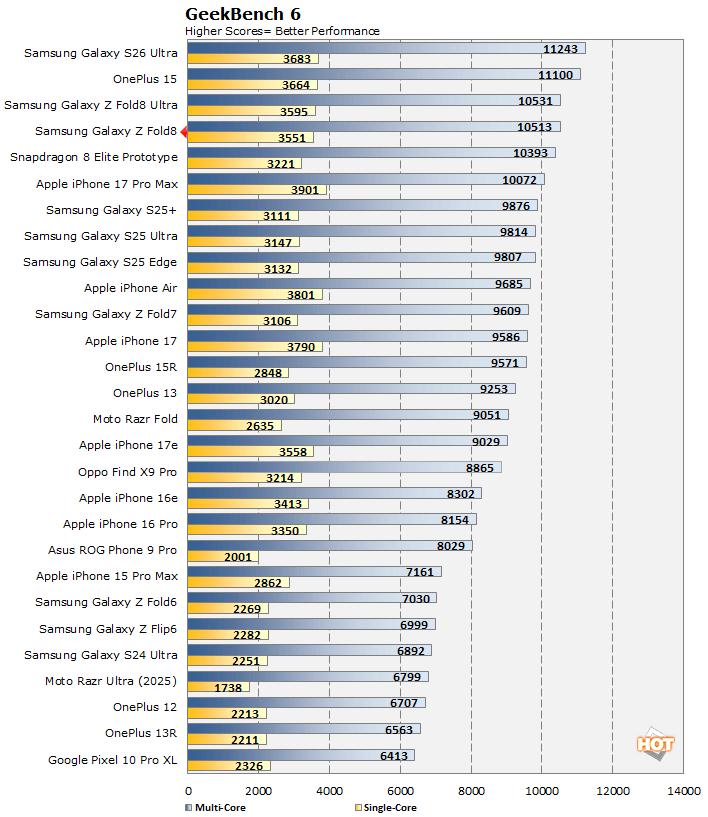
Image: HotHardware
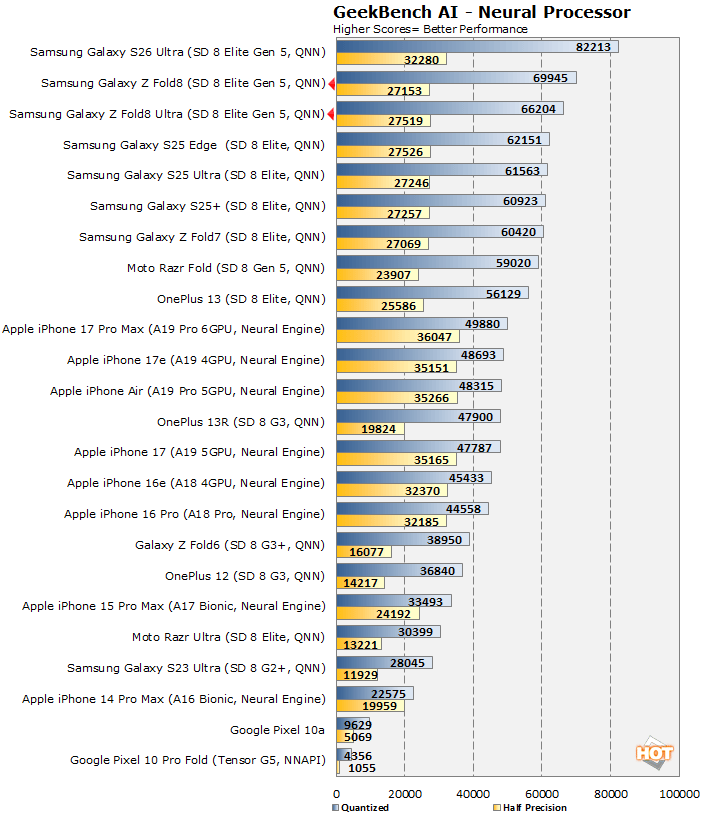
Image: HotHardware
Galaxy Z Fold8 and Z Fold8 Ultra PCMark Results
Futuremark's PCMark for Android is an excellent suite of tests if you want to benchmark a wide range of tasks on any handset -- things like image and video editing, as well as lighter-duty, everyday workloads such as email and web browsing. When you see the test running live, it's clear the scripted application tests are carefully selected and tuned to make use of the each mobile platform in a very controlled way...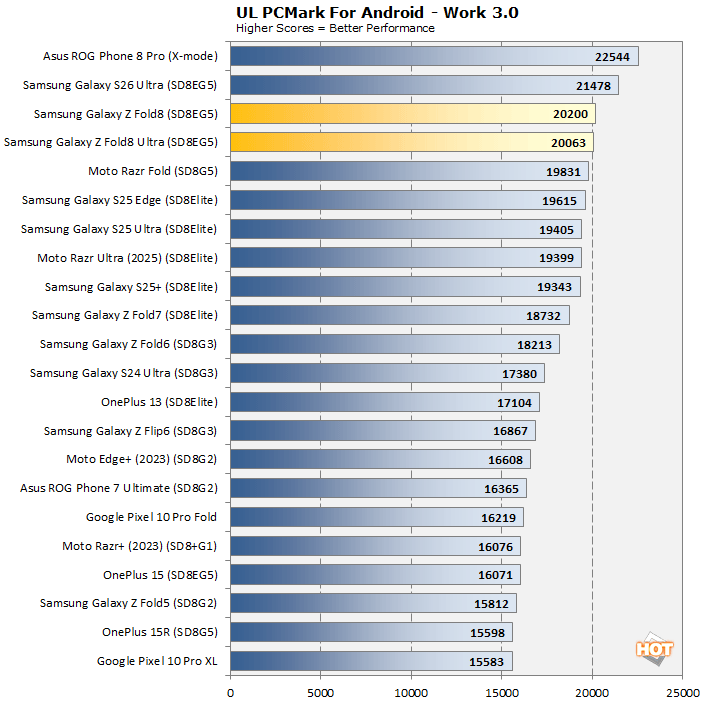
Image: HotHardware
Here Samsung's latest folding phones show slightly better performance than previous generation models, with the Galaxy Z Fold8 and Z Fold8 Ultra scoring between the Snapdragon 8 Gen 5-equipped Moto Razr Fold and the Galaxy S26 Ultra
Galaxy Z Fold8 and Z Fold8 Ultra AnTuTu Results
AnTuTu’s latest benchmark returns a number of metrics ranked with somewhat nebulous scores, rather than frame rates or time to complete. Here we're running the latest version of AnTuTu across multiple Android devices. AnTuTu returns four top level performance results which are all included here: CPU, RAM, 3D, UX (or User Experience), along with a total score.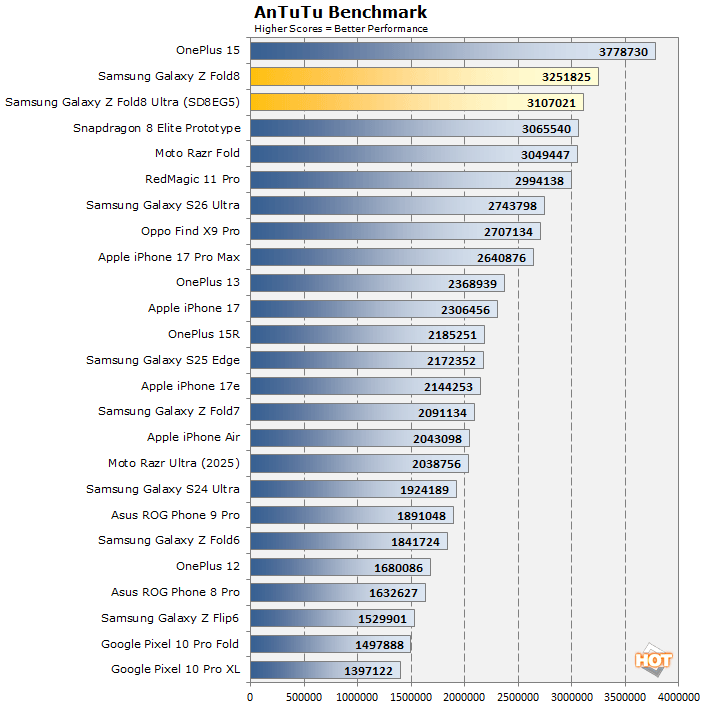
Image: HotHardware
According to AnTuTu, the Galaxy Z Fold8 and Z Fold8 Ultra offer a notable increase in performance vs. Samsung's previous generation folding handsets, slotting right below the OnePlus 15 in terms of its overall score.
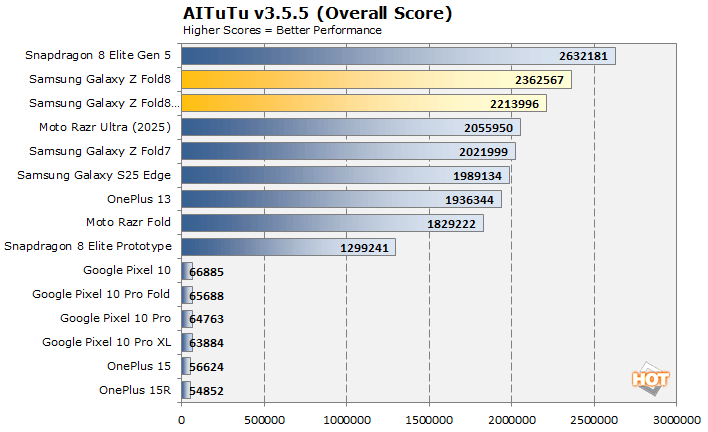
Image: HotHardware
The Galaxy Z Fold 8 and Z Fold8 Ultra's performance in AITuTu is among the best, with scores close to Qualcomm's Snapdragon 8 Elite Gen 5 prototype at the top of the chart.
Galaxy Z Fold8 and Z Fold8 Ultra 3DMark Results
3DMark is the latest cross-platform graphics benchmark from UL. Its primary purpose is to measure GPU performance across platforms, and two distinct tests are available. The standard 3DMark tests are designed to give feedback on how a game performs over a short period of time. With mobile games, people typically play in brief spurts when they find some free time; be it on the bus, on the subway, or a quick battle royale session over lunch break. The 3DMark stress tests, on the other hand, show how a device performs over a longer stretch of time, and take note of performance degradation that might occur due to increased heat levels and throttling.
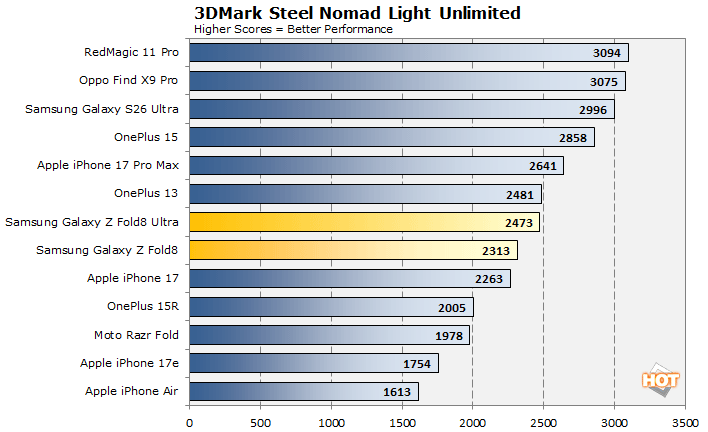
Image: HotHardware
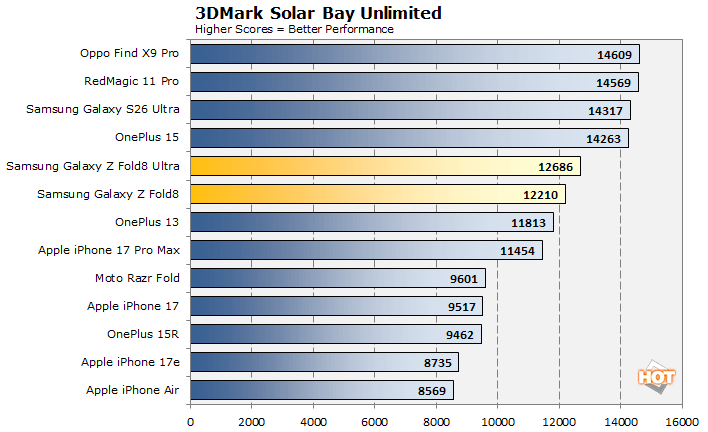
Image: HotHardware
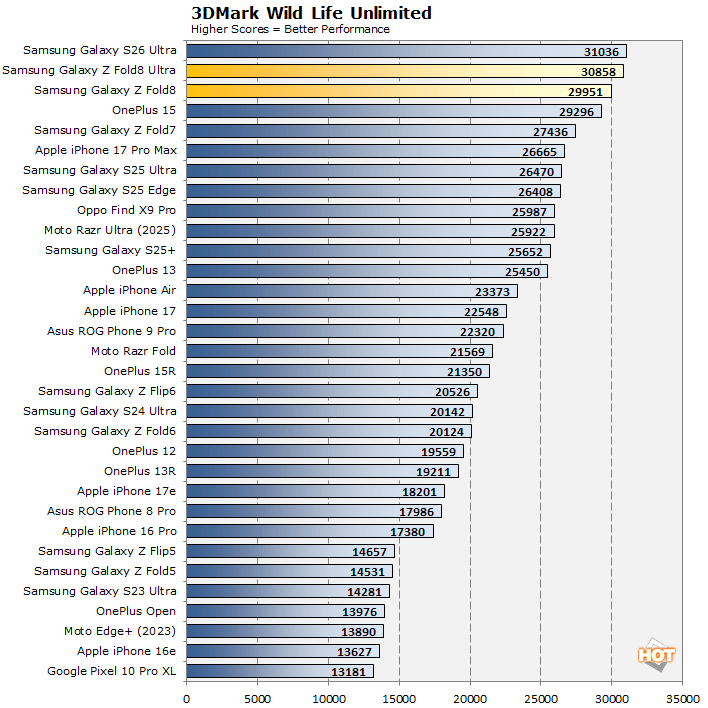
Galaxy Z Fold8 and Z Fold8 Ultra Sustained Performance


Unfortunately, being ultra-thin devices means Samsung's latest folding handsets both exhibit significant thermal throttling, managing a stability score of just 43.5% (Galaxy Z Fold8) and 51.8% (Galaxy Z Fold8 Ultra) in the Wild Life Stress test. This is similar to what we experienced with last year's Galaxy Z Fold7.
Galaxy Z Fold8 and Z Fold8 Ultra Additional Features And Battery Life
The Z Fold 8 Ultra and Z Fold8’s remaining specs are on par with other Snapdragon 8 Elite Gen 5 flagships. Both include sub-6GHz and mmWave 5G (SA / NSA), CAT 22 LTE, tri-band WiFi 7 (802.11be), Bluetooth 6.0 (LE), NFC, UWB, dual-band A-GPS / GLONASS / BeiDou / GALILEO / QZSS positioning – along with the usual array of sensors on board (ambient light, proximity, accelerometer, gyro, compass, and barometer).Rounding things up, both handsets feature high quality haptics thanks to a linear vibration motor. The side-mounted capacitive fingerprint sensor is fast and reliable. Face unlock is also available, and works as expected. Both phones support 45W wired charging (USB PD 3.0) and 25W wireless charging (Qi 2.2, with 4.5W reverse wireless charging), but as usual with Samsung, there’s no charger supplied in the box.
Both phones also lack the built-in magnets needed for MagSafe/Pixelsnap support. That’s understandable considering the ultra-thin design, but it’s nonetheless disappointing. And while the Z Fold 8 Ultra and Z Fold8 charge faster than the Z Fold7 (45 vs. 25W wired, and 25 vs. 15W wireless), that pales in comparison to Chinese folding competitors, which offer much higher charging speeds (80W wired and 50W+ wireless).
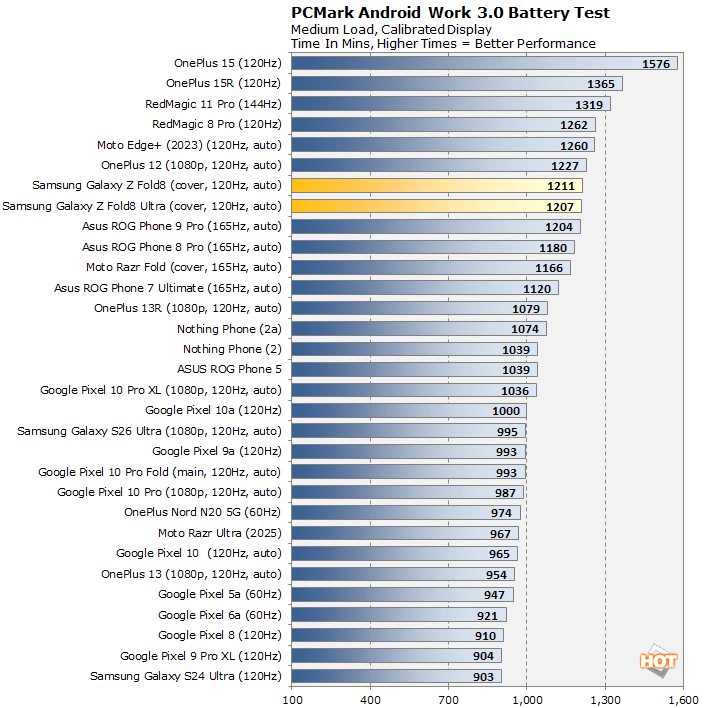
Obviously, the Z Fold8 Ultra's battery capacity is a welcome improvement over the Z Fold7’s (5,000 vs. 4,400mAh), but ultimately it’s not a significant enough jump in capacity. Samsung’s clearly just dipping its toes into silicon-carbon batteries here. That’s understandable, but I hope they push the envelope further with the next generation.
Next up: software, AI, and review summary...