Google Pixel 11 Series Review: The Experience Is The Upgrade

I used the Pixel 11 and 11 Pro XL primarily on AT&T, T-Mobile, and Telus’ sub-6GHz 5G and 4G LTE networks in Vancouver (Canada), and didn’t run any problems with call quality or data speeds. These phones also work fine with Verizon, smaller US carriers, and MVNOs. In the US, the Pixel 11, 11 Pro, and 11 Pro XL lack SIM trays (dual eSIM), but support mmWave 5G. Abroad, these handsets are dual SIM (nano SIM plus eSIM), but drop mmWave 5G.
Pixel 11 Series Reception And Sound Quality

The Pixel 11 and Pixel 11 Pro XL feature stereo speakers that sound pleasantly loud and clear. Google’s phones don’t offer Dolby Atmos, and indeed, that’s still the case here, but spatial audio is available when using headphones or earbuds. As you’d expect, there’s no headphone jack, but the Pixel 11 and 11 Pro XL connect to wired digital accessories via USB Type-C and support LDAC and aptX HD codecs for wireless audio over Bluetooth.
Pixel 11 Series Performance
Google’s new Tensor G6 SoC powers the Pixel 11 series, and while it delivers better efficiency and performance than its predecessor, it’s not on the same level as Qualcomm and MediaTek’s best chips. On the plus side, the Tensor G6 is manufactured using TSMC’s 3nm process and is paired with MediaTek’s M90 5G modem, which is a vast improvement over Samsung’s Exynos Modem 5400 used in last year’s Pixel 10 lineup.Memory configurations are as follows: 12GB of RAM and 256GB or 512GB of UFS 4.0 storage for the Pixel 11; 12GB of RAM (vs. 16GB last year) and 256GB of UFS 4.0 storage for the entry-level Pixel 11 Pro and 11 Pro XL; 16GB of RAM and 512GB or 1TB of Zoned UFS 4.0 storage for the higher-end Pixel 11 Pro and 11 Pro XL. As you’d expect, there’s no microSD expansion. I tested a 12/256GB Pixel 11 and a 16/512GB Pixel 11 Pro XL.
Overall, these handsets feel as smooth and responsive as any other modern flagship. The Pixel 11 and 11 Pro XL handled my usual suite of social media, communication, productivity, and entertainment apps without skipping a beat. That being said, while in our benchmarks the Tensor G6 improves upon the Tensor G5, it still lags behind current flagship Snapdragon and Dimensity processors in terms of performance.
In addition, both handsets throttle more with sustained workloads than last year’s Pixel 10 series. The Pixel 11 and Pixel 11 Pro XL posted stability scores of 60.6% and 62.5% in 3DMark’s Wild Life stress test, respectively. That’s not great, but it won’t really matter unless you enjoy playing the latest, most graphically demanding games.
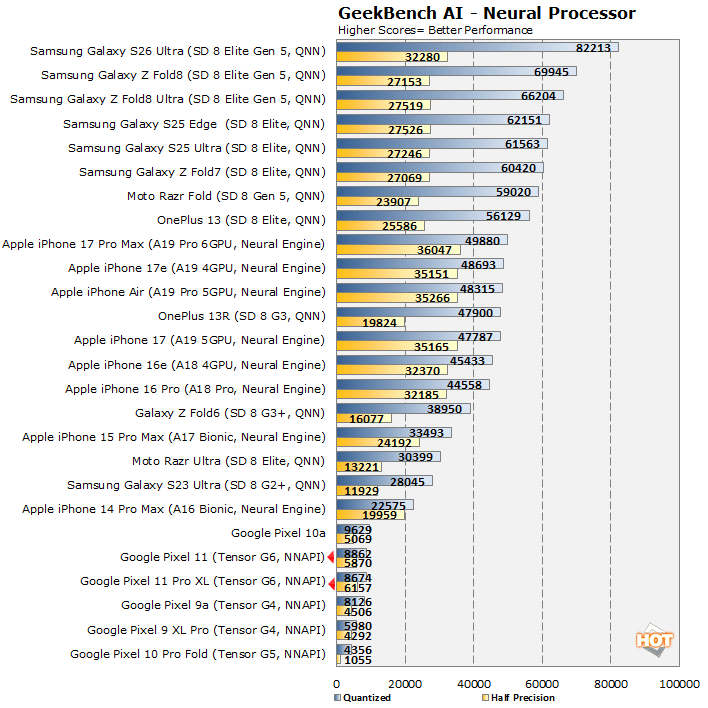
Pixel 11 Series Geekbench Results
GeekBench is a cross-platform benchmark that simulates real-world processing workloads in image processing and particle physics calculation scenarios. We tested all of the smartphones featured here with GeekBench's single and multi-core workloads.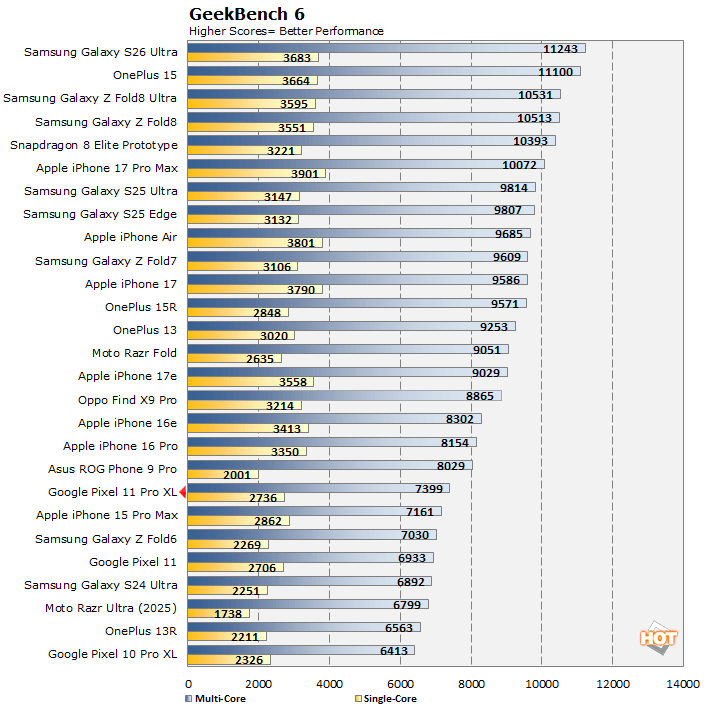
Pixel 11 Series PCMark Results
UL's PCMark for Android is an excellent suite of tests if you want to benchmark a wide range of tasks on any handset -- things like image and video editing, as well as lighter-duty, everyday workloads such as email and web browsing. When you see the test running live, it's clear the scripted application tests are carefully selected and tuned to make use of the each mobile platform in a very controlled way...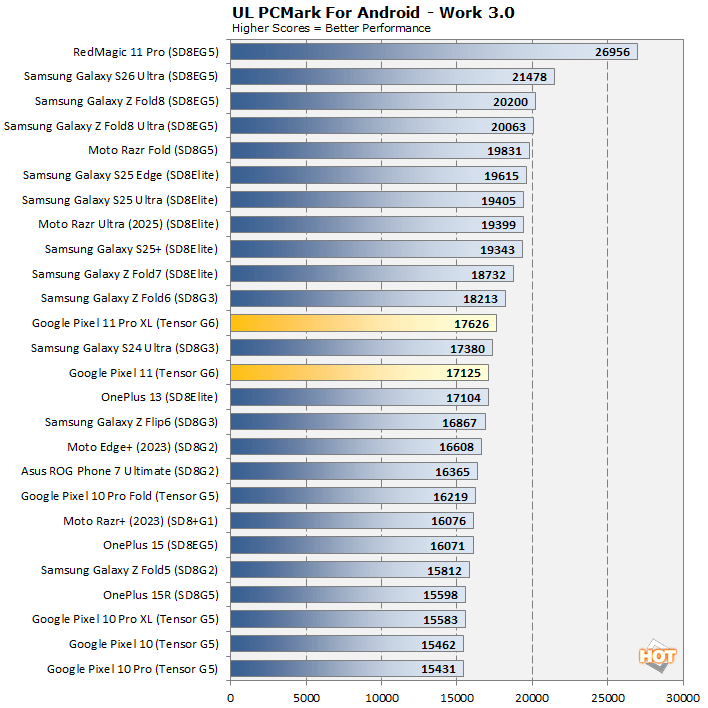
Here Google's latest phones show slightly better performance than previous generation models, with the Pixel 11 and Pixel 11 Pro XL scoring between the Snapdragon 8 Elite-equipped OnePlus 13 and Galaxy Z Fold7.
Pixel 11 Series AnTuTu 8 Benchmarks
AnTuTu’s latest benchmark returns a number of metrics ranked with somewhat nebulous scores, rather than frame rates or time to complete. Here we're running the latest version of AnTuTu across multiple Android devices. AnTuTu returns four top level performance results which are all included here: CPU, RAM, 3D, UX (or User Experience), along with a total score.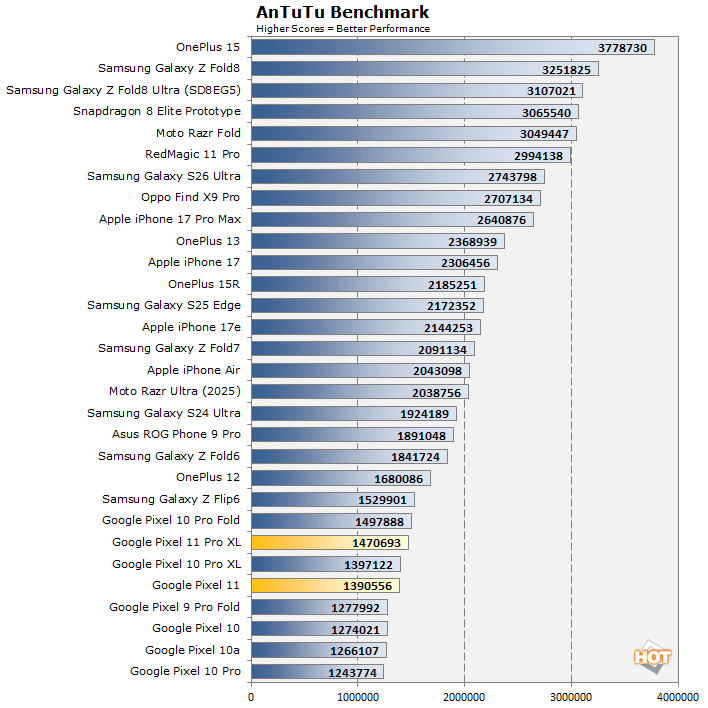
According to AnTuTu, the Pixel 11 and Pixel 11 Pro XL deliver similar performance to previous generation Pixel handsets, flanking the Pixel 10 Pro XL in terms of overall score.
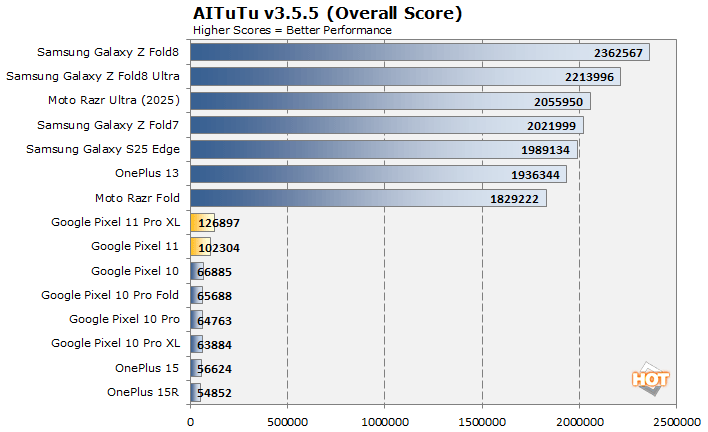
The Pixel 11 and Pixel 11 Pro XL's performance in AITuTu is significantly better than the Pixel 10 series, but doesn't come anywhere close to matching the current crop of Snapdragon-powered flagships.
Pixel 11 Series 3DMark Wild Life Benchmark Tests
3DMark Wild Life is the latest cross-platform test from UL. Its
primary purpose is to measure GPU performance across platforms, and two
distinct tests are available. The standard Wild Life test is designed to
give feedback on how a game performs over a short period of time. With
mobile games, people typically play in brief spurts when they find some
free time; be it on the bus, on the subway, or a quick battle royale
session over lunch break. The 3DMark Wild Life Stress Test, on the other
hand, shows how a device performs over a longer stretch of time, and
takes note of performance degradation that might crop up due to
increased heat levels and throttling.

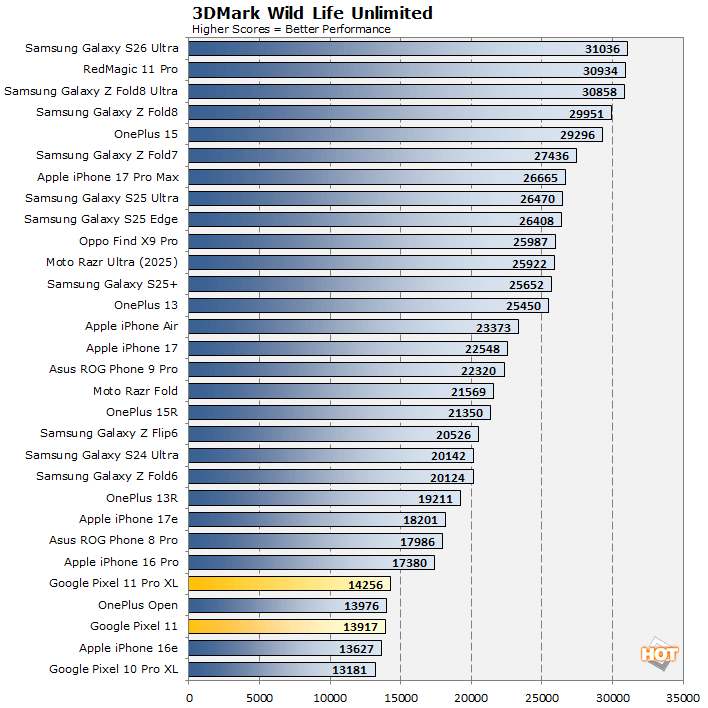
3DMark Wild Life is a significantly more taxing graphics benchmark
that employs cutting-edge mobile game engine technologies to deliver
impressive visuals -- as you can see in the screen shot above. Here, the Pixel 11 and 11 Pro XL slot ahead of the Pixel 10 series and below Snapdragon 8 Gen 3-powered handsets.
Pixel 11 Series Sustained Performance


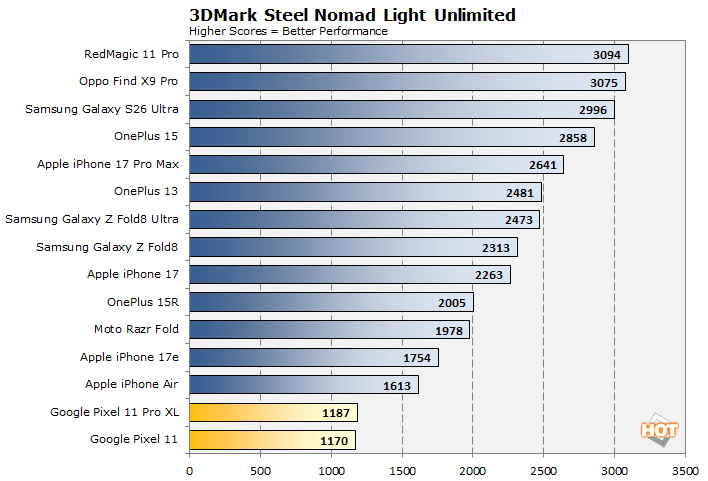
The Pixel 11 and 11 Pro XL both exhibit noticeable throttling in the Wild Life stress test, achieving a stability score of 60.6% and 62.5%, respectively, but perform better in the Steel Nomad Light stress test, managing a stability score of 80.6% and 77.5%, respectively.
Pixel 11 Series Additional Features And Battery Life
On the Pixel 11 you get sub-6GHz and mmWave 5G, 4G LTE, WiFi 6e (802.11ax), Bluetooth v6.0 + LE, NFC, and dual-band A-GPS / GLONASS / Galileo / BeiDou / QZSS / NavIC positioning, plus the usual array of sensors. The Pixel 11 Pro and 11 Pro XL add WiFi 7 (802.11be) and UWB to the list. Haptics are strong and precise thanks to a quality linear vibration motor, and the ultrasonic in-display fingerprint sensor is quick and reliable.
The Pixel 11’s battery is slightly larger than before (4,985 vs. 4,970mAh), but the Pixel 11 Pro and 11 Pro XL’s batteries are marginally smaller (4,850 vs 4,870mAh and 5,115 vs 5,200mAh). Wired charging speeds remain the same as last year, at 30W for the Pixel 11 and 11 Pro, and 45W for the Pixel 11 Pro XL, but wireless charging speeds are now 25W across the board (Qi2.2 with magnets). There’s still no reverse wireless charging or charger in the box.
Battery life on the Pixel 11 and Pixel 11 Pro XL is better than on its predecessors, but only by a small margin. After a few days of use, I’m seeing a roughly 5-10% improvement in battery life over the Pixel 10 series. The Pixel 11 and Pixel 11 Pro XL lasted 14h 33m and 16h 12m in our PCMark Work 3.0 battery test, respectively. While that's not spectacular, I’m pretty confident that these handsets will last an entire day on a charge for most people.
Next up: software, AI, and review verdict...