


ASUS ROG XBOX Ally X20 OLED Review: Peak Handheld PC Gaming


ASUS ROG XBOX Ally X20 Handheld Gaming Benchmarks
Despite the picture above, I didn't test Don't Nod's Remember Me for performance. Instead, I tested the 14 games from our previous handheld reviews, as well as two additional titles. All of the game benchmark data in this review is freshly generated (except where noted), and in some cases multiple times over as I investigated anomalies and aberrations. There is a lot of commentary on this page with some important details, so grab your beverage of choice and sit back to take your time reading.
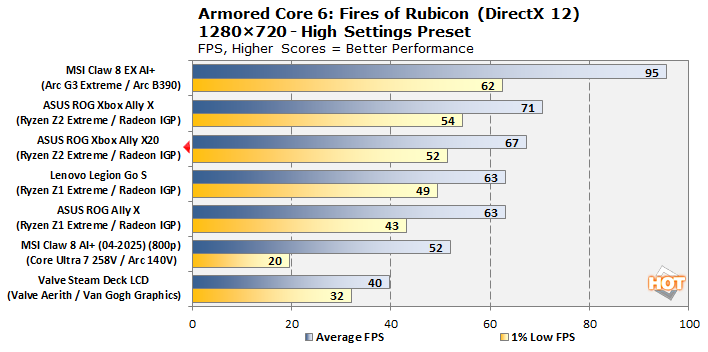
Armored Core 6: Fires of Rubicon has a major scheduling snafu: it piles most of its work on Core 0. Windows exclusively uses Core 0 for interrupts and other important system calls, so games that do this deliver much worse performance than they otherwise might. As such, every Windows system here has an affinity fix applied that disallows the game from using Core 0, making performance skyrocket versus our previous results, which is why the old data from the MSI Claw 8 AI+ looks so bad.
The Ally X20 basically matches the older Xbox handheld here; there's some variation in our data due to the live nature of the testing. Both lose to the Arc G3 Extreme in the Claw EX AI+, but that's to be expected as it's a much newer chip on a much more efficient fabrication process.

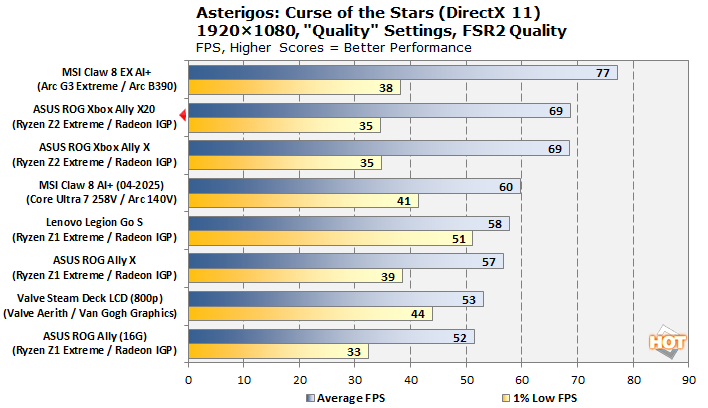
In indie Souls-adjacent RPG Asterigos: Curse of the Stars, the ROG Xbox Ally X20 comes in just behind the faster MSI Claw handheld with an overall admirable performance. This game relies on an older version of Unreal Engine 4 and generally has quite stuttery performance on Windows, while the Linux machines are very stable. This is no doubt to some degree down to shader compilation, but it definitely isn't just that; there are also scheduling issues here as threads get scheduled on Zen 5c (Z2 Extreme) or Darkmont (Arc) cores too. Meanwhile, the ROG Ally 16G system from 2023 struggles due to its limited memory; it was tested or attempted to be tested in every game here, so if you don't see it in the chart, it failed to run a game, usually due to insufficient RAM.

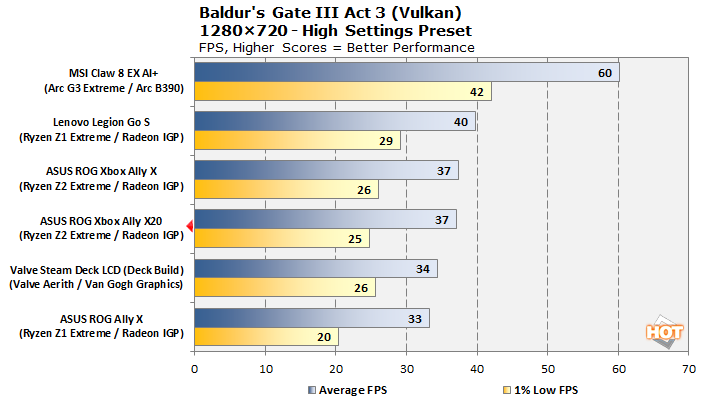
In the demanding Baldur's Gate 3 Act III test, most of the machines put up a pretty similar performance. The Steam Deck cheats a bit with the build of the game that is explicitly made for it, but that just highlights how much faster these other handhelds are considering they're all running the full desktop version of the game. The MSI Claw 8 EX AI+ leaps out ahead of the other machines thanks to its more efficient SoC; this game doesn't fully load CPUs or GPUs on the AMD handhelds because the whole thing is starved for power at 30-35W.

One of the more fascinating consequences of AI in software development has been the explosion of "decomps" and "recomps", projects which attempt to break down games from other platforms into their source code so that they can be recompiled for another platform (usually, the Windows PC.)
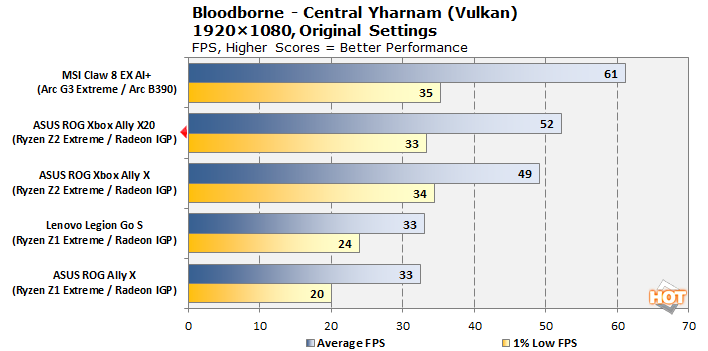
Fans have been crying out for a PC port of legendary From Software game Bloodborne from the PlayStation 4 for over a decade, and now we have several. We're using Jgamrot's "yharnam-pc" port here and testing the game basically as it appeared on the PS4, in native 1080p resolution with "original" model quality, and it's another case where the Ryzen Z2 Extreme nips at the heels of the Arc G3 Extreme. This game is actually completely playable in Performance (17W) mode on this machine (around 35 FPS), and Auto HDR really makes the game's highlights pop on the gorgeous OLED.

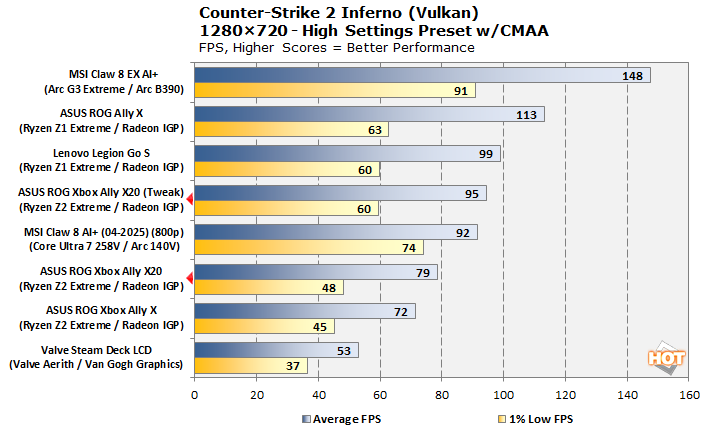
The Strix Point processor that the Ryzen AI Z2 Extreme chip is based on has an unusual configuration with four Zen 5 CPU cores and eight Zen 5C dense cores. The Zen 5 cores clock higher, but the Zen 5C cores use less power at the same clock rate. Unfortunately, they also have less local L3 cache per core, and they don't clock up as aggressively, either. As a result, the Ryzen Z1 Extreme actually wallops the Z2 Extreme in CS2 at default settings. I was able to drastically improve things by manually forcing the game onto the Zen 5 cores, gaining me about 20% frame rate immediately. However, Intel has a system driver specifically to manage just this sort of thing, and as a result the Claw 8 EX AI+ absolutely runs away with this game.

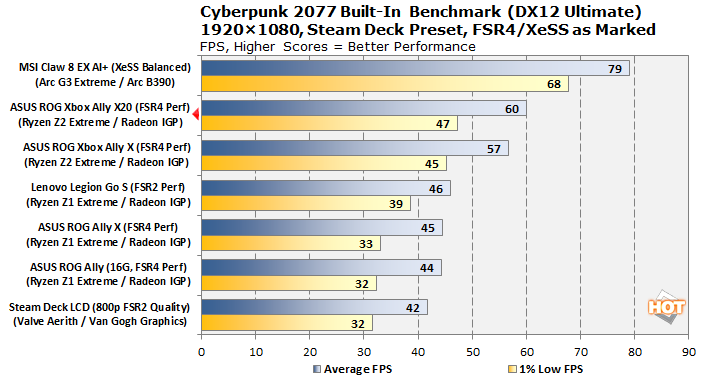
In the familiar Cyberpunk 2077 benchmark, the ROG Xbox Ally X20 consistently produces slightly higher performance versus the last-gen machine. This could be due to its superior cooling, which we'll talk about on the next page. Make sure you look carefully at the results, as we're testing different upscalers here based on the machine; FSR4 doesn't seem to be available on Linux yet—at least, not without a third-party hack, anyway. XeSS after version 1.3 uses different scaling factors than FSR; XeSS "Balanced" is the same 2.0x scalar that FSR "Performance" uses, so the internal resolution here is the same across everything except the Steam Deck.

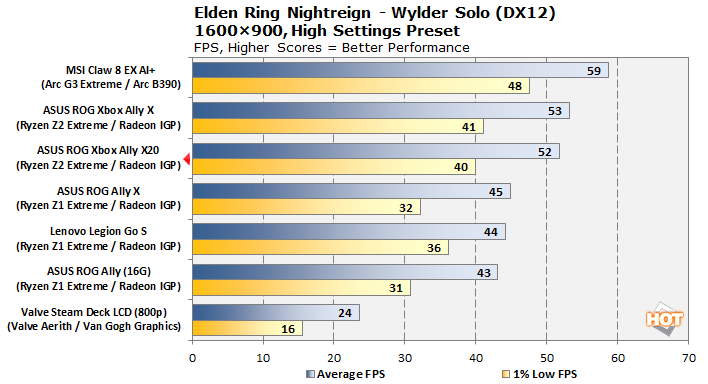
In Elden Ring Nightreign, the performance of the two Xbox handhelds is basically identical after accounting for run-to-run variance, and fairly close to that of the MSI Claw with the Arc G3. Actually, on that machine, I'd probably play in 1080p, although it looks remarkably good in 900p. The game's capped at 60 FPS either way, so this is a great result. Even in its native 800p, the Steam Deck struggles badly in this game.

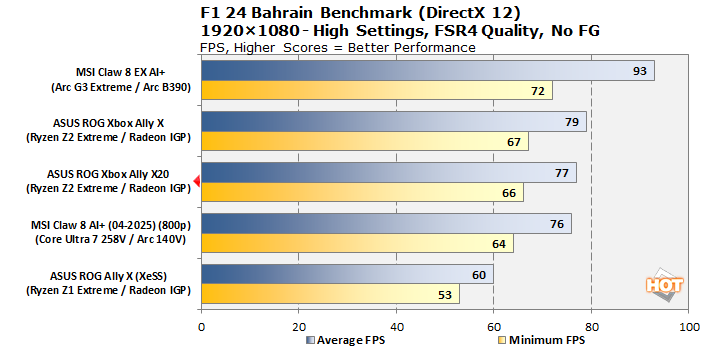
You won't see the Linux systems here, because they can't run this game; rather than put zeroes in the chart, I simply left them off. You also won't see the ROG Ally 16G here, because it likewise can't run this game. Out of the machines that can, the Strix Point systems offer a very solid performance gain over the Phoenix machine. I wasn't able to get FSR 4 working on the Z1 Extreme, so it's running XeSS instead of FSR 4, although the performance between the two seems to be very similar. Note that I forgot to label it, but the Claw 8 EX AI+ is also using XeSS, which it has dedicated accelerators for. In any case, this game is a prime candidate for frame generation, which would easily take you to the screen's 120-Hz refresh rate on the ROG XBOX Ally X20.

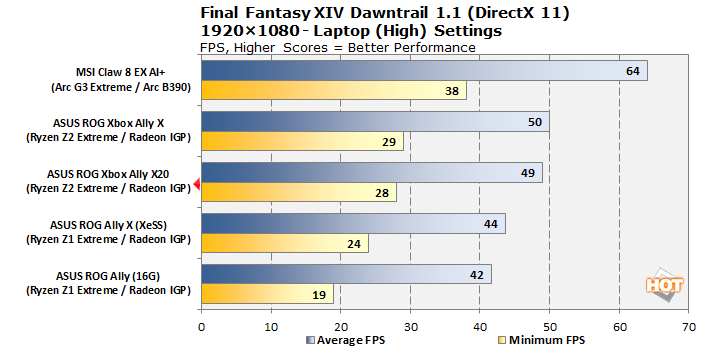
I resurrected the Final Fantasy XIV Dawntrail 1.1 benchmark due to a request from a reader. This aging DirectX 11 MMORPG still pulls tens of thousands of players every day (making it a relevant test case), and it's designed for console play, so it's fully playable on a handheld. All of our systems seem to struggle a little with the single-threaded CPU load of this game; looking into it, it doesn't seem to be a scheduling issue so much as potentially an I/O issue with the external NVMe SSD I was using for testing. In any case, the performance rankings are exactly what you'd expect.

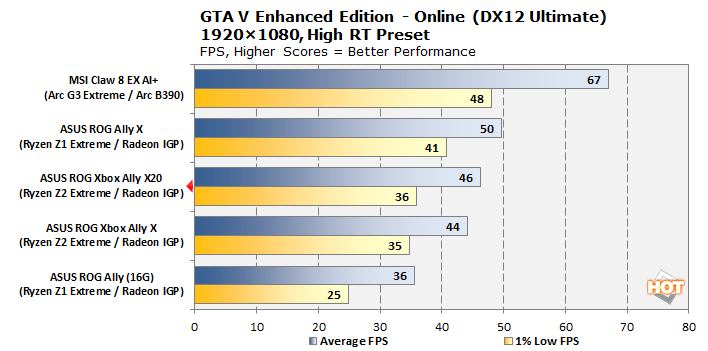
This is another game where the Linux systems aren't able to play, so I excluded them from these results. Interestingly, I couldn't get this game to launch on the old 16GB ROG Ally until I did the Windows 11 26H2 update, which dropped the memory consumption of the OS itself and allowed me to get this game and a couple of others running. This test is using ray-tracing, which helps to explain why the Arc G3 Extreme dominates, but you'll notice that I'm not using upscaling here.

This is native 1080p resolution with ray-traced reflections and shadows, and it looks phenomenal. Because upscaling reduces the render resolution of the game and the upscaling effect itself happens at the end of the render pipeline, you can end up with some noticeable artifacts, like the pixelated reflections you can see in the car body above. The performance with or without upscaling is actually nearly the same anyway, so you might as well enjoy that sharp native clarity. Oh, and the Ally X beats the Xbox handhelds here because this is another game where the game threads want to schedule on the Zen 5C cores, but I wasn't able to tweak the affinity due to the Battleye anti-cheat. The performance still isn't bad, but it's a shame AMD hasn't gotten this worked out yet.

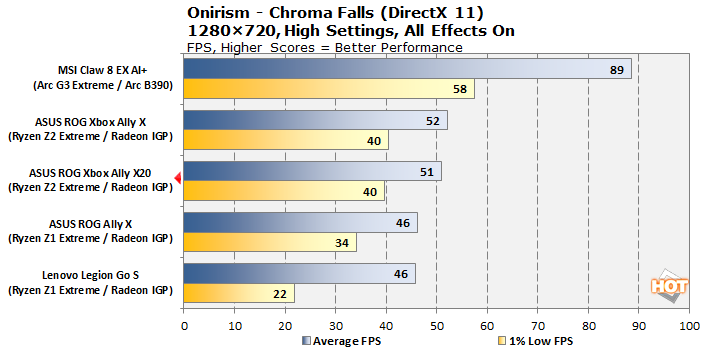
Despite being an indie game made over the course of a decade by a tiny team, the 1.0 release of Onirism is quite polished, and also remarkably demanding. I wasn't able to get it running on either of the 16GB machines (the Steam Deck and the ROG Ally 2023). So it goes that we have the results above, where the Arc G3 Extreme absolutely obliterates all comers. The game is perfectly playable and actually a bit more consistent on the Ryzen Z2 Extreme parts, though.

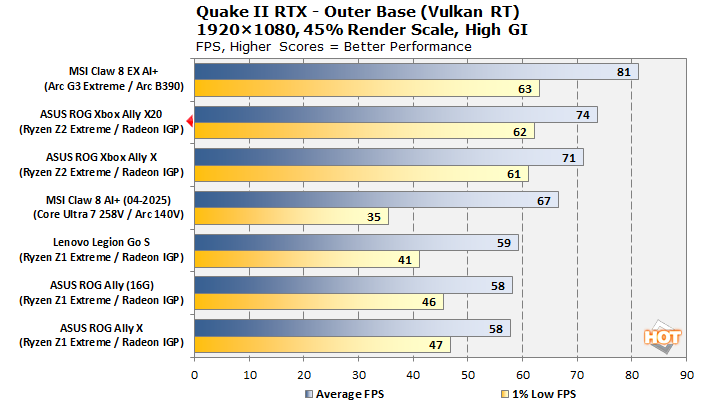
If these results seem out of order, it's because there are fractional values that aren't listed in the charts. I was really surprised by these results as Quake II RTX is obviously an NVIDIA product and Intel's Arc architecture typically has better ray-tracing performance than AMD's GPUs. The Claw does win here, but only just so; Quake II RTX runs very well and smoothly on the Ryzen Z2 Extreme handhelds. It was surprisingly laggy in Linux on the Legion Go S even as it put up a slightly better average.

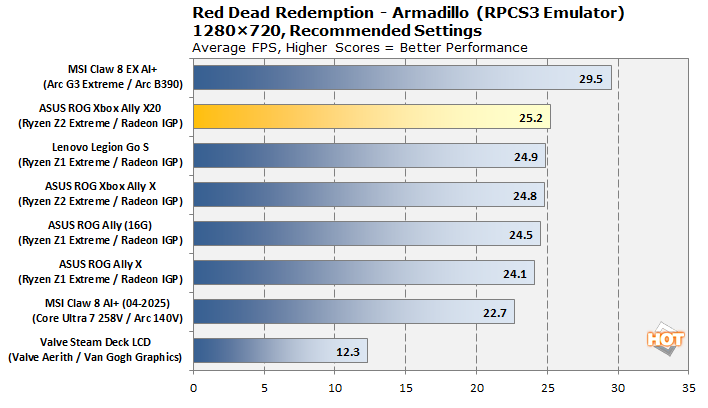
These RPCS3 PS3 emulator results were the ones that I spent the most time on. My previous Red Dead Redemption testing had higher numbers than this, and it turns out that accuracy-focused code changes in RPCS3 seem to have tanked performance on gaming handhelds. Broadly, all of the Ryzen machines perform about the same as a real PS3 in this game; the Armadillo benchmark is one of the very most demanding scenes in the whole game. Efficiency improvements in Linux allow the Legion Go S to mix it up with the newer Ryzen Z2 machines.

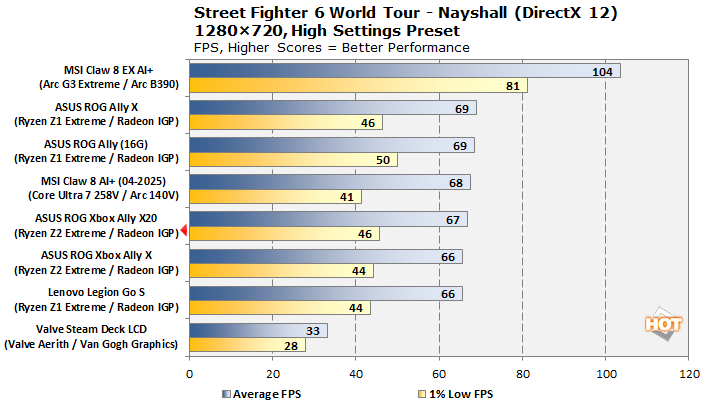

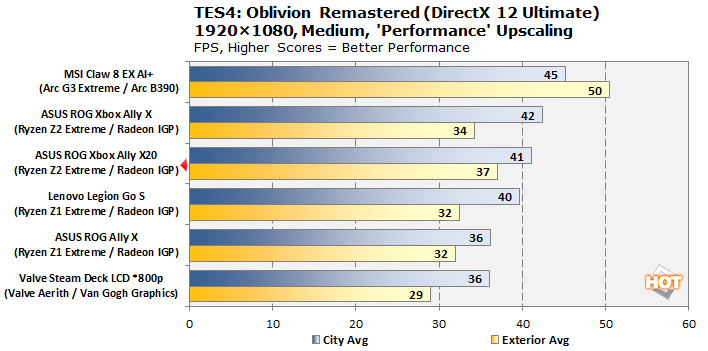
We do things a little differently for Oblivion Remastered; in this Unreal Engine 5 remake of the beloved open-world RPG, instead of reporting 1% low frame rates, we report performance inside the Imperial City and outside in the open world. That's because this game stutters like crazy on every machine, even powerful desktops, so the 1% lows just look terrible and clutter up the chart without being useful.
The MSI Claw machine does indeed run this test better outdoors than inside and it's not clear why. The Xbox Ally X20 performed considerably better than the original machine outdoors, and I'm chalking that up to random spawn behavior. In any case, this game is more than playable at these settings. By the way, I used FSR4 for the AMD machines and XeSS for the Intel system, so it looks great no matter what.

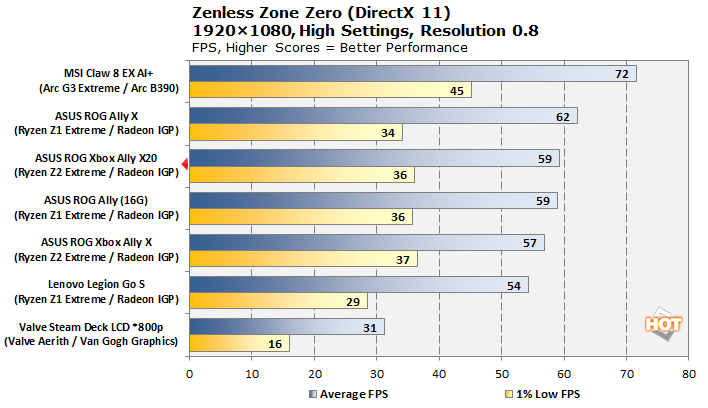
Finally in waifu-'em-up gacha Zenless Zone Zero, every system save the Steam Deck runs the game admirably, with only a relatively small advantage in smoothness for the Arc G3 Extreme. This is another game that is remarkably stuttery no matter what you do, so to some degree it is what it is. There's very little going on in this game in terms of advanced rendering or shaders; that might be why the Ryzen systems are all clustered together the way they are. Intel's advantage is likely mostly down to its superior single-threaded CPU grunt.
Head over to the next page for a summary of the handheld gaming benchmarks as well as thermals, noise, battery life, and our conclusions.