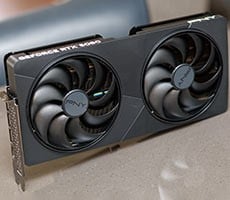
PNY GeForce RTX 5080 Slim OC Review: Big 4K Performance In Two Slots


Note, we are running a limited set of tests in this review. At this point, we suspect most of your reading this know how a GeForce RTX 5080 performs and where it falls in the current GPU pecking order. The PNY GeForce RTX 5080 Slim OC is a somewhat different form factor than most other RTX 5080's, but its speeds and feeds don't deviate much from NVIDIA's reference specs. With that in mind, we ran only a subset of our usual tests, to clearly show how the PNY GeForce RTX 5080 Slim OC compares to a couple of other RTX 5080s and some competitive offerings.
Our Test System Configuration:
| Hardware Used: AMD Ryzen 7 9800X3D (4.7GHz - 5.2GHz, 8-Core) MSI X870E Carbon WiFi 32GB G.SKILL DDR5-6000 Samsung SSD 990 Integrated Audio / Network Radeon RX 7900 XTX Radeon RX 9070 GeFoce RTX 5070 GeForce RTX 5070 Ti GeForce RTX 5080 GeForce RTX 5090 MSI GeForce RTX 5080 Expert OC PNY GeForce RTX 5080 Slim OC |
Benchmarks Used: Geekbench AI Blender v4.3 Blackmagic RAW Speed Test v4.3.1 UL 3DMark Games Tested: Black Myth Wukong Homeworld 3 Cyberpunk 2077 The Talos Principle II F1 24 Relevant Software: Windows 11 Pro 24H2 AMD Radeon v24.12.1 NVIDIA Drivers v576.52 / v580.88 |
 Geekbench AI Testing

Geekbench AI is a cross-platform benchmark tool designed to evaluate the performance of AI workloads on a wide range devices, including smartphones, tablets, laptops, and desktops. It measures the performance of CPUs, GPUs, and NPUs (Neural Processing Units) across different operating systems like Android, iOS, Windows, macOS, and Linux with an array of machine learning tasks.
This benchmark has quite a bit of variability from run to run. In any case, the PNY GeForce RTX 5080 Slim OC lands somewhere in between the GeForce RTX 5080 FE and MSI's custom RTX 5080 Expert, in-line with the pair of Radeon RX 9070 XTs we tested (at least when sorted by the Quantized score).
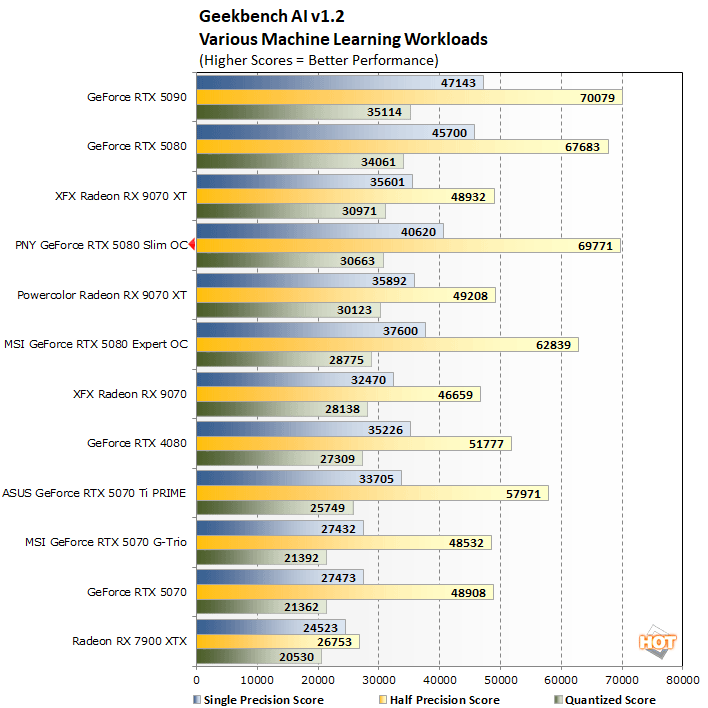
This benchmark has quite a bit of variability from run to run. In any case, the PNY GeForce RTX 5080 Slim OC lands somewhere in between the GeForce RTX 5080 FE and MSI's custom RTX 5080 Expert, in-line with the pair of Radeon RX 9070 XTs we tested (at least when sorted by the Quantized score).
Blender v4.3 GPU Rendering Benchmarks
Blender is a free and open source 3D creation suite that can handle everything from modeling, rigging, and animation, through simulation, rendering, compositing, motion tracking, and even video editing or game creation. The developers offer a standalone benchmark tool that will track performance while rendering a handful of models. We used all three of the default models for these tests...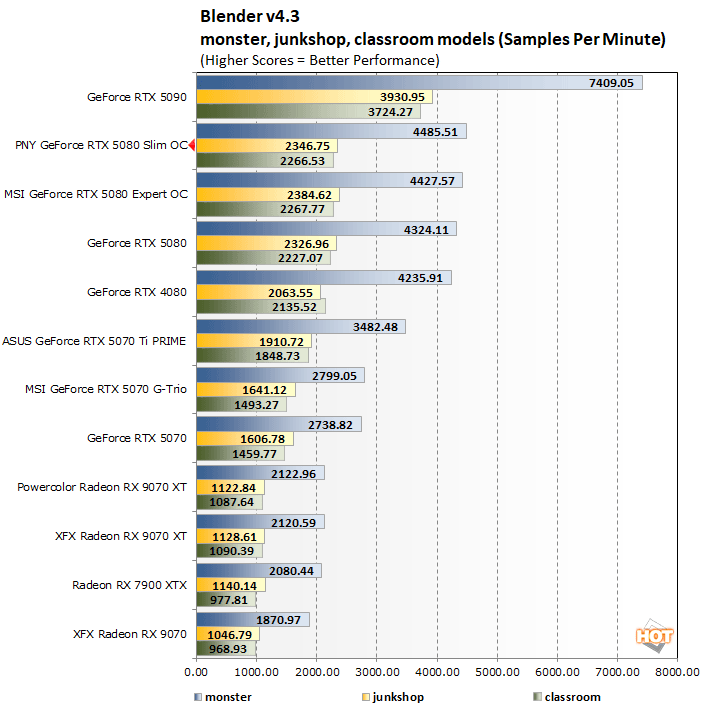
There's not much separating the GeForce RTX 5080 cards here. The PNY GeForce RTX 5080 Slim OC technically edges out the MSI Expert card, and its higher clocks give it somewhat of an edge over the RTX 5080 Founders Edition, but the deltas separating the three cards are quite small with all three models.
Blackmagic RAW Speed Test Results
The Blackmagic RAW Speed Test is a CPU and GPU benchmarking tool that determines the speed of decoding full-resolution Blackmagic RAW video frames. The tool can be used to evaluate performance at various resolutions and bitrates on the CPU or using OpenCL or CUDA on a GPU. We're reporting four results here, at 8K and 4K resolutions, but at differing bitrates and compression levels.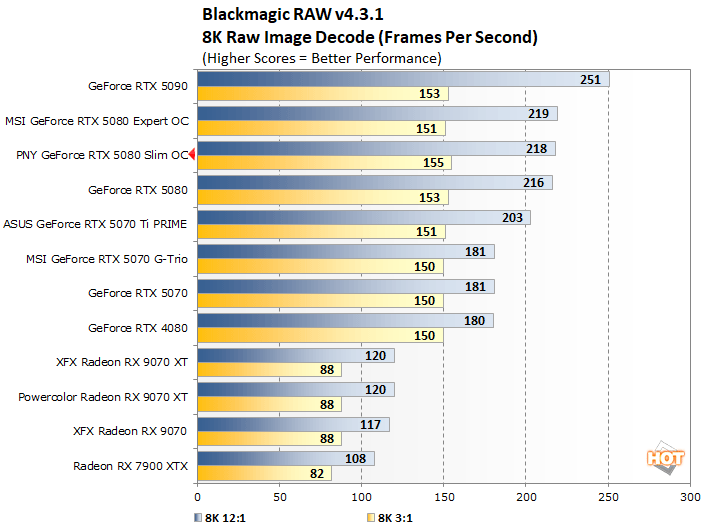
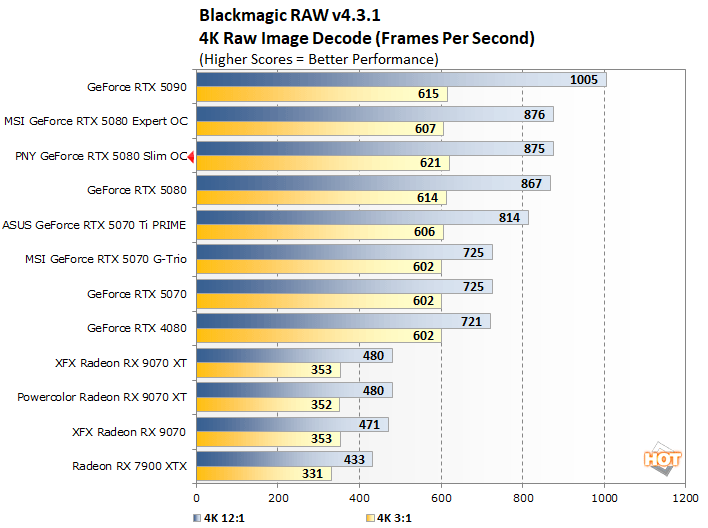
At both resolutions and compression levels, the PNY GeForce RTX 5080 Slim OC slots in between the GeForce RTX 5080 FE and MSI's custom Expert edition card, which is to say it performs very well. Only the GeForce RTX 5090 is materially faster.
UL 3DMark Speedway DX12 Ultimate Benchmarks
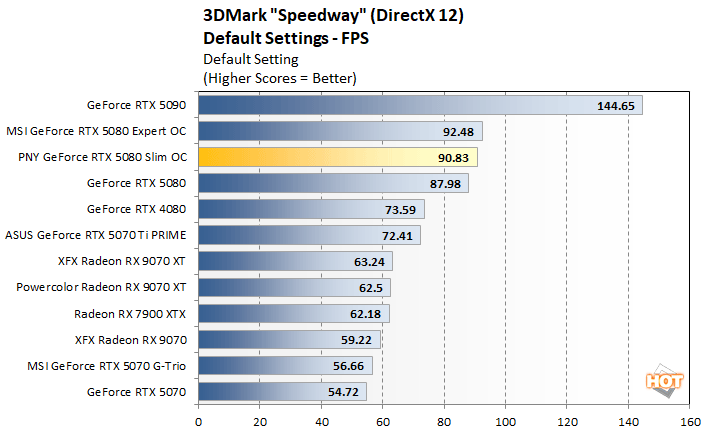
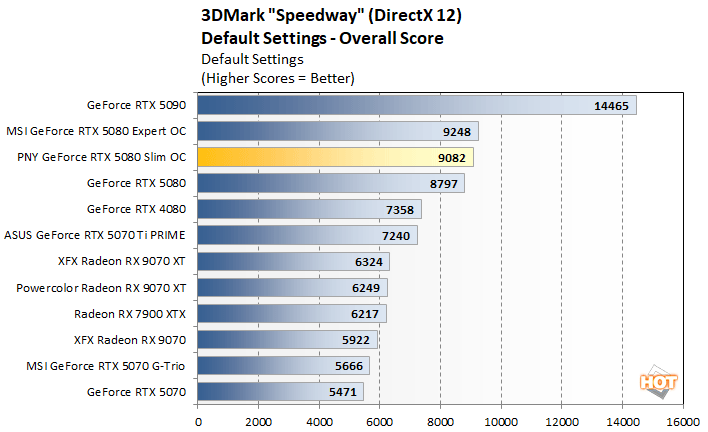
Speed Way is the most recent addition to the UL 3DMark graphics test suite. Speed Way uses the DirectX 12 Ultimate API and leverages advanced features like DirectX Ray Tracing tier 1.1 for real-time global illumination and ray traced reflections, Mesh Shaders, and high resolution textures and artwork. All of the graphics cards here were testing using the default benchmark options should you want to compare the performance of your system to our test rig...
3DMark Speed Way
UL 3DMark Steel Nomad DX12 Benchmarks
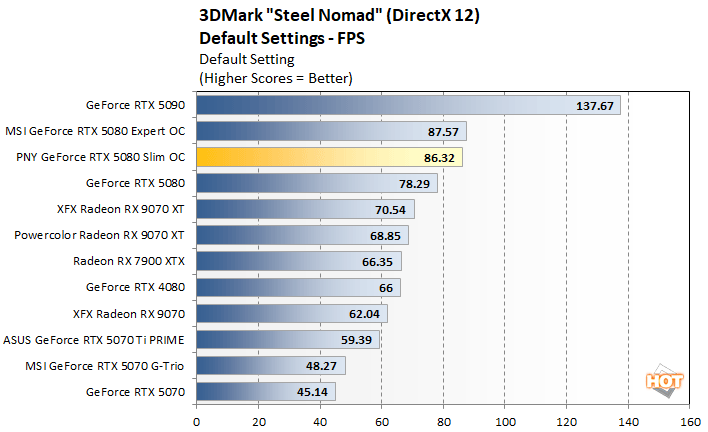
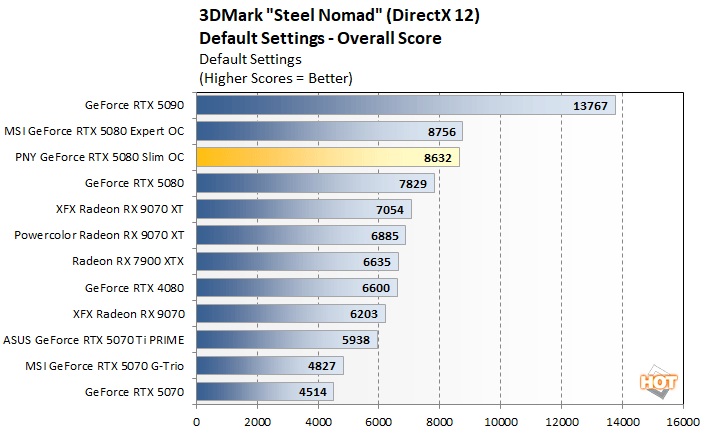
3DMark Steel Nomad is one of the newer cross-platform GPU benchmarks developed by UL Solutions as part of the 3DMark suite. This test is designed to evaluate the performance of modern gaming hardware in non-ray-traced scenarios, but using otherwise advanced rendering techniques with DX12.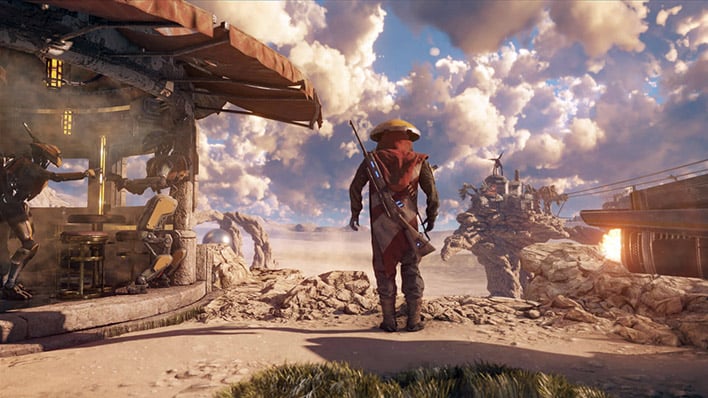
The Talos Principle II Testing
Croteam’s The Talos Principle II is a sequel to the original first-person, puzzle-based adventure game that features philosophical themes and expansive environments with increasingly more difficult challenges as the game progresses. It was originally released for multiple platforms, but has been continually updated on the PC.

The Talos Principle II
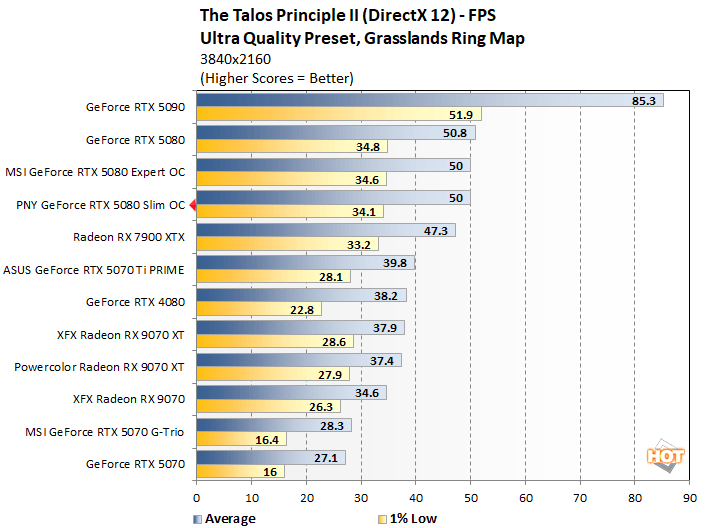
All three of the GeForce RTX 5080 cards performed similarly here, with less than a single frame per second separating them. Technically the PNY GeForce RTX 5080 Slim OC trailed the others by a small margin due to a slightly lower 1% low, but the deltas separating the cards fall within the margin of error for this benchmark.
Homeworld 3 Benchmarks
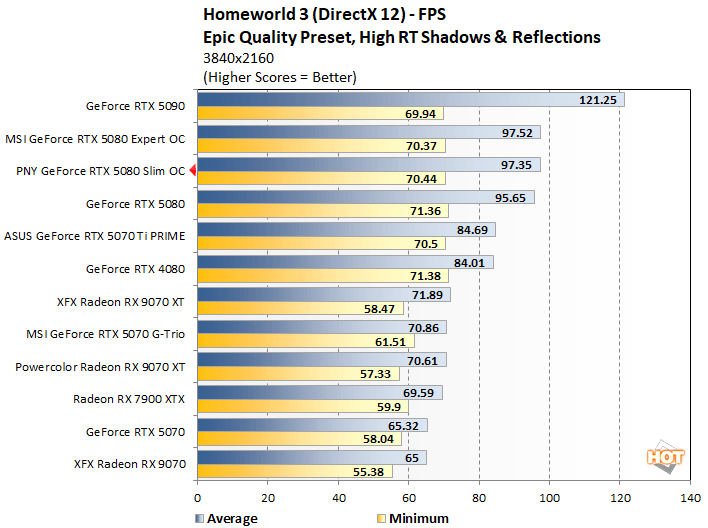
With all of the AI, creator, and synthetic tests out of the way, let's move on to the actual games. Homeworld 3 is the latest installment in the long-running real-time strategy (RTS) series, developed by Blackbird Interactive and published by Gearbox Software. Released in mid-2024, Homeworld 3 continues the space saga that began with the original Homeworld game. We tested Homeworld 3 at 4K, without resolutions scaling enabled.
Homeworld 3
Black Myth: Wukong Benchmarks
Black Myth: Wukong is a title with a storied history. It began development way back in 2018, and was first showed to the public with an incredible trailer in 2020, but the pandemic and other internal struggles delayed the game's development and it wasn't released until last year. Black Myth: Wukong supports a variety of upscalers, including NVIDIA's DLSS, AMD's FSR3, Intel's XeSS, and Epic's own TSR. Using DLSS, FSR3, or TSR gives you the option of enabling frame generation too, which you'll need if you want to crank up the visuals in this stunning title to maintain smooth animation.
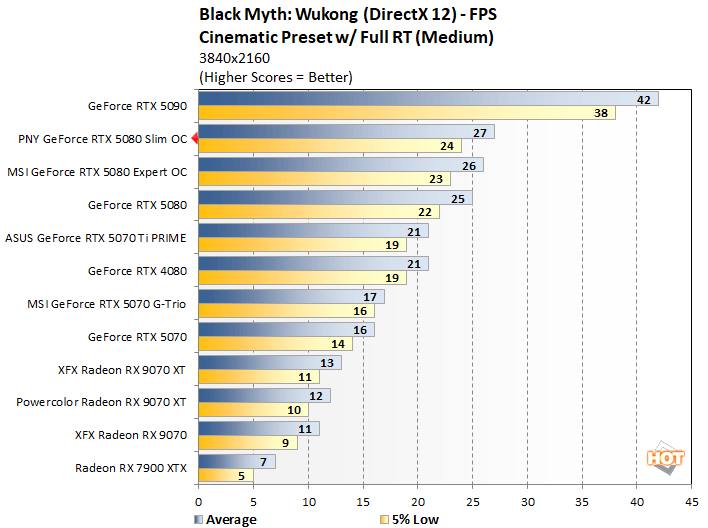
Black Myth: Wukong's Cinematic image quality preset with full ray tracing enabled (at medium quality) is a GPU killer. The GeForce RTX 5080s represent the second fastest GPUs available, behind only the mighty GeForce RTX 5090. The PNY GeForce RTX 5080 Slim OC pulled off a slight victory over the MSI card here, but again, the differences are small.
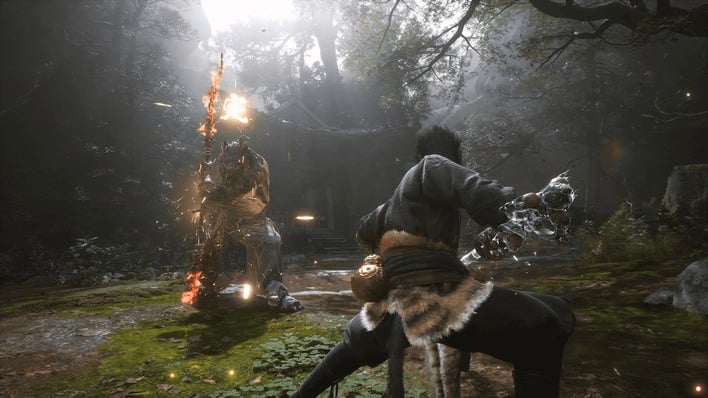
Black Myth: Wukong
F1 24 Racing Sim Benchmarks
F1 24 is Codemaster’s latest Formula One racing simulation, and like previous version of the game, it sports impressive visuals. This latest addition to the franchise supports DirectX 12 with ray tracing, and it incorporates support for a number of AMD's FidelityFX Super Resolution (FSR) features and NVIDIA technologies, like DLSS with frame generation. We tested the game with its Ultra High graphics preset, with ray tracing and TAA enabled to see what these graphics cards could do.

F1 24
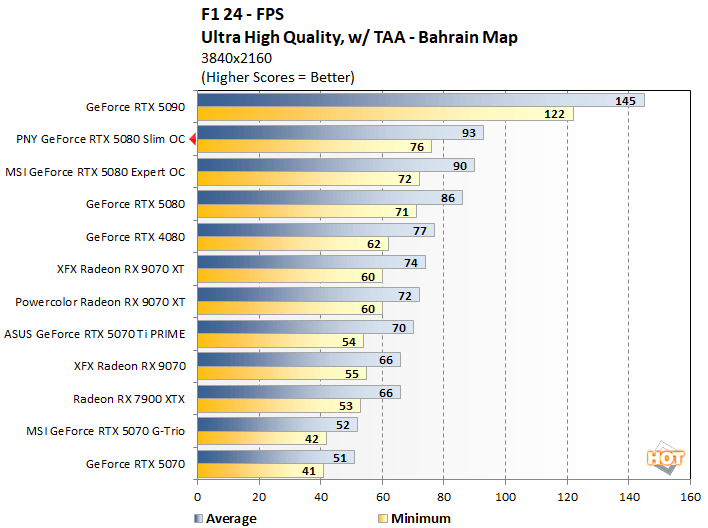
F1 24 doesn't tell us much we didn't already know. The PNY GeForce RTX 5080 Slim OC chalks up another slight victory over the other 5080s, and it can effectively outrun anything but the flagship GeForce RTX 5090 in this game.
Cyberpunk 2077 Benchmarks
Cyberpunk 2077 is based on the Cyberpunk tabletop role-playing game franchise. The tabletop game was published for the first time all the way back in 1988, and the intervening 30-odd years has not changed the game world all that much. As a result, Cyberpunk 2077 looks somewhat retro-futuristic, as this is how people in the '80s imagined what the future would look like.The PC game make use of virtually every advanced DirectX graphics technology and features support for DLSS, FSR and XeSS, and after a somewhat rocky release, it has been significantly updated and optimized for a multitude of hardware configurations. Although it is no longer considered a new title, Cyberpunk 2077 remains a showcase for many advanced graphics technologies.
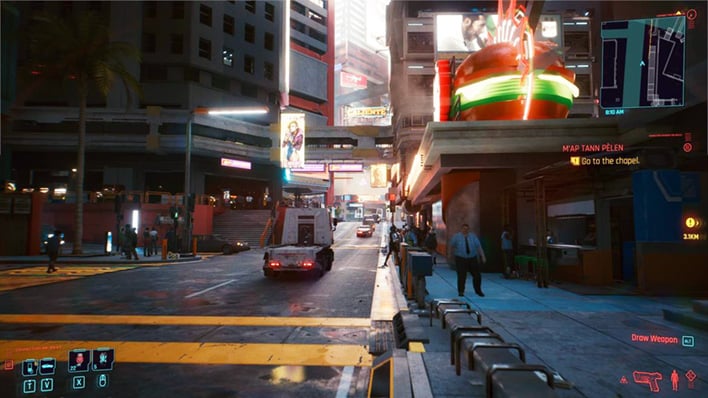
Cyberpunk 2077
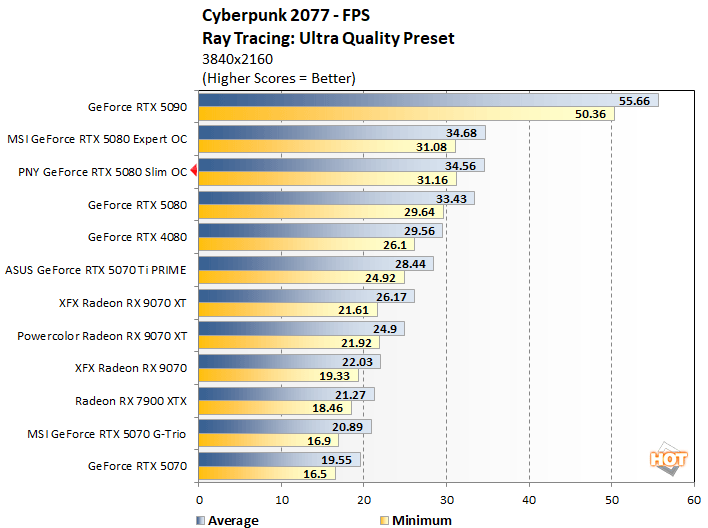
What all of these benchmarks show is that properly running GeForce RTX 5080 cards should perform similarly, all things being equal. What really differentiates the cards are their form factors, coolers, and other features.