Intel Xeon 658X Review: 24 Cores, Massive Memory Bandwidth Tested


| Intel Xeon 658X: MSRP $1,699 The Intel Xeon 658X brings the Granite Rapids architecture to professional workstations. It offers increased CPU throughput, memory bandwidth and higher efficiency than its predecessors.
|
|||

|

|
||
Intel announced its Xeon 600 series processors for workstations back in February of this year. The Xeon 600 series processors supplant Intel’s previous-gen Xeon W chips, and are based on the Granite Rapids architecture, which you can read about in our initial deep-dive coverage.
The Xeon 600 series is fabricated on Intel 3, just like Granite Rapids-based server processors, and feature the Redwood Cove core architecture which debuted in Meteor Lake back in December of 2023. Xeon 600 series processors should offer performance and efficiency improvements over older Sapphire Rapids based processors and offer higher density as well. In fact, the top end Xeon 698X is an 86-core CPU—the previous-gen flagship Xeon x9-3595X has only 60 cores.
There are a number of other enhancements including a large increase in L3 cache up to 336MB, and full support for AVX-512 and Intel's AMX extensions. For all of the details, you’ll want to check this out.

There are 11 processors in the Xeon 600 series, starting with the 12-core Xeon 634 and moving all the way up to the 86-core Xeon 698X. As is typically the case, maximum turbo frequencies, cache sizes, and power differ depending on the core count—TDPs range from 150 to 350 watts. Also note, only SKUs with an X designation are unlocked and only the top-end SKUs have MRDIMM support. Prices range from $499 to $7699 for this series of chips.

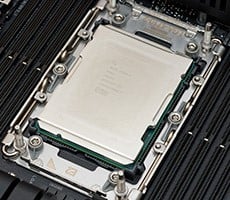
We got the middle-child in for testing, the Xeon 658X, which is a 24-core chip with maximum turbo frequency of 4.9GHz and 144MB of L3 cache.
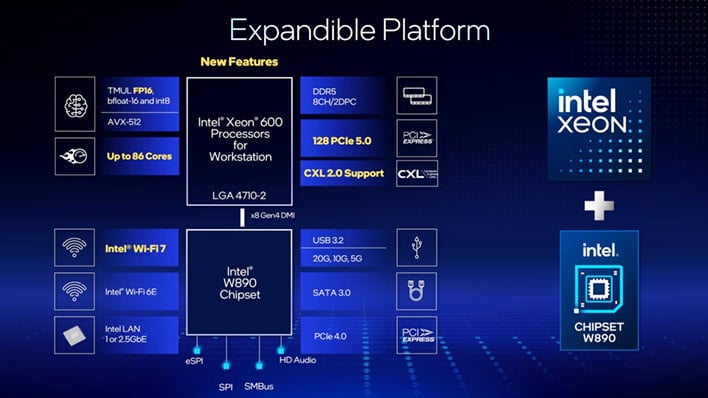
Intel Xeon 6 series processors for workstation require motherboards built around the Intel W890 chipset and LGA4710-2 socket—they are not compatible with the W790 boards used with older Xeon W series processors.
All W890-based motherboards currently available are decidedly high-end options, built with ultimate connectivity and reliability in mind. The PCIe Gen 5 connectivity (up to 128 lanes) comes by way of the processors, which support up to 8 channel memory configurations (Xeon 654 and higher), and the chipset brings additional PCIe Gen 4 lanes, high-speed networking and many USB and SATA ports.
The ASUS Pro WS W890-SAGE SE Motherboard
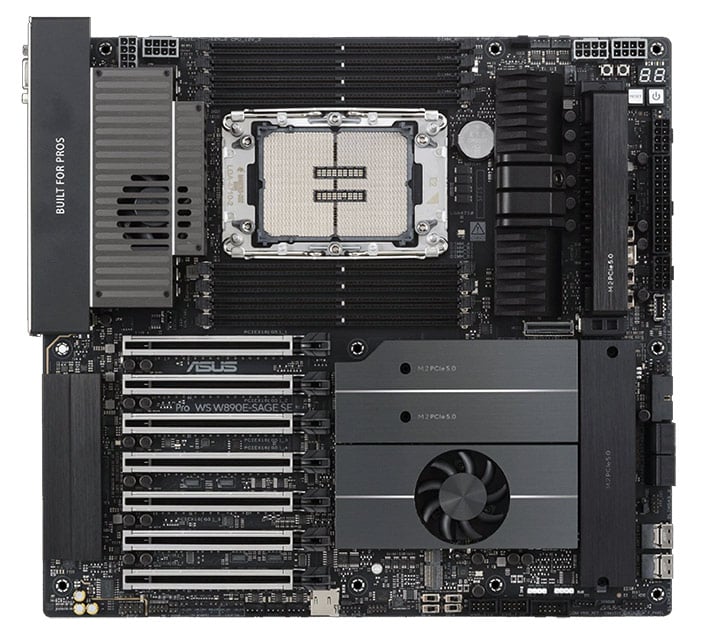
For our Xeon 658X test rig, we utilized the ultra-premium ASUS Pro WS W890-SAGE SE motherboard. The Pro WS W890-SAGE SE is about as high-end a motherboard as you’ll find out in the wild. The board is obviously built around the W890 chipset and is designed for ultra enthusiasts and professional workstation users.
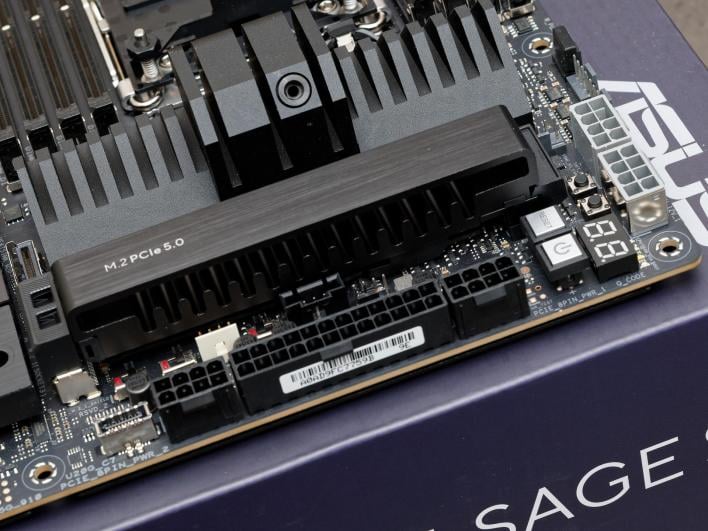
The Pro WS W890-SAGE SE is loaded with modern features. This motherboard is outfitted with elaborate cooling, which includes integrated low-profile fans for the chipset and VRM cooling hardware, and a multitude of additional features over and above what’s offered by the chipset itself. The board features 22 teamed power stages, seven x16 Gen 5 slots for multi-GPU configurations, USB 4, dual SlimSAS ports, four M.2 slots and support for up to 4TB of RAM, including support for Multiplexed Combined Rank DIMMs (MRDIMM).
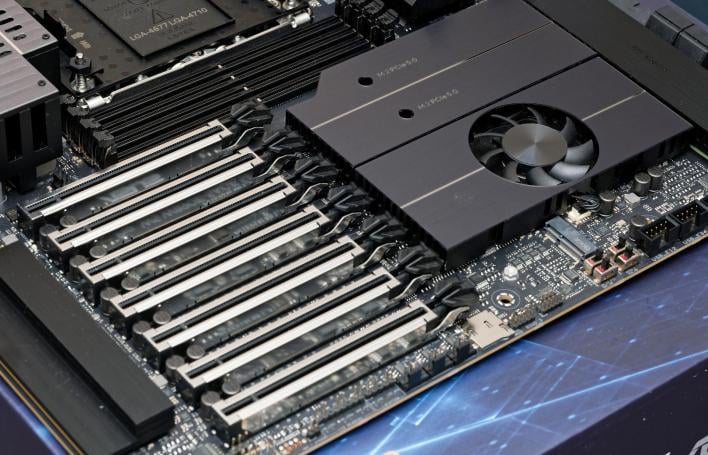
The ASUS Pro WS W890-SAGE SE lacks any RGB lighting of its own, which is par for the course on the company’s Pro WS-class boards, but it does have two ARGB headers should you want to add some. It also has metal reinforcements on all seven of its expansion slots, and additional shielding covers the back panel I/O, and the area around the chipset as well. The heatsinks behind the topmost slots and along the front edge of the board are removable and provide cooling for the solid-state drives installed into the M.2 slots beneath. Those M.2 slots have simple locking mechanisms too, so its easy to plug in drives without any fuss.
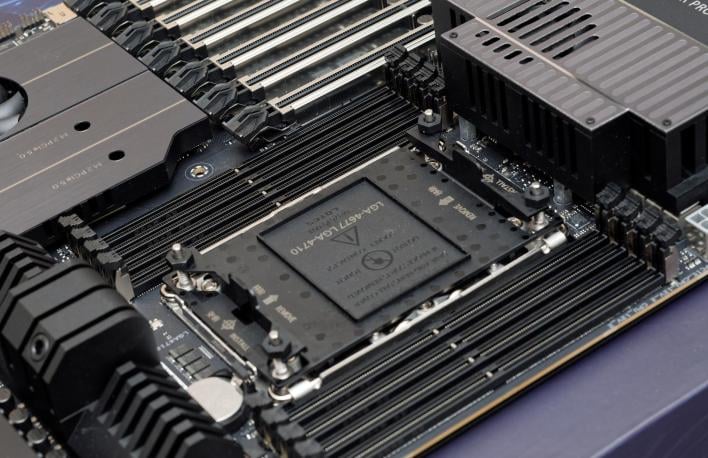
The Pro WS W890-SAGE SE features high-end capacitors and chokes throughout its design, to improve long-term reliability and overall efficiency, and provide smooth, clean power. Unlike most other high-end boards currently on the market, however, it does NOT feature a mouse-friendly BIOS / UEFI. Instead, the board returns to the pale blue AMI-BIOS text menus of old. For OG hardware guys like us, the BIOS is still plenty easy to navigate and it offers an extensive array of performance-related options, but if you’re used to graphically-rich BIOS menus from more mainstream desktop motherboards, you may be taken aback.
The Pro WS W890-SAGE SE also has IPMI remote management capabilities built-in to allow for out-of-band management of many aspects of the system. As long as the Pro WS W890-SAGE SE powers up and a working ethernet cable is plugged into the dedicated port (and you know the system’s IP address), you can log into the management interface via a web browser and manage the system.
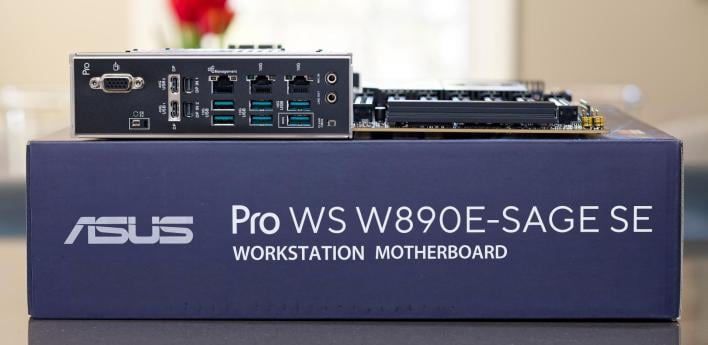
The ASUS Pro WS W890-SAGE offers basic audio functionality by way of a Realtek controller, with a couple of 3.5mm audio jacks for line-in and out in the board’s IO panel. It’s also got dual 10Gb (Intel) Ethernet, 1Gb (Realtek) wired Ethernet for remote management purposes, a VGA output for the on-board ASPEED BMC controller, 6 USB Type-A ports (a mix of USB 2.0 and 3 up to 10Gbps), two mini DisplayPorts, and dual USB-C 40Gb ports. ClearCMOS and BIOS Flashback buttons are also present.
We ran some G-SKILL Zeta R5 Neo RDIMM memory in our test rig, specifically the 64GB F5-6400R3239G16GQ4-ZR5K quad-channel kit. G.SKILL has a few Zeta R5 RDIMM kits currently available, in quad and eight channel varieties, for both Intel Xeon processors and AMD Threadrippers. The kit we used consists of four, matching 16GB sticks of memory, for a grand total of 64GB when configured in a 4-channel setup. This memory is capable of running at 6,400MT/s with CL32-39-39-102 timings at 1.4v.
And with that, let's see how the Xeon 658X performs...