PNY GeForce RTX 5080 Slim OC Review: Big 4K Performance In Two Slots


| PNY GeForce RTX 5080 Slim OC: Currently $1,299 The PNY GeForce RTX 5080 Slim OC is a custom, no-nonsense, factory overclocked RTX 5080 card with a trimmed-down waistline that requires only dual-slots but delivers excellent performance.
|
|||

|

|
||
A few weeks back, PNY announced its “Slim” family of GeForce RTX 50 series cards. There are currently three members in the PNY GeForce RTX Slim family, an RTX 5070, a 5070 Ti, and the top-end GeForce RTX 5080 Slim, which we’ll be showing you here. All of the models have modest factory overclocks, but more importantly they all feature custom designs and take up only two slots in a system, hence the “Slim” moniker.
If you’re a regular around here, you know I’m not a huge fan of unnecessarily massive GPUs. For a flagship piece of ultra high-end kit that will actually benefit from a large heatsink—fine. But most of today’s GPU makers are slapping 2.5 – 3-slot, oversized coolers on mid-range, power-limited graphics cards where they’re simply not needed. There’s nothing technically wrong with a massive cooler, that all but ensures heat will never be an issue, but it’s still overkill and often precludes the GPU’s use in some mainstream or smaller form factor systems.
That’s where cards like the PNY GeForce RTX 5080 Slim OC come in. Take a look...

PNY GeForce RTX 5080 Slim Specifications

Most of the PNY GeForce RTX 5080 Slim OC's specifications look just like NVIDIA’s own Founders Edition card, except for the maximum boost clock and dimensions. The number of cores, 16GB memory capacity, 30 Gbps effective memory speed, ports, interface and feature support are all the same.
In our real-world testing, our GeForce RTX 5080 Founders Edition peaked at a 2,617MHz boost clock when running in its default configuration, but hovered closer to 2,580MHz while under load and gaming most of the time. The PNY GeForce RTX 5080 Slim OC, however, features an out-of-box boost clock of 2,730MHz. Practically, as you’ll see a little later, that spec is just a guideline, however. The card actually boosts even higher than this when at stock settings, but overclocking it manually can push things much higher. We'll do some of that too.
The PNY GeForce RTX 5080 Slim OC measures 300 x 150 x 40 mm (2-slots wide), whereas the NVIDIA-built Founders Edition, which is the only other 2-slot RTX 5080 card measures 304 x 137 x 40 mm. The PNY card is a but taller than an FE card, but its svelte next to most other partner boards. PNY uses that additional height to stretch out the cooler a bit, and to good effect. Despite its relative thinness, GPU temps remain surprisingly tame with this card.
The PNY GeForce RTX 5080 Slim OC
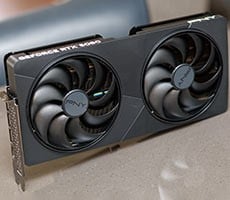
The PNY GeForce RTX 5080 Slim OC reminds me of graphics cards from years past. There are no wild curves or angles, and there’s no lighting or in-your-face bling. The PNY GeForce RTX 5080 Slim OC is not an unattractive graphics card, but it doesn’t subscribe to the typical gaudy gamer aesthetic either.
The front of the card is dominated by a sleek fan shroud with a couple of embossed angular lines and the dual 120mm fans. Both the PNY GeForce RTX 5080 Slim OC and RTX 5070 Ti feature 120mm fans, while the smaller PNY GeForce RTX 5070 Slim has 100mm fans.

The back of the card has a metal reinforcement plate, with some simple branding and a few large cut outs—one for the backside of the GPU, another for the recessed power connector, and another for air to pass through the cooler.

PNY claims this cut out is somewhat larger than other RTX 5080 cards, which can improve cooling performance somewhat, but that’s not something we can verify without measuring them all. Anecdotally, we can say the cooler performs very well on this card, as you’ll see a little later.


These are the real money shots with the PNY GeForce RTX 5080 Slim OC. As you can see, the card is relatively narrow, and is no wider than the two slot case bracket. These shots also show the relatively short PCB and massive heatsink and heatpipes underneath the fan shroud. The PCB is only about half as long as the card; the rest is all heatsink.

As you can see, the PNY GeForce RTX 5080 Slim OC is a no-nonsense graphics card. There isn't a lot of flash or gaudy accoutrements, and there's no RGB lighting or other lighting either.
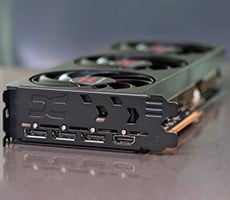
Like other GeForce RTX 50s, the outputs on the PNY GeForce RTX 5080 Slim OC include a trio of DisplayPorts (2.1b) with a single HDMI port (2.1b) at the bottom. There's some venting in the case bracket too, to allow some warm air to escape a system. This shot also clearly shows how much taller the PNY GeForce RTX 5080 Slim OC is than the case bracket. If your chassis has a ridge in front of the screw holes, be prepared with a magnetic screwdriver to mount this thing—it's a pain getting in there with your fingers.
And now that you're familiar with the card, what do you say we get to some benchmarks?