MSI Raider 16 Max HX Review: 300W Of Power In A Beastly Laptop


MSI Raider 16 MAX HX Noise and Thermals
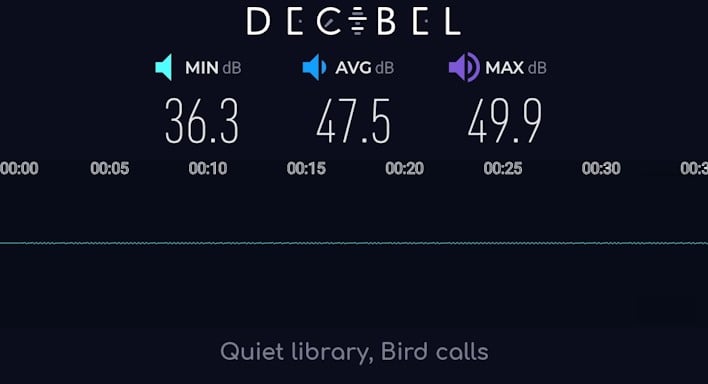
This is a capture of Cyberpunk 2077 gameplay using headphones and a quiet wireless gamepad under the desk. This was captured with the microphone exactly 50cm away from the laptop, which is about the same distance between my head and the machine. It accurately captures what I noticed: this thing is incredibly quiet.
Now, to be clear, it will absolutely make some noise if you crank up the fans intentionally. In fact, there's a "Cooler Boost" option in the MSI Center settings that will ramp all the fans to 100% manually, and with that enabled I measured over 63 decibels coming out of the thing. If you make it, the machine screams like a banshee, although as with most modern cooler designs the character of the sound is more "high-speed airflow" and less "shrieking fan".
That is not the case during normal use, though. Whether in Cinebench 2026 or in Cyberpunk 2077, this system pretty much stays under 50 decibels, which is incredibly impressive considering the combined 300W TDP of the hardware inside.

Despite the relative lack of fan noise, though, the machine stays cool. This result above was taken during a Cinebench multi-threaded run that slammed the CPU to 100% utilization. While in the turbo power window, the CPU does creep up to 94℃, but that's still well within the 105℃ thermal limit. After settling down to the 125W long-period maximum, temperatures stabilize just under 90℃, which is phenomenal.

Which isn't to say that the CPU never approaches its thermal limits; the above screenshot is the Steam detailed monitoring overlay while compiling shaders for Street Fighter 6. In that case, with the GPU also drawing power (albeit lightly loaded), the CPU spiked up to 105℃ numerous times, and you can see that CPU clocks have throttled down to 4.65 GHz. That's not normal gameplay, though, and it also cooled off fairly quickly as the fans kicked up. Obviously, it was better-behaved in gameplay, too.

As far as the GPU itself goes, MSI did a good job with it. You can see here that in our Cyberpunk 2077 test, we were drawing a full 194 (okay, 193.999) watts through the GPU, and yet the temperature peaked at only 77.7℃. Toasty, but again, far from the 87℃ thermal limit defined in the firmware. There is some weird reporting here we should point out; we recorded a maximum GPU clock of 28,364 MHz, which is obviously wrong, but the power and thermal numbers match what Steam and NVIDIA's own overlay show, so we're confident in those numbers.
MSI Raider 16 MAX HX Battery Life Benchmarks
Gaming laptops aren't typically known for their battery life. Once upon a time, the untethered lifespan of most gaming portables was easily measured in minutes, not hours. These days things aren't like that. There's still a huge gulf between the battery life of a gaming laptop and a thin-and-light system, but the MSI Raider 16 MAX HX puts up a darn respectable time in its own right: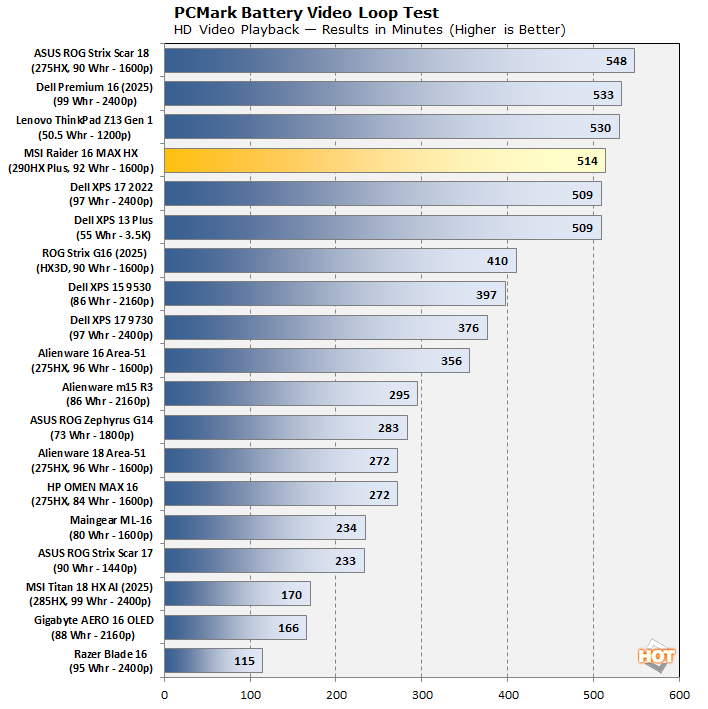
514 minutes probably doesn't knock your socks off, and it shouldn't. That's right about eight and a half hours of video playback, which isn't great compared to modern thin & lights putting up literal all-day 24-hour-plus results. Those systems aren't carrying around 24-core desktop-class CPU cores nor 24GB discrete GPUs, though. They also aren't illuminating a brilliant 1000-nit HDR OLED. With that in mind, we think 514 minutes is pretty respectable. It comes in ahead of the ASUS ROG Strix G16, which had a slower GPU, and it comes in just behind the Lenovo ThinkPad Z13, a tiny little system based on a mobile Ryzen APU. It's good stuff.
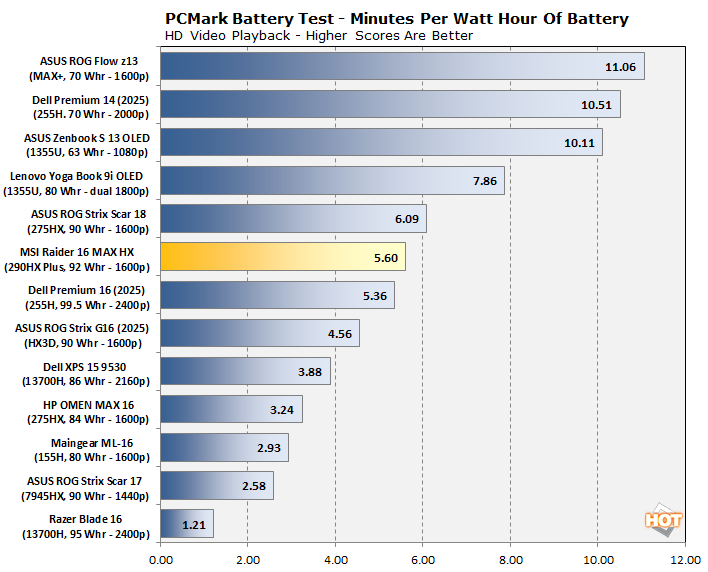
If we slap it down on our efficiency chart, its 5.6 minutes per watt-hour of battery honestly looks pretty good. Most of the systems beating it have integrated graphics, and the ROG Strix Scar 18's Ultra 9 275HX is a fair bit slower than the 290HX Plus in the MSI. All around, it's a very solid efficiency result for a gaming laptop.
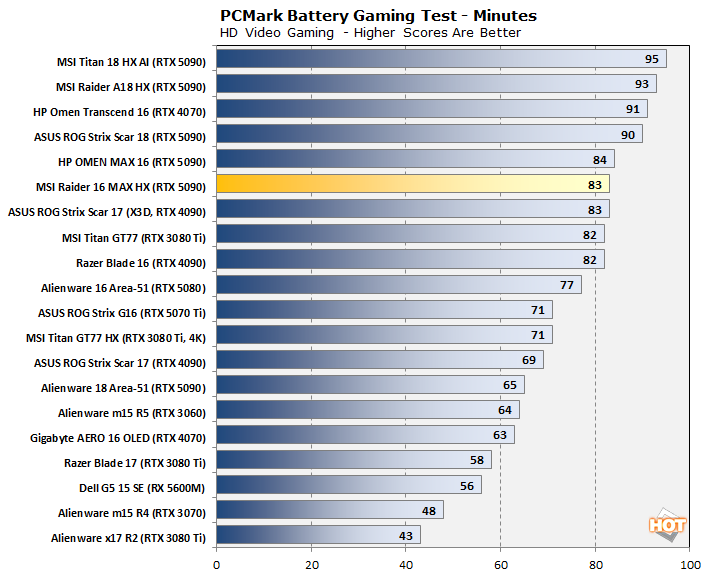
The PCMark Battery Gaming test is a little bit of a meme at this point, because it uses the 3DMark Fire Strike test, capped at 30 FPS, running in a 1080p window. That test is 13 years old at this point, and the 30 FPS cap means that a massive GPU like the GeForce RTX 5090 can basically idle through it, which is why we see better results from 5090 machines here versus systems with smaller GPUs; they simply don't have to clock as high. The 83 minute result here isn't bad at all and lines up right along with the very similar HP Omen Max 16.
MSI Raider 16 MAX HX Review Conclusions
As we finalize our thoughts on the MSI Raider 16 MAX HX, it's important to keep things in context. My previous laptop review was of a gorgeous thin & light system that made specific sacrifices for the form factor. The Raider 16 MAX HX is a laptop that refuses to make sacrifices, though. It's not as sleek as the Dell XPS 16 I was speaking of previously, and it lacks a level premium feel due to the mostly-plastic construction. Thad said, it's also potentially the fastest 16" laptop we've ever tested, depending on the workload.All of our issues with this system come down to minor frustrations with a few of MSI's design decisions. The proprietary power plug is probably the biggest, for repairability reasons, but we understand why MSI had to go that route; USB-C can't carry enough juice, and a barrel plug has its own drawbacks. The onboard speakers aren't great but many gamers with headsets might not use them much anyway, and the Steelseries GG software requirement is basically a nitpick on a machine with 32GB of RAM.

Meanwhile, the things we love about this machine are legion: awesome performance, a gorgeous OLED screen, plenty of ports for external devices, a solid keyboard layout for folks that actually want to get things done, and very easy access to the most important upgrades. If the RAMageddon settles down next year, you could throw a pair of hot-clocked CSODIMMs and a 4TB PCIe 5.0 SSD in this thing in five minutes.
As with any product review, it all comes down to pricing and your personal priorities in the end, and that's where this machine really blows its competitors out of the water. If you're OK with its few setback, then this machine delivers bombshell 16-inch laptop performance for $4,299 MSRP. That's pricey, but considering that an identically configured Alienware 16 will run you $4,709, it's competitive.
The thing is, this system isn't available at MSRP; in fact, it appears to currently be a Micro Center exclusive, where it's presently selling for just $3,499. That is, frankly, a great price for this class of machine. If you have use for an incredibly powerful 16" laptop with a glorious OLED display and decided gamer aesthetics, you'd better get on the road to your nearest Micro Center store before this HotHardware Editor's Choice machine sells out. Hopefully it comes to this page at Amazon soon. There's also an AMD-powered version with an RTX 5080 on board that's kicking around Amazon as well.