Dell XPS 16 (2026) Review: Thin, Elegant And Surprisingly Fast


This is a screenshot taken several minutes into a Cinebench 2026 multi-core test. Cinebench doesn't load the SoC's integrated GPU, but that's fine; the sixteen CPU cores can more than overdraw the chip's power limit by themselves. As you can see, even with the fans on "Ultra Performance" mode, the XPS 16 will absolutely hit its thermal limit and throttle a bit as a result.
However, you can also see on the left that temperatures are significantly below that despite that the test is still ongoing. This is because the system will only hit its thermal limits when PL2 is active, the short burst power limit that allows the chip to draw some 65W for short intervals. Once that time limit has expired and the CPU falls back to its 25W PL1, it is easily able to keep it cool under sustained work. Performance falls off, especially if you're using the GPU (which can trivially pull 25W by itself), but the chip isn't overheating and so it won't become a reliability issue.
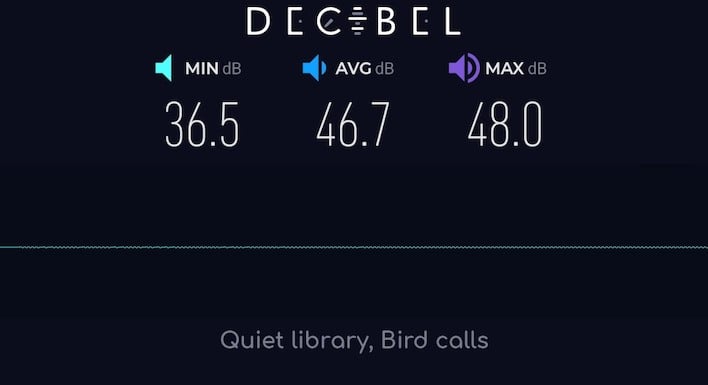
The XPS 16 (DA16260) is almost inaudible to this old man's ears at virtually all times. As you can see, it is possible to force the machine to make a little noise; this Decibel result was captured during a power limit test using Prime95. Even when the fans go full throttle they're remarkably quiet, though. Under normal usage, the only noise that comes out of this system is from its speakers. Impressive engineering from Dell, especially considering that this low sound level in the upper 40-decibel range is able to keep the SoC (at 25W) plenty cool.
It Performs, It Cools, And It's Quiet, So What About Battery Life?
The narrative is that Arm processors have amazing efficiency while x86 machines have crap efficiency. The truth is a little more complex than that, as we've shown in previous battery life tests. It comes down to a great many factors, including processor type but also including screen type and size, system specifications (like RAM and storage), and perhaps most importantly, operating system and drivers.The XPS 16 (DA16260) has a large and vibrant OLED screen, and that's not going to help its battery life. But let's not ramble on before you see the results:
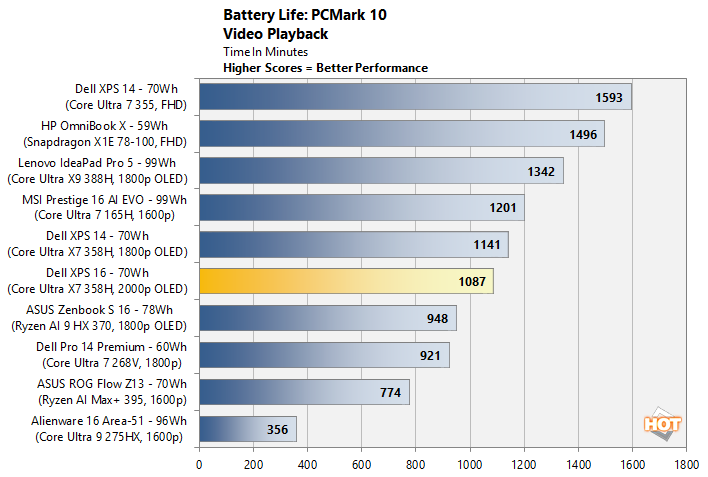
In PCMark 10's Video Playback battery life test, which loops an HD video until the battery dies, we see a runtime of 1087 minutes for the XPS 16. This is, frankly, a phenomenal result considering the howerpower on tap, the battery size, and the screen on this machine, which is a high resolution (230 PPI) tandem OLED. You don't have to take our word for it, though, check this out:
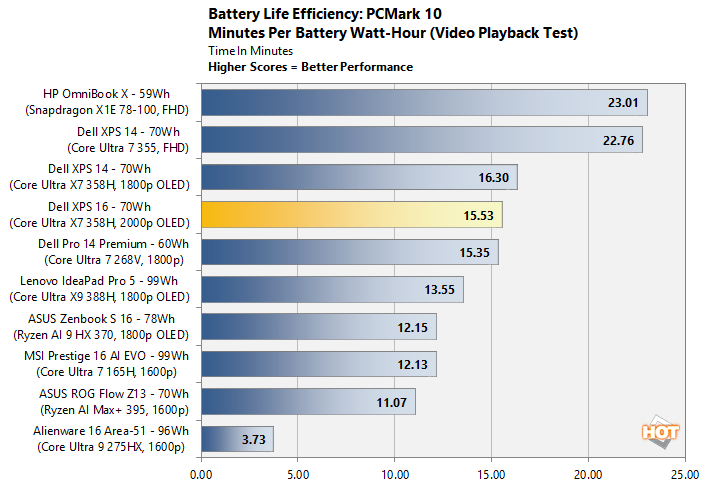
This is a phenomenal result for the XPS 16. It might not look like it, but consider this: it's matching the older Dell Pro 14 Premium, which not only doesn't have an OLED screen, but it has a significantly smaller and weaker processor with on-package memory. It's also running very close behind the Dell XPS 14 on the same platform, which is impressive considering the difference in screen area. It's true that the real efficiency kings leap out ahead, but they have neither the compute horsepower nor the gorgeous displays of these systems.
This is absolutely a battery life win for Dell. Over 18 hours of battery life playing HD video translates easily to six to eight hours of typical desktop use, like browsing, chatting, using Office, and doing image edits. I know that because I've used this machine for most of my work this week and I haven't even gotten it below 50% battery without playing a game on it. This system has some serious all-day battery life; don't be fooled by the comparison against some lower performing systems that last even longer.
Dell's XPS 16 (DA16260) Premium Laptop Review: Our Thoughts
It's never really been in question whether or not Dell knows how to make a good laptop. There are few companies who have been in the game as long as Dell, and the firm's laptops, particularly on the high end, have usually been a high water mark for quality and features. We were pleasantly satisfied with last year's Premium machines, but the return of the XPS brand has come along with a truly excellent machine that achieves every goal it sets out to reach.We were elated with the XPS 14 earlier this year, and we're extremely happy with the XPS 16 as well. My only complaints with the machine are the relatively meager external I/O (which is a trend in premium thin & light systems like this) and the inefficient use of space for the keyboard. Simply put, it's difficult to justify the compact key layout in a system this size. Not everyone will care about that, though, and the keyboard as implemented is excellent to type on.
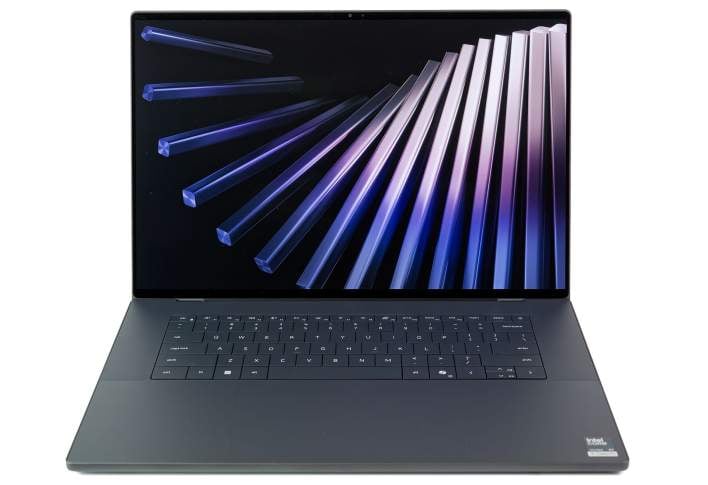
Aside from that, you get stellar CPU and GPU performance, a gorgeous OLED screen, a durable-feeling and elegant chassis, excellent laptop sound, and a relatively bloat-free software experience. No product is perfect, but these new XPS machines are probably the closest we've come to laptop perfection since the ASUS ROG Strix Scar 18 we reviewed around this time last year. As such we're going to give Dell's New XPS 16 the same Editor's Choice award.
This is a laptop built for purpose, and that purpose is being both portable and stylish while allowing you to get work done anywhere. It smashes that target with panache. You can pick up the New Dell XPS 16 laptop as configured here on Dell's website for $2,349, which isn't trivial, but it's also not on sale, and compared to other premium thin & light machines, it's competitive when you account for this system's superior tandem OLED screen. If you're keen to pick up an XPS 16 but are uncertain about the value proposition, keep an eye out for summer sales that will likely bring the cost down a bit. As is, though, the Dell XPS 16 is excellent.