MSI Claw 8 EX AI+ Review: Arc G3 Extreme Takes The Handheld Crown


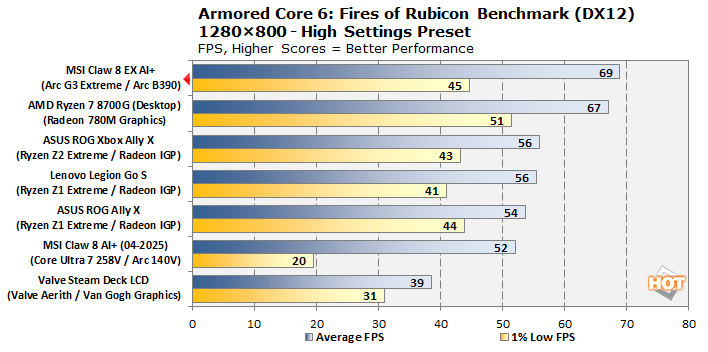
Starting off with Armored Core 6: Fires of Rubicon, we see our first chart-topping performance, with the Arc G3 Extreme and its B390 graphics putting up the best performance to date of the handhelds we've tested. That's going to become a bit of a theme, so settle in. With that said, Intel's graphics driver doesn't seem to like FromSoftware's engine, as performance here is unusually laden with hitches that make it a less pleasant experience than it might be otherwise. It's still great, but not as good as the high average FPS number would indicate.

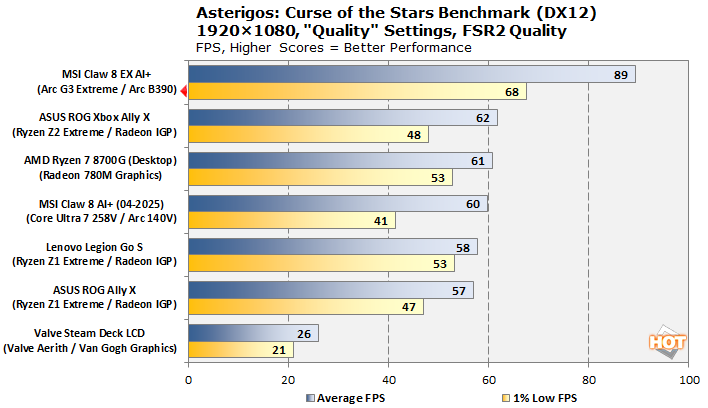
In Asterigos, on the other hand, performance is smoother and the Arc G3 Extreme takes home an easy first-place finish. This colorful third-person action-RPG looks gorgeous at these settings on the Claw 8 EX's vibrant IPS display, and circa-90-FPS with VRR is extremely smooth. Definitely recommended on this machine.

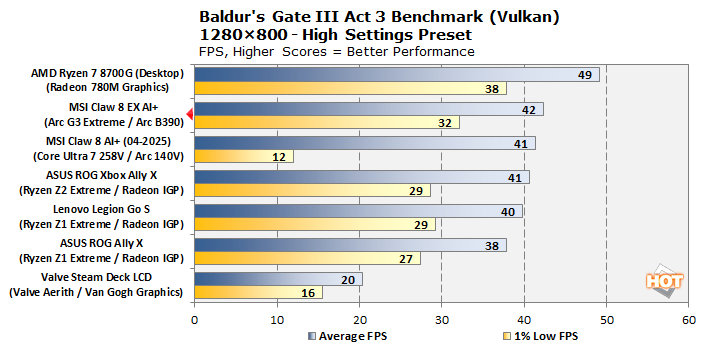
Mega-popular Dungeons & Dragons RPG Baldur's Gate III becomes a CPU benchmark toward the end of the game, and that's where we tested: in Act 3, inside the nominative city of Baldur's Gate. The Claw 8 EX AI+ still gives the best performance of any of the handhelds here, but it does fall behind the desktop Ryzen 7 8700G likely due to that system's higher CPU clocks and tight memory timings. The nasty stuttering problem that plagued the previous MSI Claw 8 in this game has been fully sewn up at this point; we expect the Lunar Lake machine would do better if we were to re-test it, too.

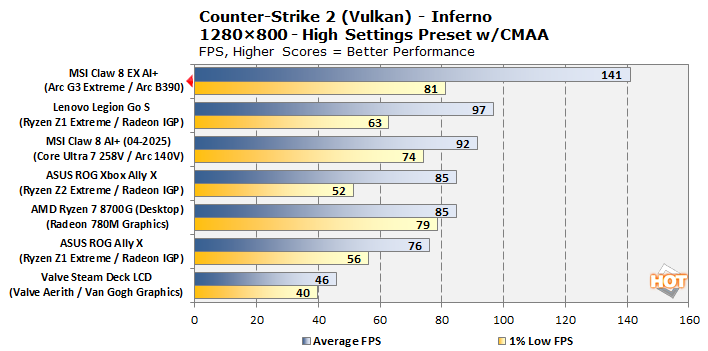
In Counter-Strike 2 the MSI Claw 8 EX AI+ blows the doors off of basically everything. Performance here is a little inconsistent, but it looks fantastic and plays great thanks to VRR. 81 FPS is very well within the VRR window, so it never looks stuttery. We'd probably cap the frame rate below the 120-Hz refresh rate to save battery power, but it's fascinating to know that integrated graphics can push CS2 past 120 FPS.

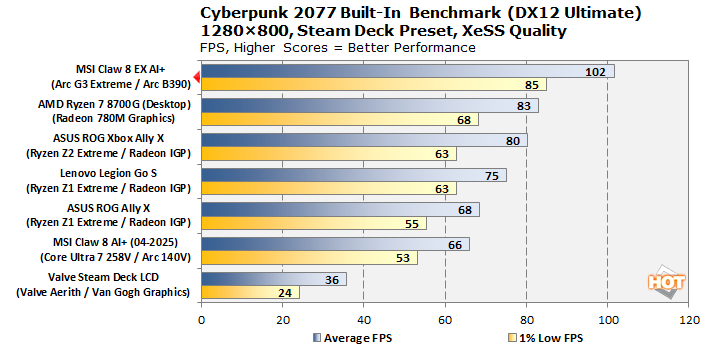
Everyone's favorite benchmark Cyberpunk 2077 has seen copious optimization in Intel's Arc graphics driver, and so the performance on the Arc B390 is nothing short of outstanding. Putting the hurt on the Ryzen 7 8700G is incredibly impressive as the Claw 8 EX is on "AI Engine" here, meaning it's using a max of 30 watts, while that desktop part is sucking down triple digits. Fantastic work by Intel.

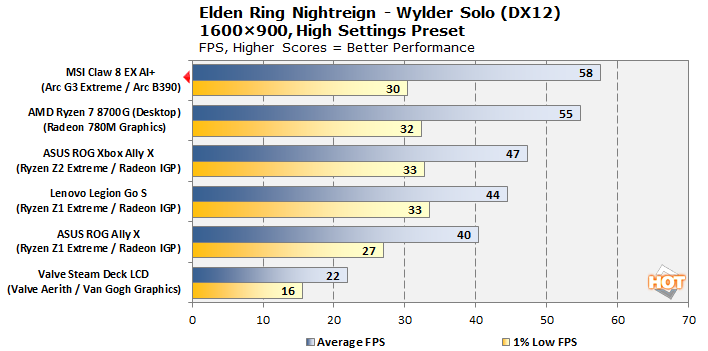
The consistency issues with FromSoftware's game engine rear their head here, too, as Nightreign uses the same engine as Armored Core 6, above. Performance is still very good, but there's definitely more stuttering than we'd like to see. Elden Ring and Nightreign are both capped at 60 FPS, so we'll have to raise settings if handhelds keep getting faster like this!

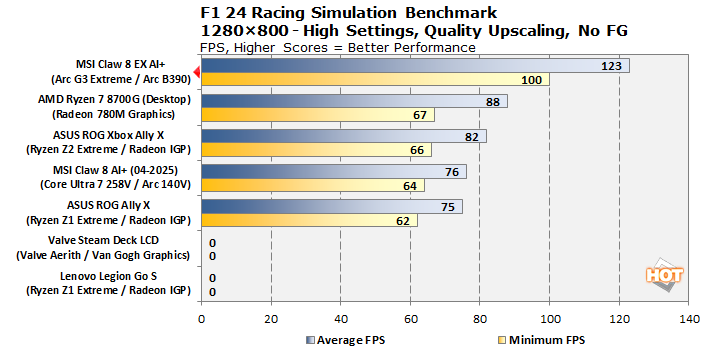
In F1 24, using these admittedly modest settings, we see the MSI Claw 8 EX AI+ break a triple-digit minimum frame rate, which is just astonishing. This is another game that has seen a massive amount of optimization work from Intel and the company's hard work has clearly paid off as the chip beats all of AMD's handheld parts by nearly 50%. To curb cheating in the online component, F1 24 uses restrictive kernel-level anti-cheat that barfs on Linux, so those two handhelds simply can't play this game at all. Image quality in this title is better than you might expect thanks to Intel's XeSS, which we used for the upscaling.

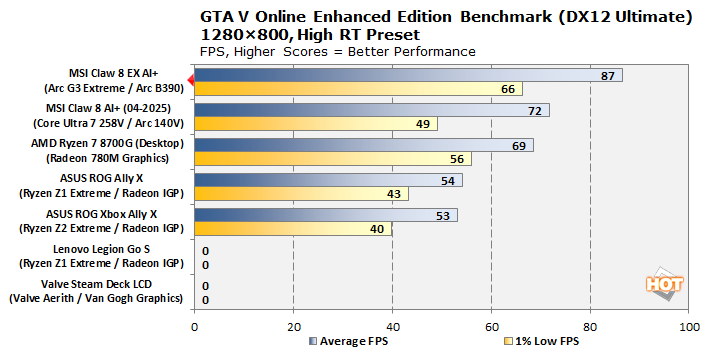
GTA V's Enhanced Edition piles in the ray-traced effects, and we've got both shadows and reflections enabled through the use of the "High RT" graphics preset here. Intel's Xe3 has outstanding ray-tracing performance, and so it goes that the Claw 8 EX AI+ stomps all over the competition here. It's hard to test GTA V Online with any degree of repeatability, but that's why we do five separate runs on each system to try and establish a more consistent baseline. Check out the improvement in minimum FPS from the last-gen Claw. Oh yeah, and just like with F1, the Linux-based handhelds can't run GTA V's Online component, so they score big fat goose eggs.

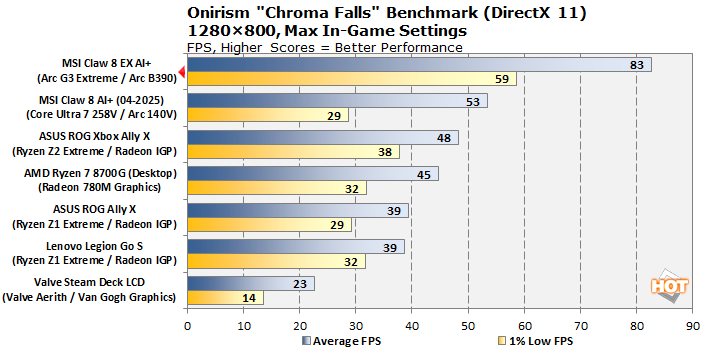
Indie cute-'em-up Onirism has finally hit 1.0! This result warrants some explanation, because with the game's official launch came a full rework of the front-end as well as an engine upgrade, and it means that these results aren't necessarily directly comparable to the results of the previous-gen MSI Claw. However, the other handhelds were re-tested since the 1.0 launch, and those results are fully valid. Intel dominates in this DirectX 11 Unity game, and that should bode well for many other indie games on the same engine.

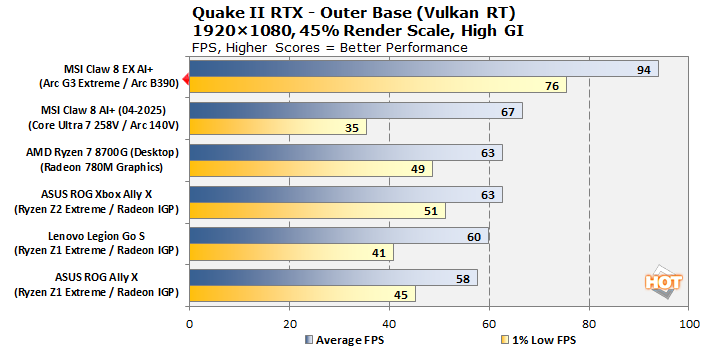
We include Quake II RTX not because it's a very popular game, but because it serves as an easy-to-benchmark example of ray-tracing on the Vulkan API. The strong ray-tracing performance of the Xe3 architecture once again comes into play here and we see the Claw 8 EX AI+ putting up a higher 1% low than any previous handheld has achieved as an average. Killer stuff here, seriously.

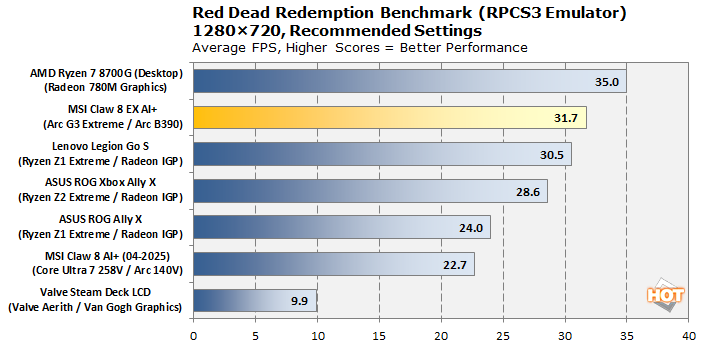
In Red Dead Redemption, run via the RPCS3 emulator, the Claw 8 EX AI+ is the fastest handheld we've ever tested. 31.7 FPS might not sound very impressive, but RPCS3, particularly in this game, is extremely sensitive to memory latency. That's been a weak point of Intel's chips from the last few generations, so this strong result is excellent news for the blue team. The Ryzen 7 8700G skips out ahead thanks to AVX-512 and ultra-low-latency DDR5 memory; it's hardly a fair comparison.

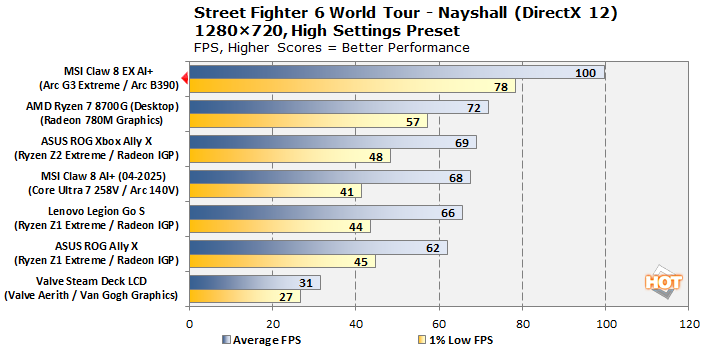
In Street Fighter 6 we see another absolute victory for Intel, as the Arc G3 Extreme absolutely blows past every other system we tested. The Nayshall area of SF6's World Tour mode is extremely densely populated, with dozens of NPCs milling about, and an incredible amount of detail in the environment. We have the game on High settings, so that detail is preserved, and this result is awesome. This is the first handheld we've tested that can maintain a perfect 60 FPS during regular 1-on-1 online play matches, too, which is outstanding.

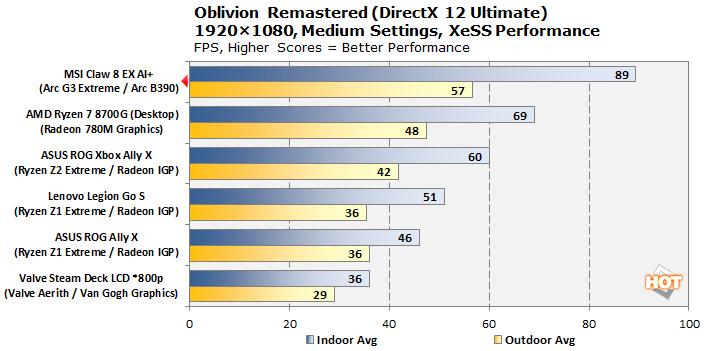
In the Unreal Engine 5-powered pseudo-remaster of The Elder Scrolls Part IV: Oblivion, the Claw 8 EX AI+ delivers nearly 60 FPS outdoors, which is stunning considering the visuals on display. Take careful note that this isn't averages and 1% lows like usual, but rather indoor and outdoor frame rates. This is another one where we'd probably apply a framerate cap, or simply raise settings for improved visuals. XeSS does a great job here, though.

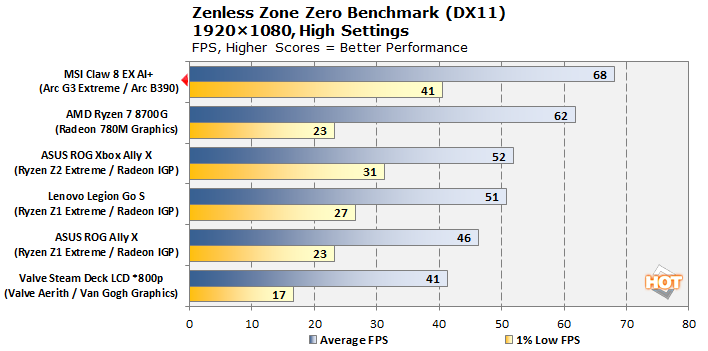
Finally, in Zenless Zone Zero, the MSI Claw 8 EX AI+ steps out ahead with an average that barely beats the desktop part, yet a vastly superior 1% low score. Zenless Zone Zero is a mobile game, so you might think that it's well-suited to these integrated GPUs, but the Windows port supports higher settings than the mobile version and it looks pretty sharp on a system that can handle its high settings. Every machine here suffers from somewhat poor frame pacing; that's developer Hoyoverse's fault, not AMD or Intel's.

Intel claims that its chip is 42% faster than AMD's Ryzen Z2 Extreme when both are set to 35W. In our testing, it's closer to 39.6%, but that's close enough given that we didn't test the same titles Intel did. These are the results of Intel's foundry work as much as its chip design team; the Arc G3 Extreme benefits tremendously from its most power-thirsty parts being fabricated on Intel's 18A process. That's a full two nodes ahead of the 4nm process that AMD's parts were made on.
It's no real surprise that Intel's chip, a full two nodes and two years newer than AMD's, is faster. However, AMD isn't going to have a mainstream answer to this for at least six months and potentially even longer. Sure, there are the Ryzen AI Max processors that offer better performance, but the power consumption and efficiency of those parts isn't in the same ballpark as the Arc G3 Extreme.