

HP Omnibook Ultra 16 Review: An All-Aluminum RTX Spark Portable AI Powerhouse


HP OmniBook Ultra 16 Internals, Thermals, And Noise
Flipping over the OmniBook Ultra 16, we're greeted with a flat surface that is about half fan grille, with rubber feet top and bottom. There's some regulatory information and a QR code that takes you to the support page for this specific model; this is a nice touch that's quickly becoming standard practice in the industry.
There are four tiny screws to remove if you want to get into the thing, placed squarely at the four corners of the bottom casing. None are captive screws, so be careful you don't drop one like I did. (I found it, don't worry.) Once you remove these screws, nothing happens because the bottom is held onto the machine with an unbelievable number of clips that you'll have to carefully pop with a spudger or similar tool.

After you're done popping all the clips the base of the machine will eventually come loose and you're greeted with this internal view. There's honestly nothing to see here. On the left is the M.2 slot, and you can technically replace the SSD if you want, but the included drive is one of the very fastest on the market. There's no second slot, and the memory is soldered down, so ultimately unless you're replacing a faulty component or dead battery, there's really not much reason to get into the thing.
Be very careful when putting the bottom cover back on, because you'll have to re-do all the snaps before you screw it down; otherwise, the snaps become impossible to get into place and it's very easy to bend them out of place.
So with all that cooling hardware, how is the thermal performance?

Pretty darn great, actually. While under a heavy CPU and GPU load (running Cinebench and Cyberpunk 2077 simultaneously), the RTX Spark SoC reached a peak temperature of 97.7°C, which is very warm, but still under the machine's thermal limits. The GPU temperature somehow stayed at a relatively chilly 77°C. Curiously, neither CPU nor GPU usage ever hit 100%; not sure what that's about, but it could just be the reporting tool not reading sensors properly on the platform just yet.

Even more impressive is that the machine stays whisper quiet even under such a heavy workload. Even the max value of 48.5 decibels here is very pleasant, and the average of 41.1 decibels across the benchmark period is basically inaudible in a typical environment. HP knocked it out of the park with the cooling design on this machine.
How Is The HP Omnibook Ultra 16's Battery Life?
Battery life is critically important for a mobile PC. Being productive on the go could mean long stretches away from power outlets, so the machine needs to last through hours of work--whether it's for writing e-mails or poring over spreadsheets. Binging on content during long flights is another common use case. Here we've calibrated the laptop displays to a similar fixed brightness in an effort to minimize that aspect of power draw, though lots of other variables come into play, like battery capacity, or the number of integrated peripherals in a system, for example.
With this particular test, battery life falls down into the lower-third of the test group, similar to the Microsoft Surface Ultra, although it's important to keep it within its context. Comparing this machine to other systems with integrated graphics, it generally doesn't have great battery life, but the performance of this system's integrated graphics is a world apart from most of the others. Yet, it's not actually that different from the ASUS ROG Flow outside of AI workloads, and that machine is only just behind despite having a considerably smaller battery. Let's look at the efficiency metrics, which take battery size into account.

It beats the Alienware 16 Area-51, but that machine has desktop-class parts and discrete graphics, so it's not really apples to apples. The ultimate conclusion is that RTX Spark is a powerful, thirsty SoC and it's in a similar situation to the ASUS ROG Flow. In our review of that machine, we remarked how it lands in an odd middle area, offering better performance than typical integrated GPU thin & lights, and better battery life than discrete GPU gaming laptops. RTX Spark systems seem to fall into that same odd middle ground in terms of battery life.
What Do We Think About The HP OmniBook Ultra 16?
Indeed, in the pre-release briefing for the OmniBook Ultra 16, HP specifically emphasized the "middle ground" nature of this machine, noting that professionals will likely buy a Zbook, while gamers will flock toward the HyperX range, both of which we're quite fond of. The OmniBook Ultra exists to serve a hypothetical third market of tech savvy customers who want a high-end laptop with the features of an AI workstation but the portability of a thin & light.In that goal, the OmniBook Ultra 16 broadly succeeds. The battery life is middling and it's both heavier and thicker than your usual boardroom weapon, but it wouldn't look out of place at all, and it's so quiet, it won't start wheezing and annoy everyone. Performance-wise, it's mostly beyond reproach; while Intel and Qualcomm machines offer superior web and application performance in some scenarios, you probably won't perceive any issues while you're actually using this system in the real world.

The question is, who is this system really for? People who want big GPU grunt are probably going to prefer discrete GPUs, and people who want desktop-replacement horsepower will probably gravitate toward something with more I/O and better upgradeability. The software ecosystem is also a consideration. Microsoft's Prism emulation is outstanding, but there is a performance hit when running x86 applications, and you can't get around that as a power user on Windows. Though, the situation has improved significantly in the last couple of years and is not a concern if your most commonly used apps are offered in Arm-native versions.
All that is to say that this laptop costs over six thousand U.S. dollars, and as nice it is—and it is really nice—it's tough to justify that kind of investment, besides perhaps that of an AI developer who needs 128GB of RAM to run the models he's using and who also needs to be able to work on his AI stuff on the go. If that's you, then this, or potentially one of the other RTX Spark machines, is your laptop. If you simply want a high-end laptop for typical school or office use, this system is gross overkill for that, and if you want a high-end gaming experience, a purpose-built gaming laptop would be a better choice.

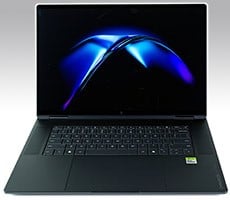
I hope that doesn't come across too negative, because I dig so much about this system. The HP Omnibook Ultra 16 is a beautiful laptop in many ways and it's undeniably powerful. It's just ideally suited to a relatively small segment of users. I suspect that, like many unusual tech products, there will be a rabid audience who absolutely adores the RTX Spark and indeed the OmniBook Ultra 16. There are certainly reasons to be crazy about it: the exterior design, premium materials, the display, and the AI performance are excellent.
There are lower-cost versions of the OmniBook Ultra 16 available, of course; the entry-level machine has the slightly cut-down N1X (with 18 cores and a 40-SM GPU), 32GB of RAM, and a 1TB SSD. It costs $3,199.99. I'm positive it's also quite a nice laptop, but the issue with getting an RTX Spark with less memory is that you're giving up one of the main things that really makes this machine exceptional, which is the large local memory for large AI models. While not quite as flexible, a systeam like this with 64GB of RAM would still be quite nice for local AI, and even a 32GB SKU will work fine for games, general use and smaller AI models. But then, for $3,199, you can buy a lot of laptops that do all of those things well.
Some of the stiff pricing is down to the ongoing RAMpocalypse. But the truth is that the GB10 Superchip the RTX Spark is based on is an extremely large processor and systems sporting it were always going to command a price premium. So ultimately, we're right back where I was 300 words ago: if this system's unique strengths are appealing and ideal for your workflow, go get one.