



Windows, Surface And RTX Spark Event: Everything AI Microsoft Unveiled


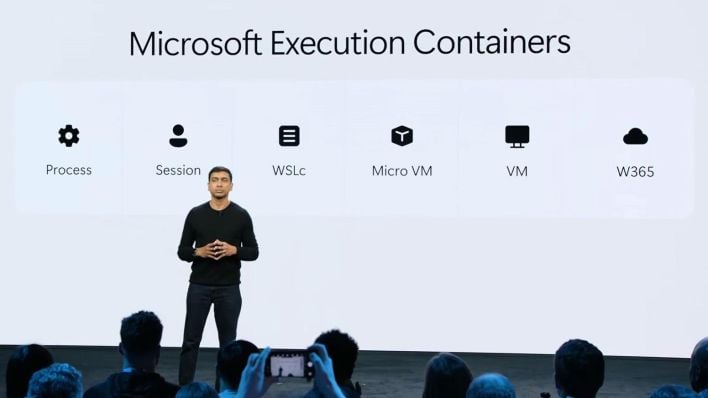
Satya Nadella and Pavan Davuluri kicked off the event, and much of the early keynote focused on securing AI agents. To that end, the company is moving its Microsoft Execution Containers (MXC) out of beta and into general availability. MXC is a policy-driven sandboxing layer for AI agents that enforces boundaries on what agents and code can access in terms of local files, network resources, and tools, across not only Windows, but Linux and macOS as well.
Microsoft also discussed its Agent 365 IT control platform, which was initially launched back in May. Microsoft Agent 365 is an enterprise-targeted control plane for AI agents that lets IT admins discover, monitor, and govern AI agents running across Windows and cloud environments. Microsoft Entra, Defender, and Purview are all core Agent 365 integrations, furthering the initial AI security and guardrail message of the event.
Another tool featured at the event targeted at the enterprise market is Microsoft AutoPilot, which Pavan called the first "enterprise-grade, long-running agent”. Microsoft AutoPilot is a cloud-based Windows provisioning system that automatically configures new devices using Intune policies to quickly streamline system setup for enterprises.
Project HydraFusion was also demoed at the event, specifically highlighting agentic AI-assisted coding workflows. HydraFusion is a GitHub Copilot multi-model orchestration system that will dynamically choose the best workflow to solve a coding task. It evaluates each request, drafts with the most efficient models, and escalates tasks only when needed to produce higher-quality results. Project HydraFusion is designed to optimize quality, latency, and cost by intelligently coordinating multiple models, whether local or in the cloud, at runtime. Here's a video of GitHub Copilot in action from the event to give you a sense of its capabilities and performance.
Pavan also revealed that llama.cpp, the popular open-source C/C++ framework for lightweight local inference, is coming to Windows ML, and that Meta’s Muse personal AI agent is also coming to Windows as a native app later in the year. Microsoft’s MAI Code 1.1 Flash, DeepSeek V4 Flash and new NVIDIA Nemotron local models are on the way, too.
Windows 11 Is Getting Deeper AI Integration In A Future Update
Furthermore, a number of new features or more streamlined AI integrations are coming to the Windows UX. Coming with a fall update, users will be able to initiate many more actions directly from the search bar. The search bar is often the first stop for Windows users looking for app or feature shortcuts, so Microsoft is surfacing more actions directly in "search" results. For example, users will be able to take screenshots, arrange windows, or even send text messages (assuming your phone is linked to Windows) right from the search pane.Windows Search will also apparently be able to connect directly with Copilot, and Copilot – with user permission – will also be able to access three new things: local context, local action, and local models. Copilot will still leverage the cloud for more complex tasks, but it will gain the ability to work locally, even when a system is completely offline, for more sensitive tasks.
Finally, a new Get Started experience will also be coming to Windows 11, though it’s not clear if or how long it will be exclusive to RTX Spark-based systems. The new Get Started experience will enable auto-setup of popular AI agent platforms right out of the box, upon first boot. As OpenClaw is one of the platforms, simplified OpenClaw setup is coming to Windows as well.
RTX Spark Powered All Of The New Systems On Display
That's it for the software updates, so now, let's go over the new hardware. Following on from the announcement at Computex this year, NVIDIA and Microsoft, as well as many of its partners, have jointly announced the launch and availability of the first wave of laptops based on the NVIDIA RTX Spark processor, as well as the Surface RTX Spark Dev Box and the new DGX Station for Windows. These announcements took place at a special gathering for industry and press in San Francisco, and our EIC Dave Altavilla is on the scene.
These machines are going to look pretty familiar if you're aware of the capabilities of the DGX Spark and acquainted with Apple's MacBook Pro family of laptops. The Surface Laptop Ultra, in particular, is a shot directly across Apple's bow; with a similar aesthetic, superior connectivity, magnetic charging, and similar prices, too: the base model starts at $2,599 for a model with the weaker 18-core CPU and 40-SM Blackwell GPU plus 24GB of unified RAM, and goes all the way up to $5,899 for the top-end variant with 20 cores, 48 SMs, and 128GB of RAM.

We're not going to go over the full specifications of the RTX Spark here; if you're unaware, you can hit up our previous coverage for those answers. Suffice to say that it's an Arm SoC featuring interconnect technology from the company's Grace Blackwell server processors and using the very same Blackwell graphics architecture from its RTX 50 Series graphics cards. It's the same GB10 Superchip found in the NVIDIA DGX Spark and its relatives.

In addition to the Surface Laptop Ultra, there are also systems from many ODMs on display at the gathering in San Francisco. ASUS has two models of ProArt laptops, Dell is showing the XPS 16 Creator Edition, HP has the OmniBook Ultra 16 it previously revealed, Lenovo brought the Yoga 9n 2-in-1, and MSI came with the Prestige N16 Flip AI+, another 2-in-1 with a huge battery. All of these machines are available for pre-order today, and will begin shipping next week, on October 16th.
While on-site, we also got the chance to see the Microsoft Surface Ultra laptop powered by the NVIDIA RTX Spark in action, running the latest Gears Of War: E-Day. Even though the game was running under Prism emulation, it hits 60 FPS natively at 1440p, but with DLSS 4.5 and dynamic framegen it maintains a locked, 120 FPS to maximize smoothness on the display.
RTX Spark Isn't Just For Laptops

Besides the laptops, Microsoft also unveiled the Surface RTX Spark Dev Box and the DGX Station for Windows. The Surface RTX Spark Dev Box is exactly what the name implies: a small, developer-focused system based on the RTX Spark processor. While the comparison to the DGX Spark is obvious, this machine doesn't appear to integrate the high-end networking of that box and seems to have more consumer-oriented features. It certainly has a striking visual design. You can pre-order one of these machines with the full-fat N1X processor, 128GB of RAM, and a 2TB SSD for $5999.99; it will be shipping sometime in November, according to the store page.

On the other hand, the DGX Station for Windows is quite a different beast. Described as a "deskside supercomputer", this machine is much more akin to the Dell Pro Max GB300 workstation that we saw back at CES. Indeed, Microsoft mentions both that system as well as the HP ZGX Fury AI Station in its blog post announcing all of this hardware. There aren't as many details out right now about these machines, but they're not up for pre-order yet, either.





