Alienware Area-51 Review: Ryzen 7 9850X3D Powered Elite Gaming


Screaming fast PCs don't have to literally scream these days. Big fans and open cooling designs can push a lot of air around without adding a ton of noise. That used to be reserved for hand-built systems and boutique builders' liquid cooling setups, but quiet is now mainstream. So when we set up our noise meter about 12 inches from the intake on the side of the system and looped 3D Mark Time Spy for a half hour, we were not surprised to find that it stayed well below 50 dBA. It was more like 46-47 decibels in sound pressure, which is quite nice, considering how much power it takes to feed the GeForce RTX 5090.
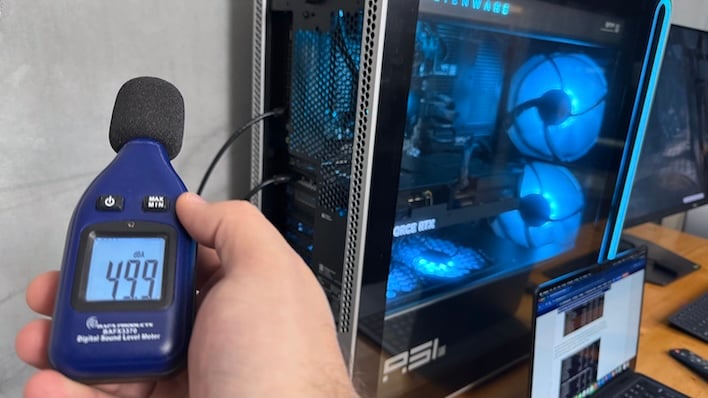
And when we moved around the rear of the system, about 12" from the exhaust--which is just about the worst case scenario--it wasn't really any louder. It came close to 50 dBA but rarely did it go beyond that. This system is definitely quieter than most high-end gaming laptops, and on par with premium desktops with similar hardware. This was all measured on the Balanced setting, but bumping up to Performance didn't have any appreciable noise impact.
A quiet system doesn't matter if the thermals get out of control, though. So how did it do? We kept HW Monitor running during the Time Spy loop, and this is what it had to say about the GeForce RTX 5090.
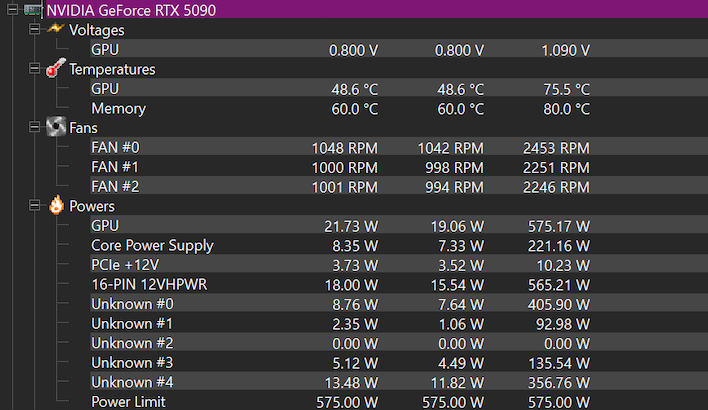
The GPU topped out at 75.5°Celsius while the memory hit 80°C. The card had no issue hitting its own 575 Watt total power limit in that time, and the fans were able to keep up. This is exactly what one would expect from this graphics card.
The thing about Time Spy is that it doesn't put a ton of pressure on the CPU so to test the cooling performance of the Area-51's 360 millimeter cooler, we cranked up the multi-threaded Cinebench 26 for a half hour. As that run finished up, HW Monitor had this to say.
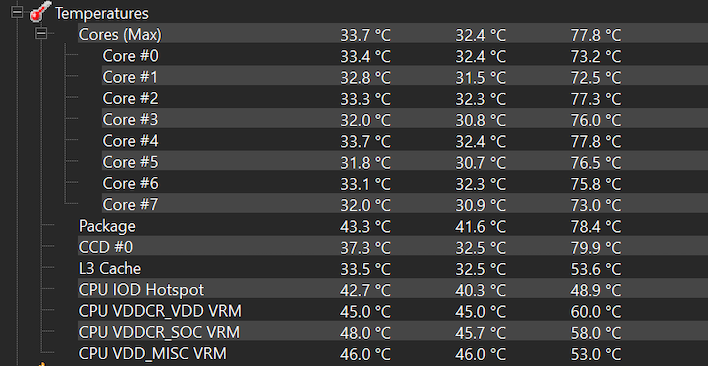
These results are surprising. The Ryzen 7 9850X3D has a maximum temperature rating of 105°C, but the CPU never even made it to 80°C under that heavy Cinebench load. My own personal Ryzen 7 9800X3D can hit 88°C with a Be Quiet! Dark Rock Pro 5, so the Area-51 was pretty impressive in how it kept the CPU cool.

While surface temps aren't as important to a desktop as they are laptops where a user physically touches the machine to use it, we still wanted to get a feel for the air coming out of the system. In a word, we'd describe it as "warm" to be sure. Measuring the surface of the rear vent, we found it hit around 45°C, which is completely expected when you've got a 600 Watt GPU to cool. The cooling is doing its job by expelling heat, and we could measure it on the surface.
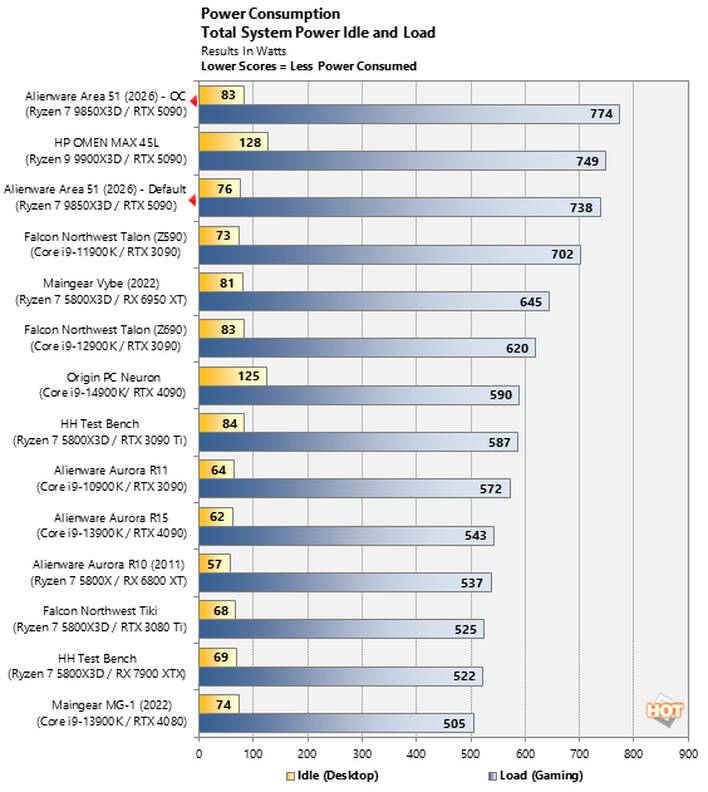
So the Area 51 isn't loud, and it doesn't overheat. How much power does it need? We tested at idle as well as watching our Time Spy 30-minute loop, and reported both figures below.

Alienware Area-51 with AMD X3D Conclusions
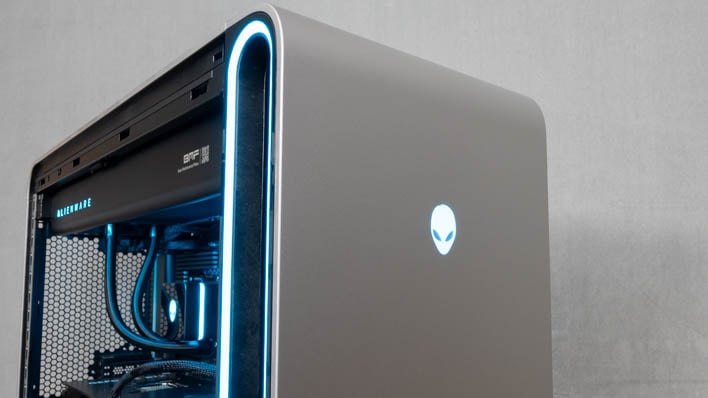
We've tested, we've investigated, we've played lots of games, and we've thought long and hard about the Alienware Area-51 and think it's a pretty solid gaming system. To start with, the Legend 3 chassis and industrial design looks great and has plenty of lighting options without getting terribly gaudy. The build quality is extremely good, and the cable management was great. Component selection for the test unit was nicely balanced to get the most performance in virtually any scenario.If the Area-51 felters anywhere, it's with internal expansion. While there are three NVMe M.2 slots, there's nowhere you could stick a PCI Express capture card that supports 4K 144 Hz capture. Popular options like the Avermedia 4K Ultra (which lives in my personal machine, for example) and Elgato 4K X both need PCIe x4 slots. SATA storage is alright, we suppose, but there's no room for multiple hard drives for folks with large media collections. There's also just a pair of DIMM slots, so adding memory is challenging, though on DDR5 systems, that often comes with slower speeds to keep things stable. Then again, this is a gaming system, and that can all probably be overlooked given the target audience. There aren't too many downsides to this system.
But there is another thing to consider, and that is cost. As configured with the AMD Ryzen 7 9850X3D, NVIDIA GeForce RTX 5090, 360-mm AI cooler, 64 GB of RAM, 2 TB PCIe 5.0 boot drive, and Windows 11 Pro, the total cost is inching upwards of $6,100. Now, some of these upgrades can be trimmed off to make the system more attainable. The GeForce RTX 5090 adds $1650 over the base 5070 (including the required PSU upgrade), while the base Ryzen 7 9700X would save $150 and dropping down to 32GB of RAM would trim another $500. The base model starts at $3479 with 32GB of RAM, 1TB SSD, and the aforementioned Ryzen 7 9700X and GeForce RTX 5070. Even that pricing is pretty solid in today's market. Trying to buy an equivalent system in parts via PC PartPicker consistently resulted in something a few hundred more expensive than the Alienware Area-51.
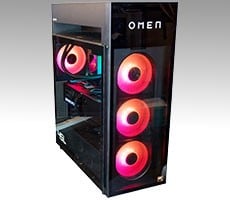
On the other hand, you're actually getting a GeForce RTX 5090 for retail price rather than the insane markups that most storefronts are putting on them right now. Somehow this might actually be the cheapest way to get the fastest graphics card on the market. So if you need a whole system, you might as well go all out, right? Building an equivalent system on Amazon pushes $7,000 right now so why not save $900? It's just a terrible time to be buying PC hardware. Alienware made the best of a bum situation, though, by keeping pricing as reasonable as possible. In fact, if we wanted to spend more, we could bump it up to the Ryzen 9 9950X3D found in the HP Omen Max 45L Desktop and actually come in a couple hundred less than that system.

In the end, the question comes down to building vs. buying, and upgrading vs. going brand new. If you're on an older system, like a DDR4-based system with a Ryzen 5000 series CPU and a GeForce 3000 series graphics card, you're probably starting to daydream about something new. In this tough market, going pre-built from Alienware is both a high-performance option as well as a relatively cost-effective one. Being able to upgrade in the future with use of ATX12VO hardware is a nice cherry on top, as well. And if that describes you, then hold on tight: the Alienware Area-51 with AMD X3D CPUs gets a HotHardware Editor's Choice award.