OnePlus 15 Review: Has The Flagship Killer Finally Settled?

OnePlus 15 Reception And Sound Quality

On the audio front, the OnePlus 15 packs a pair of stereo speakers that sound great, but don’t quite match the Pixel 10 Pro XL’s excellent speakers. Spatial audio is available of course, but Dolby Atmos isn't, and obviously, there’s no headphone jack. This phone supports LHDC, LDAC, and aptX HD codecs for high-resolution wireless playback via Bluetooth, plus digital and analog accessories for wired listening over USB Type-C.
OnePlus 15 Performance And Benchmark Results
Between Qualcomm’s mighty Snapdragon 8 Elite Gen 5 flagship 3nm SoC, a triple-layer cooling system, the aforementioned 165Hz display, and dedicated Wi-Fi 7 and touch-controller chips developed in-house, OnePlus is leaning hard into performance and gaming with the OnePlus 15. This isn’t unusual for the company, but it reminds me of the marketing behind the OnePlus 10T back in 2022, which ended up being more of a gaming phone than an affordable flagship.In the OnePlus 15, the Snapdragon 8 Elite Gen 5 is paired with 12 or 16GB of LPDDR5x Ultra/Ultra+ RAM and 256 or 512GB of UFS 4.1 storage. A version with 16GB of RAM and 1TB is also available in some markets. That triple-layer cooling system, which OnePlus calls 360 Cryo-Velocity Cooling System, consists of a screen cooler in the front, a massive 5,731mm2 3D vapor chamber in the middle, and a white graphite back cover.

While I’m very pleased with the OnePlus 15’s subjective performance, things took a strange turn when I started running our usual suite of benchmarks. If you look at the results below, the OnePlus 15 is all over the map, sometimes matching expectations, other times falling short. Enabling High Performance Mode in the settings made little difference. HotHardware’s editor-in-chief, Dave Altavilla, confirmed my findings on his review unit as well.

I reached out to OnePlus about this issue, and received the following statement:
“In everyday use – whether multitasking or heavy-duty gaming – the units run within normal thermal limits; we’ve received no reports of excessive heat.
Snapdragon 8 Elite Gen 5 delivers our highest peak performance yet, so in prolonged, all-out workloads it reaches the thermal ceiling sooner. We are already refining the thermal curve so that our peak performance remains uncompromised while surface temperatures stay comfortable.”
OnePlus 15 Geekbench Results
GeekBench is a cross-platform benchmark that simulates real-world processing workloads in image processing and particle physics calculation scenarios. We tested all of the smartphones featured here with GeekBench's single and multi-core workloads.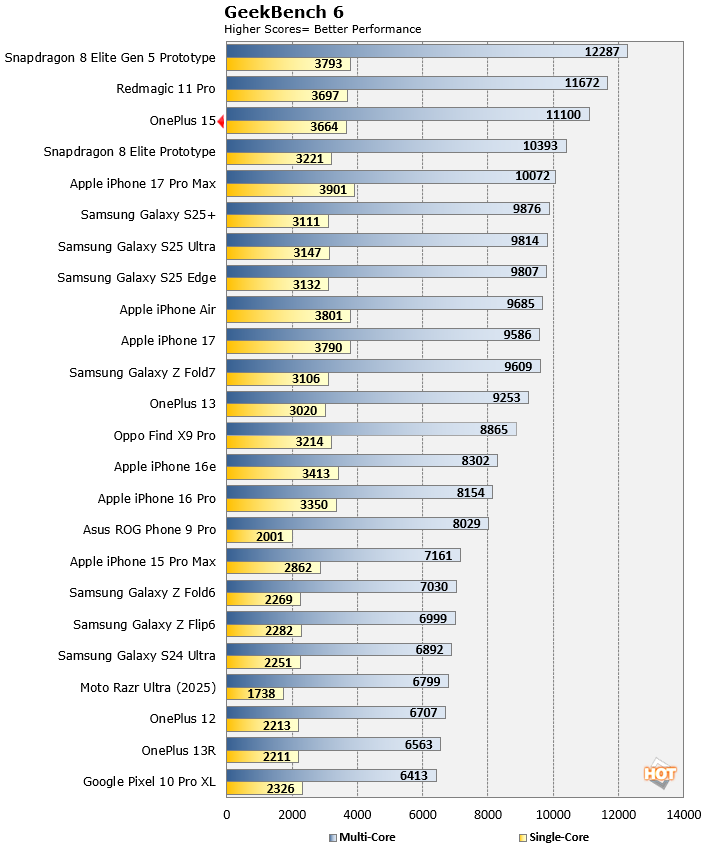
OnePlus 15 AnTuTu 8 Benchmarks
AnTuTu’s latest benchmark returns a number of metrics ranked with somewhat nebulous scores, rather than frame rates or time to complete. Here we're running the latest version of AnTuTu across multiple Android devices. AnTuTu returns four top level performance results which are all included here: CPU, RAM, 3D, UX (or User Experience), along with a total score.
According to AnTuTu, the OnePlus 15 offers an notable increase in performance vs. previous generation Android handsets, slotting right below Qualcomm's Snapdragon 8 Elite Gen 5's prototype in terms of its overall score.
OnePlus 15 Graphics And Gaming Benchmarks Results
Now, let's take a look at how the OnePlus 15 stacks up in GFXBench, which has been one of the standard mobile graphics/gaming performance benchmarks for years. To ensure that display refresh (v-sync) and resolution aren't limiting factors, we're comparing off-screen test results here. GFXBench tests OpenGL ES graphics workloads and we're specifically testing OpenGL ES 2.0 and 3.0, as well as Vulkan in the latest iterations.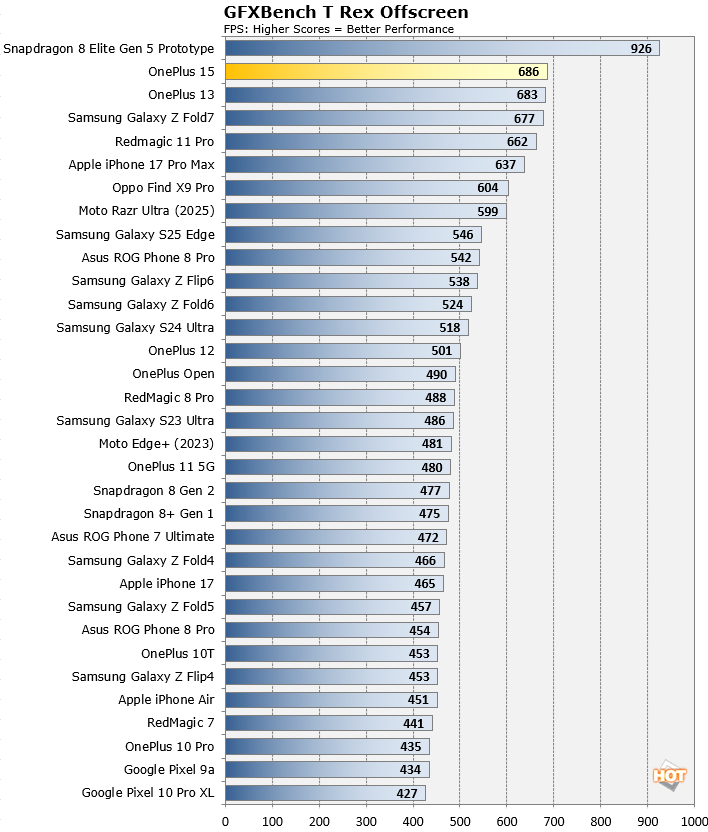
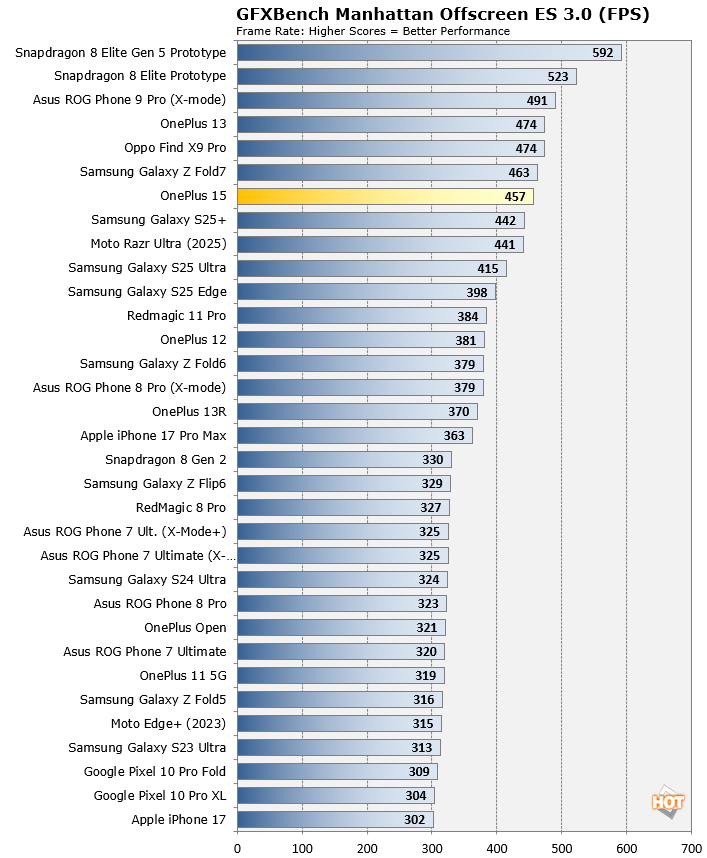
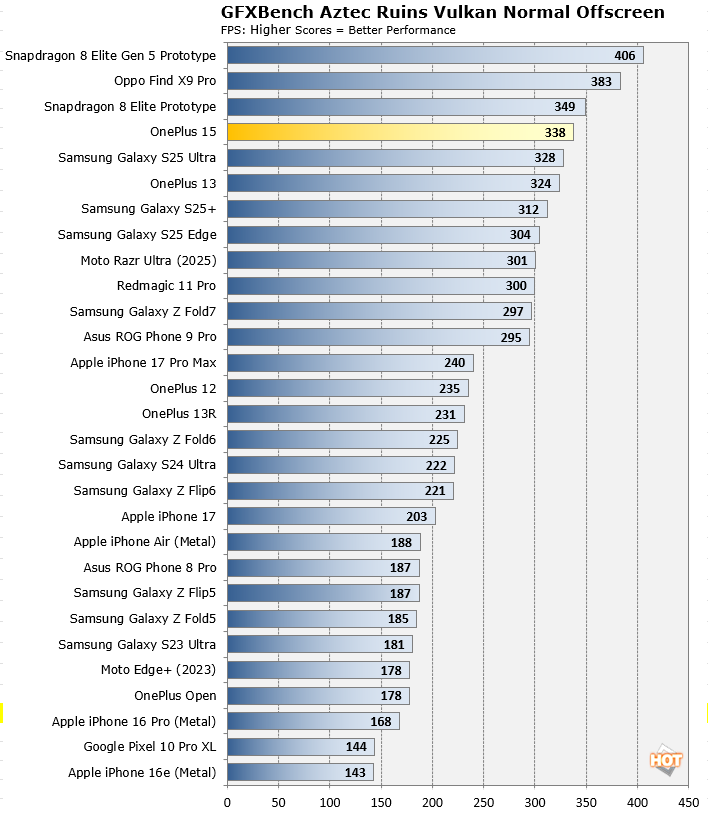
Unfortunately, we're not seeing the kind of performance improvement we expected from a Snapdragon 8 Elite Gen 5-equipped device like the OnePlus 15. This phone performs about the same as Snapdragon 8 Elite-powered devices like Samsung's Galaxy S25 Ultra and Galaxy Z Fold7 in these graphically rich, gaming-oriented benchmarks.
OnePlus 15 3DMark Wild Life Benchmark Tests
3DMark Wild Life is the latest cross-platform test from UL. Its
primary purpose is to measure GPU performance across platforms, and two
distinct tests are available. The standard Wild Life test is designed to
give feedback on how a game performs over a short period of time. With
mobile games, people typically play in brief spurts when they find some
free time; be it on the bus, on the subway, or a quick battle royale
session over lunch break. The 3DMark Wild Life Stress Test, on the other
hand, shows how a device performs over a longer stretch of time, and
takes note of performance degradation that might crop up due to
increased heat levels and throttling.
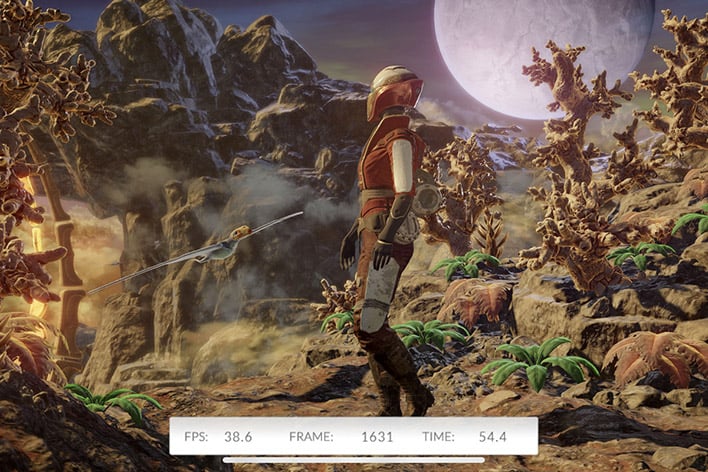
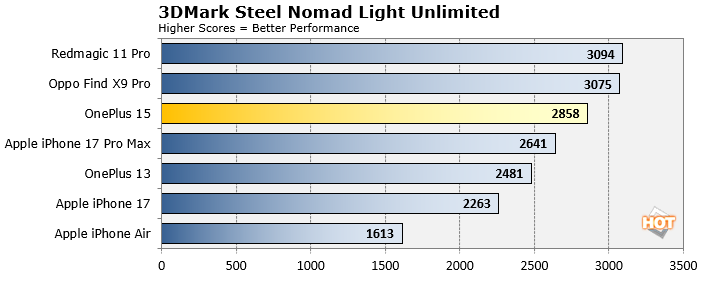
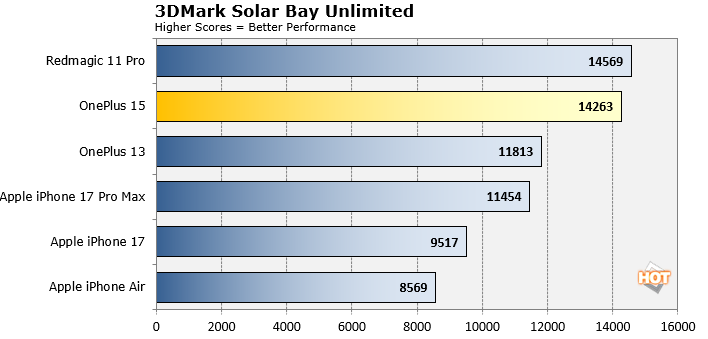
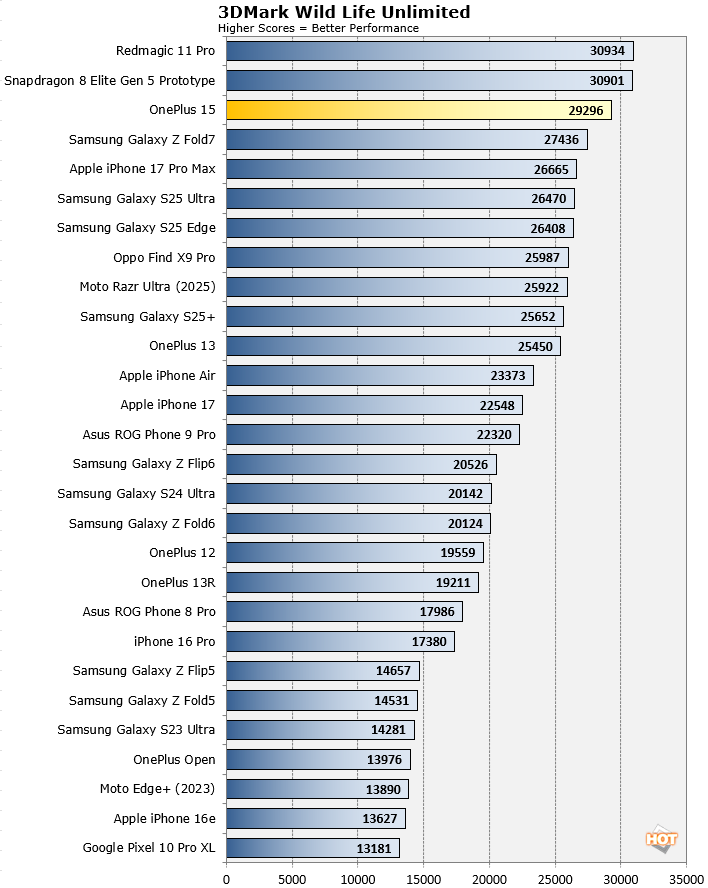
3DMark Wild Life is a significantly more taxing graphics benchmark
that employs cutting-edge mobile game engine technologies to deliver
impressive visuals -- as you can see in the screen shot above. Here the Snapdragon 8 Elite Gen 5-powered OnePlus 15 delivers a big gain in performance versus the fastest Snapdragon 8 Elite-equipped devices like Samsung's Galaxy Z Fold7.
OnePlus 15 Performance Over Thermal Saturation


The OnePlus 15 does exhibit some throttling in the
Wild Life stress test, but still achieves a stability score of 76.9%. It does worse in the Solar Bay Stress test with a stability score of just 66.4%, but performs significantly better in the Steel Nomad Light stress test, managing a stability score of 79.8%. It's worth noting that in this last stress test, the OnePlus 15 gets extremely hot to the touch, and doesn't always complete the benchmark.
OnePlus 15 Additional Features And Battery Life
The OnePlus 15’s specs are exhaustive, and include sub-6GHz 5G, CAT 22 LTE, eSIM support, dual-band Wi-Fi 7 (802.11be, 2x2 MIMO), Bluetooth 6.0 (LE), NFC, and dual-band A-GPS, GLONASS, BeiDou, Galileo, QZSS, and NavIC positioning. Biometrics are handled by a fast and reliable ultrasonic in-display fingerprint reader, alongside standard face unlock. The linear vibration motor delivers superb haptics, and completes the package.
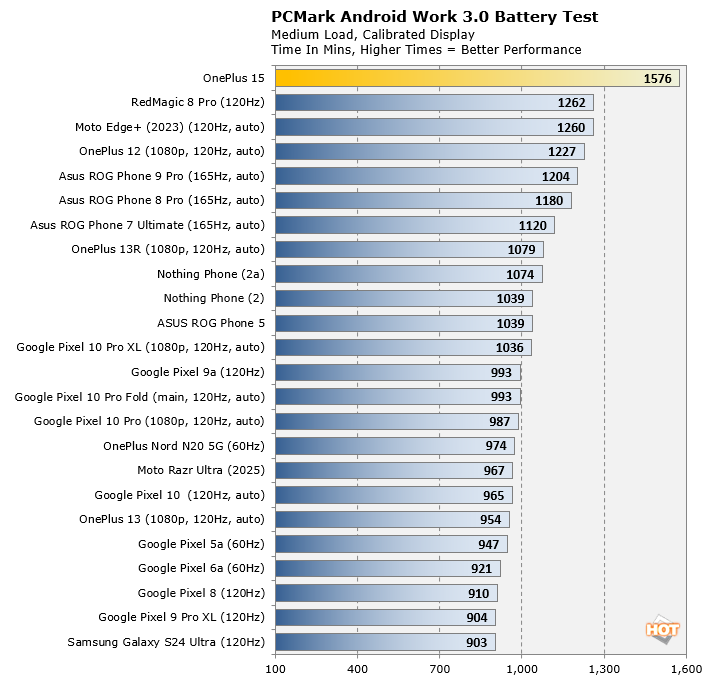
What if your smartphone could last two days on a full charge – three days with light use? The OnePlus 15 can, thanks to a gigantic 7,300mAh battery that’s made up of two 3,650mAh silicon-carbon cells (for faster, parallel charging). In our PCMark Work 3.0 battery test, the OnePlus 15 lasted an unprecedented 26 hours and 16 minutes, making it our new endurance champ. That's simply beyond outstanding or even spectacular: it's just incredible battery life!
Next up: software, AI, and review summary...