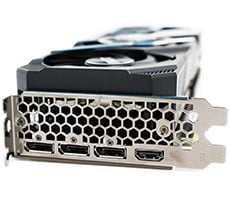
Gigabyte GeForce GTX 680 Super OverClock Review

Before bringing this article to a close, we'd like to cover a few final data points--namely, power consumption, temperatures, and noise. Throughout all of our benchmarking and testing, we monitored acoustics and tracked how much power our test system was consuming using a power meter. Our goal was to give you an idea of how much power each configuration used while idling and also while under a heavy workload. Please keep in mind that we were testing total system power consumption at the outlet here, not just the power being drawn by the graphics cards alone.

Total System Power Consumption
Tested at the Outlet

Somewhat surprisingly, despite being outfitted with five cooling fans and being clocked much higher than the reference card, the Gigabyte GeForce GTX 680 Super OverClock consumes only slightly more power. While idle, the Gigabyte card consumed only 4 more watts, and under load that delta shrunk to only 2 watts.  Also note that the GeForces consume significantly less power than the Radeons, hinting at the GeForces' better power efficiency.

We also monitored temperatures throughout testing and were somewhat impressed with the Gigabyte GeForce GTX 680 Super OverClock's cooling. The oversized, triple-slot wide cooler and five fans clearly outperform the two-slot reference cooler; Gigabyte's card was a full 13'C cooler under load. Further, in real-world conditions, the Gigabyte card's cooling fans never spun up past 48%. The five small fans on the GeForce GTX 680 Super OverClock, however, emit an audible high-pitched whine under load, which may irk some users. The card isn't loud in real-world situations, but it may be bothersome to users sensitive to certain sounds.


Marco Chiappetta

Marco Chiappetta

Marco's interest in computing and technology dates all the way back to his early childhood. Even before being exposed to the Commodore P.E.T. and later the Commodore 64 in the early ‘80s, he was interested in electricity and electronics, and he still has the modded AFX cars and shop-worn soldering irons to prove it. Once he got his hands on his own Commodore 64, however, computing became Marco's passion. Throughout his academic and professional lives, Marco has worked with virtually every major platform from the TRS-80 and Amiga, to today's high end, multi-core servers. Over the years, he has worked in many fields related to technology and computing, including system design, assembly and sales, professional quality assurance testing, and technical writing. In addition to being the Managing Editor here at HotHardware for close to 15 years, Marco is also a freelance writer whose work has been published in a number of PC and technology related print publications and he is a regular fixture on HotHardware’s own Two and a Half Geeks webcast. - Contact: marco(at)hothardware(dot)com

Related content