ASUS Zenbook A16 Review: Snapdragon X2 Elite Ultralight Game-Changer


To evaluate the Zenbook A16's real-world capabilities, we ran a mix of browser, productivity, content creation, and AI workloads, as well as some graphics and battery benchmarks. For this most recent round of refreshed mobile platform reviews, our team rounded-up an array of systems we had on-hand, reset and refreshed all of them, and fully updated the systems with the latest UEFIs, firmware, and Windows Updates. We then ran all of the latest versions of each of the benchmarks to gather fresh performance data to build upon for future reviews and analysis.
Speedometer 3.1 Web Application Performance
We use BrowserBench.org's Speedometer test to take a holistic look at web application performance. This test automatically loads and runs a variety of sample web apps using the most popular web development frameworks around, including React, Angular, Ember.js, and even simple JavaScript. This test is an example of how systems cope with real-world, modern web apps. All tests were performed using the latest version of Chrome.

The Zenbook A16 outpaced all of the other thin and light laptops we tested here--only a more powerful gaming laptop with a discrete GPU was faster, when on AC power. We also ran this test when on battery power.
When running on battery power, all of the systems bleed off some performance, but the Intel and AMD powered systems take a much bigger hit. Here, the Zenbook A16 take the top spot.
The Snapdragon X2 Elite Extreme-powered Asus Zenbook A16 put up some big numbers in Cinebench 2026. The Asus machine had the best singe-core score of the bunch and its multi-thread score crushed all of the thin and light laptops and even beat Strix Halo. Only the higher-power gaming laptop put up a higher multi-thread score.
When running on battery power, however, the Snapdragon X2 Elite Extreme-powered Asus Zenbook A16 takes the overall lead.
The Zenbook A16 also performed extremely well in Geekbench. The Asus Zenbook A16 once again lands on the top spot, offering the best single and multi-thread scores of the group.
Results are presented for three levels of numerical precision: single precision or FP32, half precision or FP16, and quantized or INT8. All results that the benchmark provides are geomean scores from multiple runs of each test workload. We've got CPU and NPU scores for you here.
The Zenbook A16 didn't fare particularly well in Geekbench AI's CPU benchmark. It was significantly faster than the original Snapdragon X Elite, but Intel and AMD have done much more optimization work for their CPU cores with this benchmark. Things look very different when testing NPUs with this benchmark, however.
The Snapdragon X2 Elite's single precision performance trails the other NPUs in this test, but its half precision score lands just behind Intel's Panther Lake. In the quantized test though, Qualcomm's 80 TOPs NPU in the Zenbook A16 decimated the Core Ultra X9 Panther Lake processor, when both are using their preferred frameworks and backends.
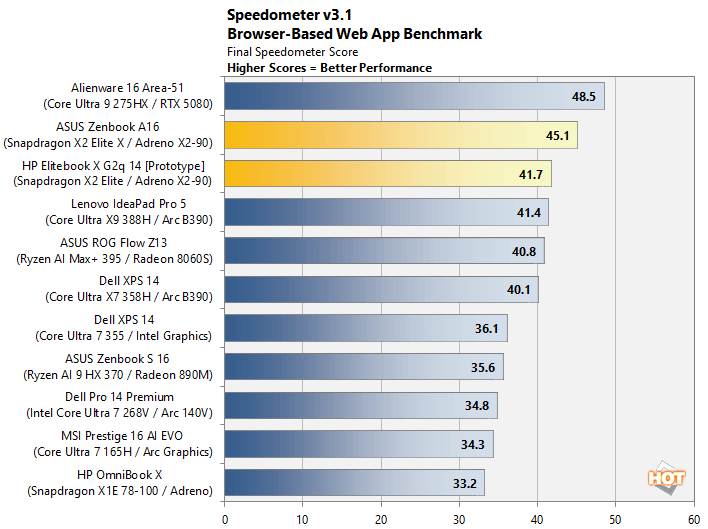
The Zenbook A16 outpaced all of the other thin and light laptops we tested here--only a more powerful gaming laptop with a discrete GPU was faster, when on AC power. We also ran this test when on battery power.
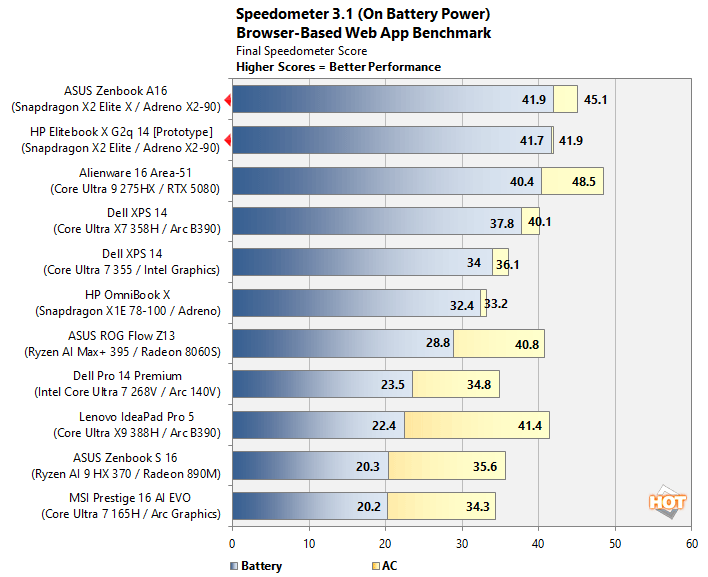
When running on battery power, all of the systems bleed off some performance, but the Intel and AMD powered systems take a much bigger hit. Here, the Zenbook A16 take the top spot.
MAXON Cinebench 2026 3D Rendering Benchmarks
Next up is the latest-generation 3D rendering benchmark from Maxon, based on the Cinema 4D rendering engine. It's a purely CPU-based test that doesn't make use of the graphics processor or NPU, and it scales very well with additional CPU cores. We ran both single- and multi-threaded tests on all of the machines in the charts.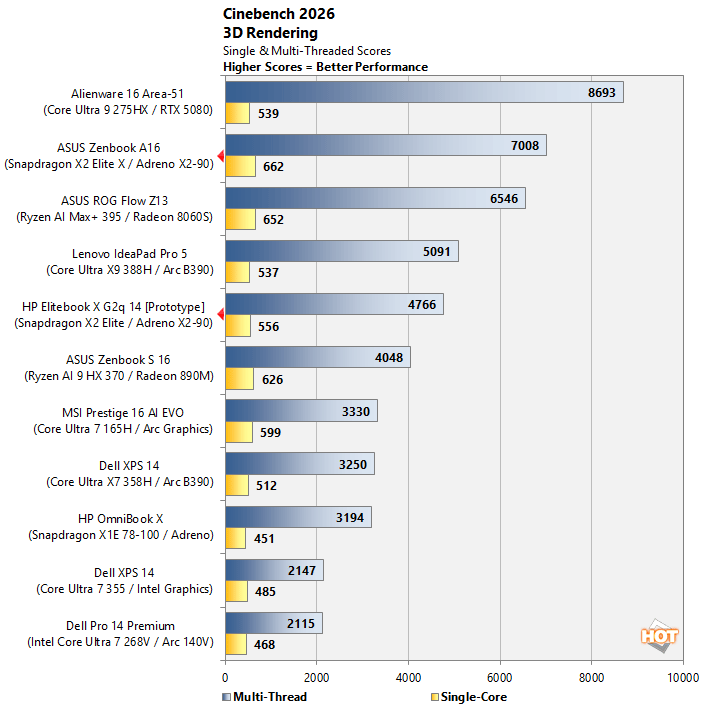
The Snapdragon X2 Elite Extreme-powered Asus Zenbook A16 put up some big numbers in Cinebench 2026. The Asus machine had the best singe-core score of the bunch and its multi-thread score crushed all of the thin and light laptops and even beat Strix Halo. Only the higher-power gaming laptop put up a higher multi-thread score.
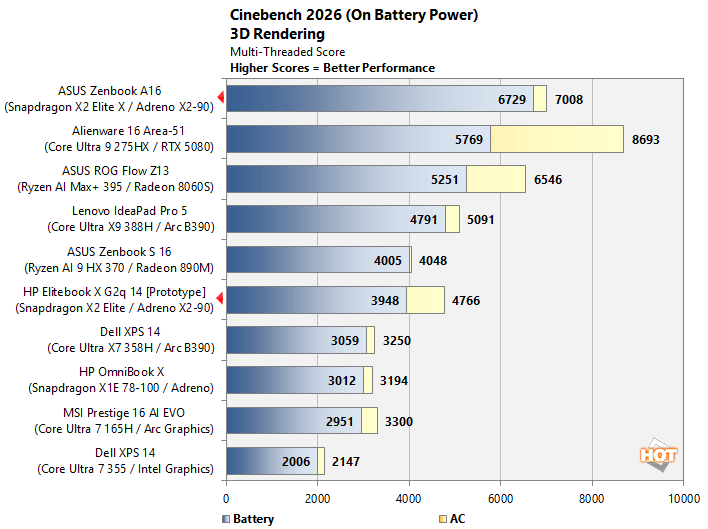
When running on battery power, however, the Snapdragon X2 Elite Extreme-powered Asus Zenbook A16 takes the overall lead.
Geekbench v6.5 CPU Benchmark
The Geekbench CPU tests stress only the processor cores in a system (not the graphics card/GPU), with both single and multi-threaded workloads. The tests are comprised of encryption processing, image compression, HTML5 parsing, physics calculations and other general purpose compute processing workloads.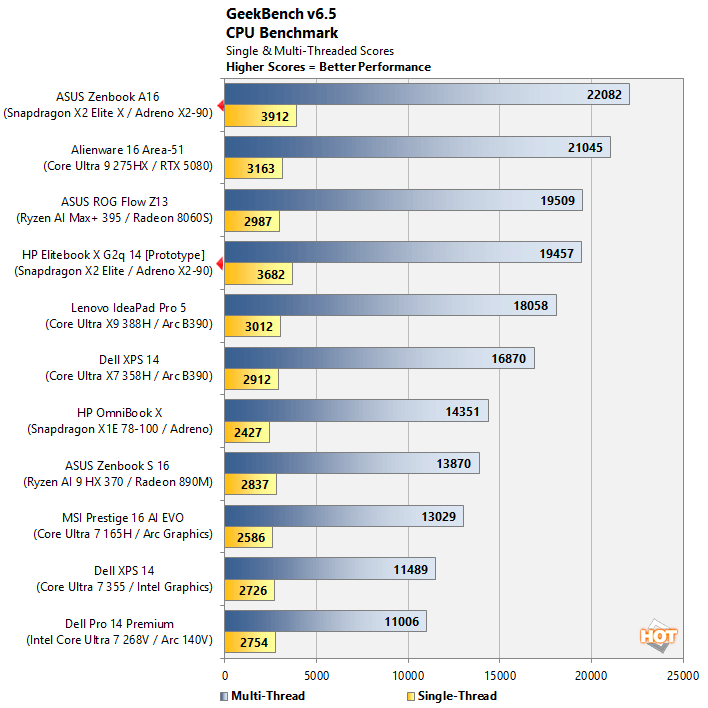
The Zenbook A16 also performed extremely well in Geekbench. The Asus Zenbook A16 once again lands on the top spot, offering the best single and multi-thread scores of the group.
Geekbench AI Machine Learning Benchmarks
The Geekbench AI benchmark provides a straightforward look at how well a device handles a variety of AI-assisted tasks. This quick and easy test gives you a numerical snapshot of a CPU, GPU, or NPU's ability to power through real-world machine learning workloads, factoring in both speed and accuracy. The higher the score, the better the device's AI chops, whether it's image recognition, object detection, or natural language processing.Results are presented for three levels of numerical precision: single precision or FP32, half precision or FP16, and quantized or INT8. All results that the benchmark provides are geomean scores from multiple runs of each test workload. We've got CPU and NPU scores for you here.
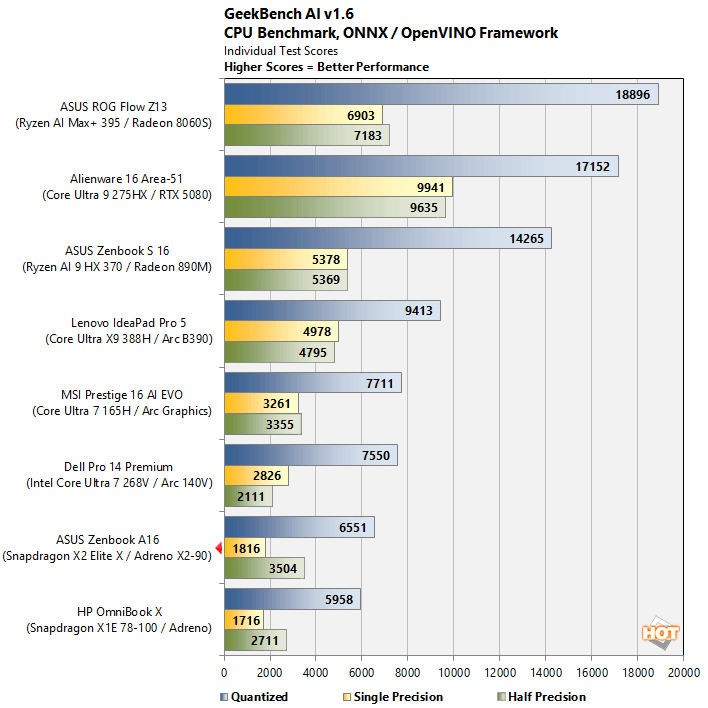
The Zenbook A16 didn't fare particularly well in Geekbench AI's CPU benchmark. It was significantly faster than the original Snapdragon X Elite, but Intel and AMD have done much more optimization work for their CPU cores with this benchmark. Things look very different when testing NPUs with this benchmark, however.
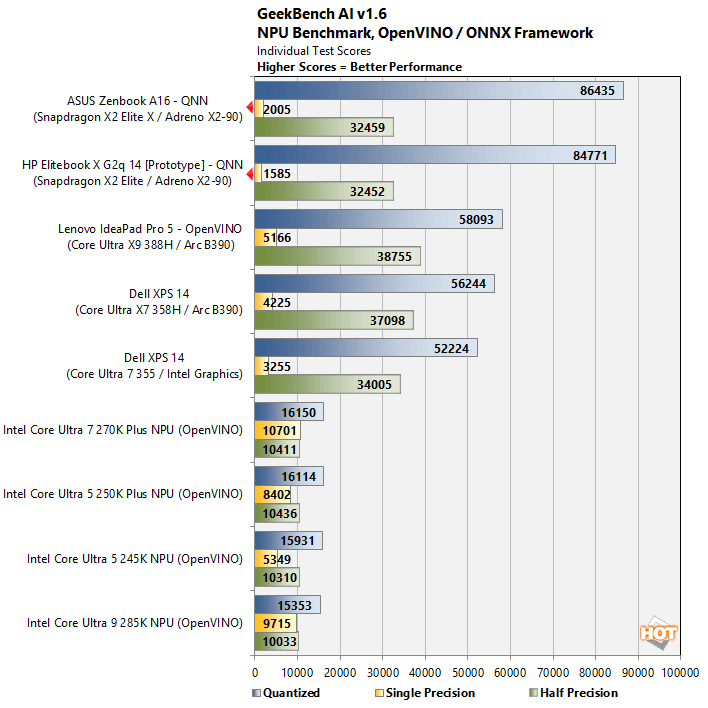
The Snapdragon X2 Elite's single precision performance trails the other NPUs in this test, but its half precision score lands just behind Intel's Panther Lake. In the quantized test though, Qualcomm's 80 TOPs NPU in the Zenbook A16 decimated the Core Ultra X9 Panther Lake processor, when both are using their preferred frameworks and backends.
Microsoft Office Performance With PCMark Applications
The PCMark 10 Applications benchmark measures performance in the Microsoft Office suite, as well as in the Edge browser, offering native instruction set-compatible versions of the apps for optimal performance across a wide variety of workloads in tools office workers, students and home users utilize every day. The following results should show a view of performance with a best foot forward from all systems tested.
The PCMark 10 Applications benchmark, which leverages actual Microsoft Office applications, had the Zenbook A16 landing in the lower half of results, but right in the mix with some of the better Intel Core Ultra Series 3 and AMD Ryzen AI-based systems. Rest assured, all of the systems we tested here are more than powerful enough for everyday, office-type productivity workloads.
The Zenbook A16 finished right in the middle of the pack according to 3DMark's CPU performance profiler. We didn't expect much here, because Qualcomm isn't targeting gamers with its PC processors yet, but they still managed to outpace Intel's and AMD's more mainstream mobile processors at the higher thread counts. With the lower thread counts, Qualcomm trails, however.
The Zenbook A16 offered particular strong graphics performance in 3DMark's Steel Nomad Lite test. Here, the Asus and HP Snapdragon-powered systems sandwiched the Dell XPS 14 with 12Xe Arc B390 graphics. The larger Lenovo system with the top-end Core Ultra X9 and Arc B390 pulls ahead, but that system has one of the fastest iGPUs in a thin and light notebook if we disregard the more expensive Strix Halo platform for a moment. Qualcomm may not lead here, but make no mistake, these are some great scores from Qualcomm's Adreno X2-90 GPU.
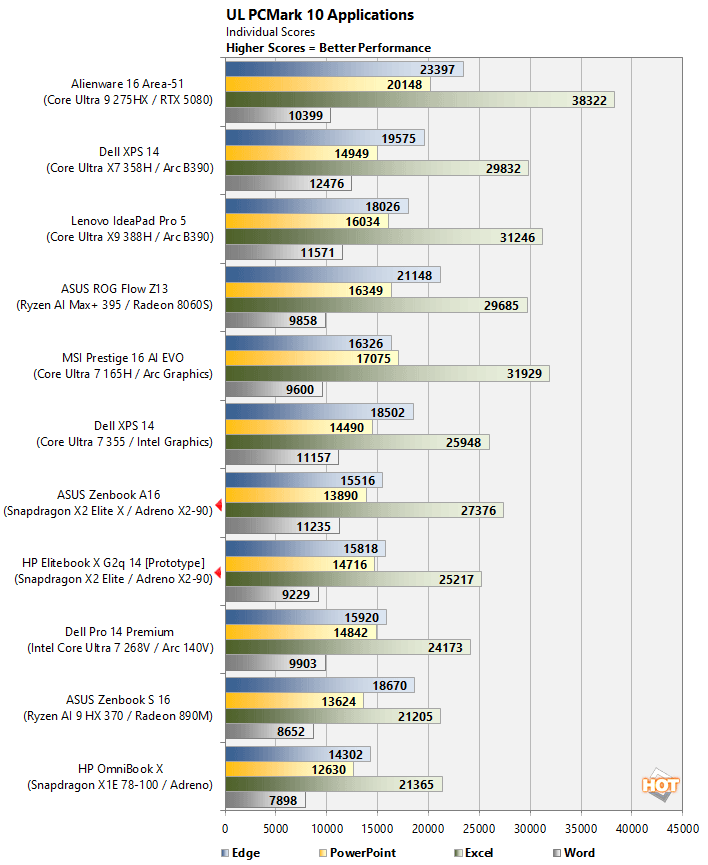
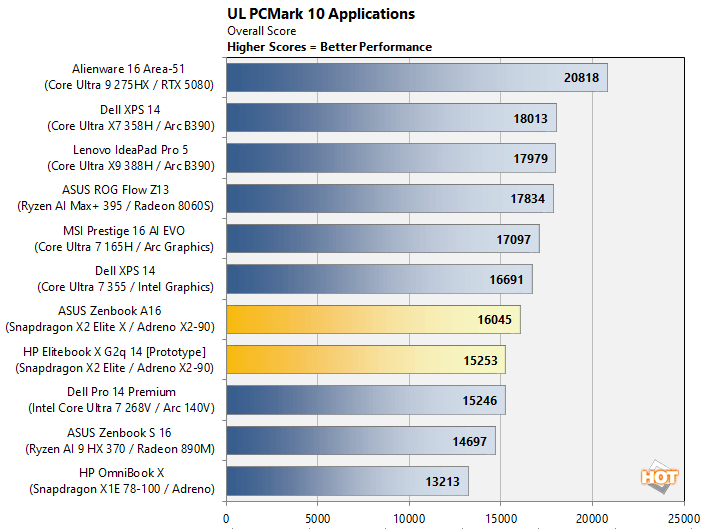
The PCMark 10 Applications benchmark, which leverages actual Microsoft Office applications, had the Zenbook A16 landing in the lower half of results, but right in the mix with some of the better Intel Core Ultra Series 3 and AMD Ryzen AI-based systems. Rest assured, all of the systems we tested here are more than powerful enough for everyday, office-type productivity workloads.
Puget Bench For Creators: Davinci Resolve
Next up we have some video editing and encoding using the Puget Bench for Creators and Davinci Resolve. Puget Systems has been developing benchmarks that leverage real-world applications and workloads for a number of years now, which are highly regarded by creators using popular Adobe applications and Davinci Resolve. Here, we used the free version of Davinci Resolve (not the Studio edition) that features less hardware acceleration and relies heavily on CPU, GPU and memory performance.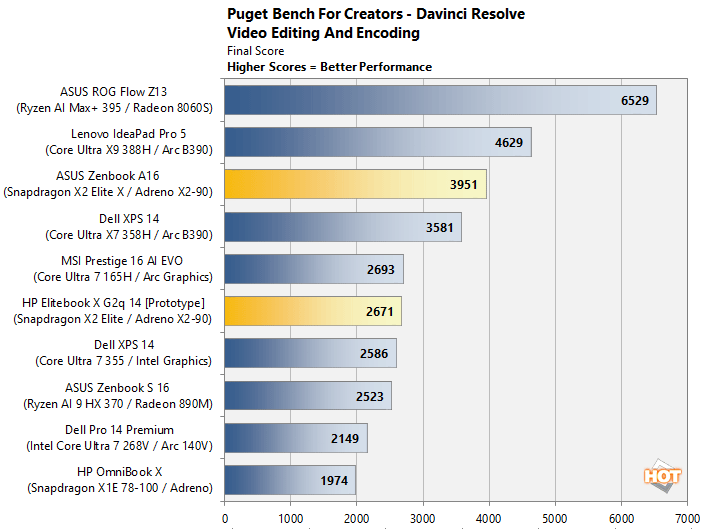
Puget Bench with Davinci Resolve had the Zenbook A16 performing relatively well. The top-end Asus Zenbook A16 with the Snapdragon X2 Elite Extreme processor, trailed only the more expensive Strix Halo system and top-end Intel Core Ultra X9 with Arc B390 graphics. The Asus machine, however, outpaced the XPS 14, with its scaled back Core Ultra X7.
UL 3DMark Gaming And Graphics Benchmarks
3DMark has a wide variety of graphics and gaming related tests available. In these tests, we chose to run 3DMark CPU Profile benchmark, which runs through an array of physics calculations with a varying number of threads, and Steel Nomad Lite, a modern DirectX 12 test specifically designed for lower-power GPUs and integrated graphics.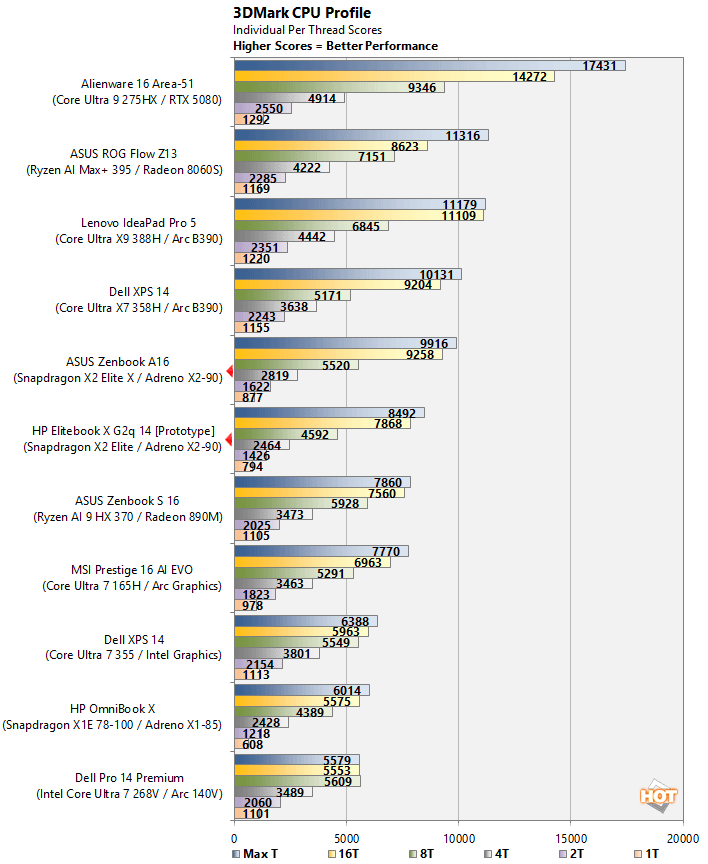
The Zenbook A16 finished right in the middle of the pack according to 3DMark's CPU performance profiler. We didn't expect much here, because Qualcomm isn't targeting gamers with its PC processors yet, but they still managed to outpace Intel's and AMD's more mainstream mobile processors at the higher thread counts. With the lower thread counts, Qualcomm trails, however.
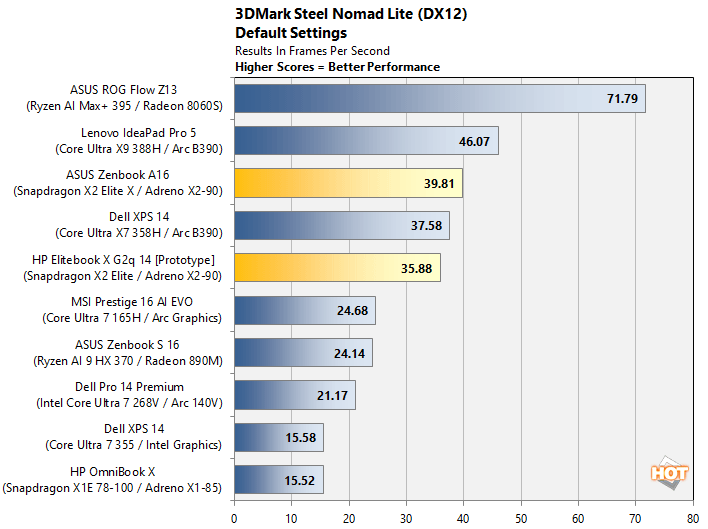
The Zenbook A16 offered particular strong graphics performance in 3DMark's Steel Nomad Lite test. Here, the Asus and HP Snapdragon-powered systems sandwiched the Dell XPS 14 with 12Xe Arc B390 graphics. The larger Lenovo system with the top-end Core Ultra X9 and Arc B390 pulls ahead, but that system has one of the fastest iGPUs in a thin and light notebook if we disregard the more expensive Strix Halo platform for a moment. Qualcomm may not lead here, but make no mistake, these are some great scores from Qualcomm's Adreno X2-90 GPU.
F1 22 Formula 1 Racing Game Benchmark
Racing simulator F1 2022 is a DirectX 12 game title that is sensitive to certain system configurations, and as such, is useful for teasing out certain performance anomalies. We tested the game in its High graphics preset, with upscaling disabled, and at 1080p resolution.
The Asus Zenbook A16 lands near the top of the charts in this game, besting all of the other integrated GPUs besides Intel's powerful 12Xe Arc B390 in the top-end Core Ultra X9 388H.
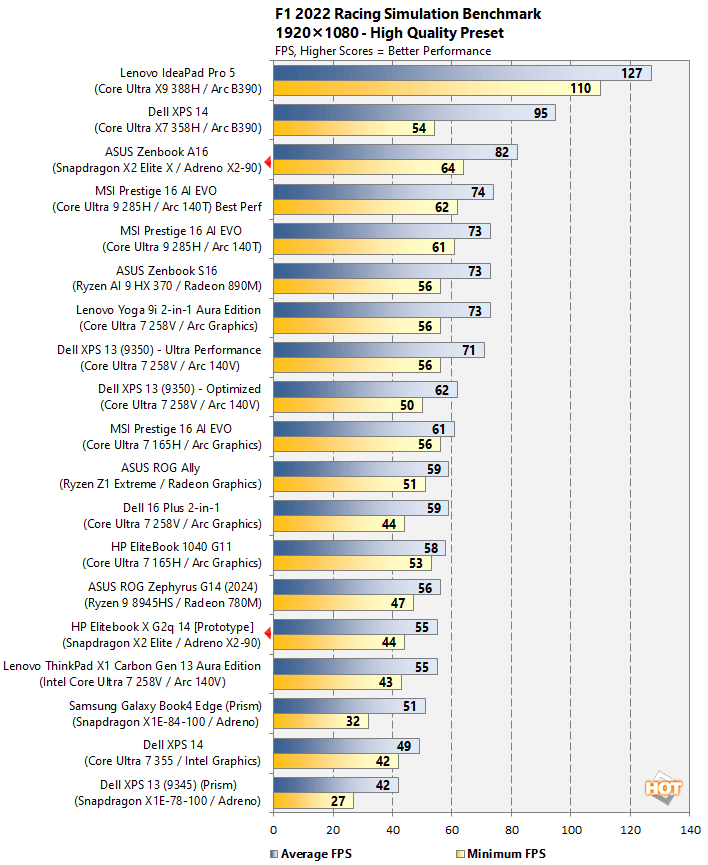
The Asus Zenbook A16 lands near the top of the charts in this game, besting all of the other integrated GPUs besides Intel's powerful 12Xe Arc B390 in the top-end Core Ultra X9 388H.
Battery Life With Asus Zenbook A16
Battery life is critically important for a business PC. Working on the go could mean long stretches away from outlets. The machine needs to last through endless hours of work that could mean e-mails and time spent poring over spreadsheets, not to mention long runs of content consumption like Netflix binging.
Here we've calibrated the laptop displays to a similar fixed brightness, in an effort to minimize that aspect of power draw, though lots of other variables come into play, like battery capacity, for example.
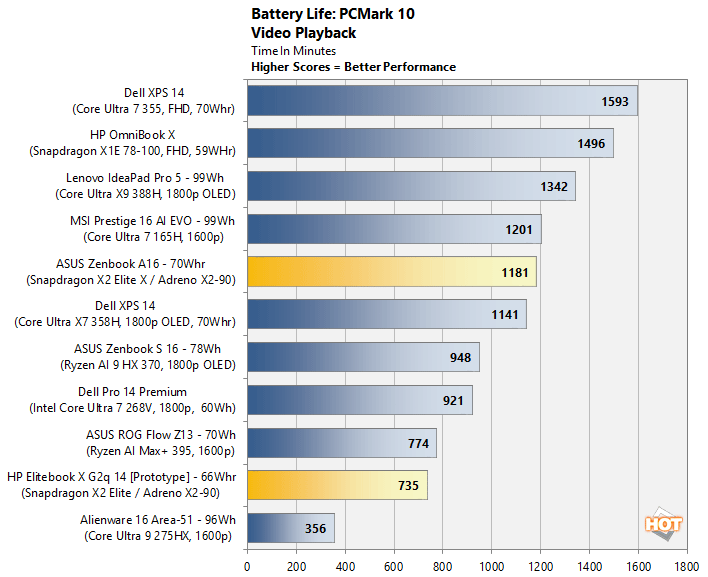
The Zenbook A16 offered very good, but unexceptional battery life. Despite being powered by Qualcomm's most powerful PC processor and featuring a large display, the Zenbook A16 ran untethered for nearly 20 hours with its display lit the entire time. That was better than the Dell XPS 14 with Panther Lake, which has a smaller display, and a similar sized battery, but not as long as some other machine with much bigger batteries.
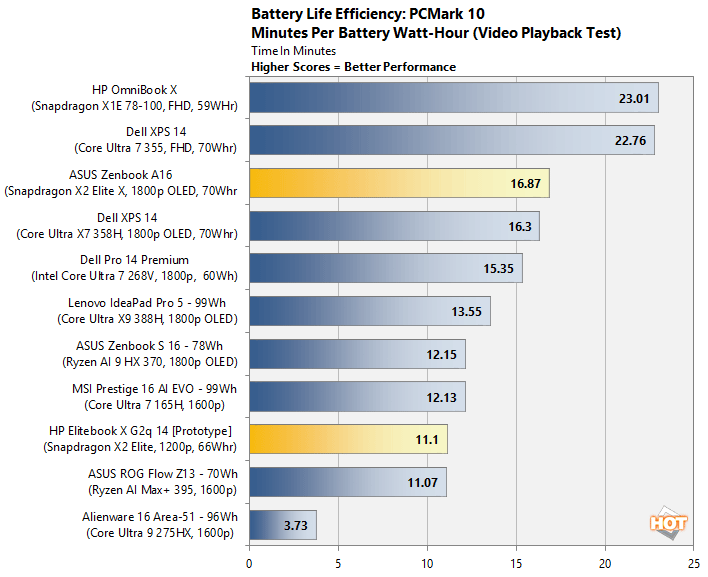
In terms of power efficiency, as defined by minutes per watt-hour, the Asus Zenbook A16 fares pretty well and outpaces the top-end Intel and AMD-based systems. Only the more mainstream laptops, with smaller, lower resolution displays finished higher.