AMD Ryzen 7 7700X3D Review: 3D V-Cache Gaming Performance For Less


For the 3DMark Physics test, we simply create a custom 3DMark run consisting solely of the physics test, which is multi-threaded and CPU dependent, and report the results...
UL 3DMark CPU Physics Benchmark
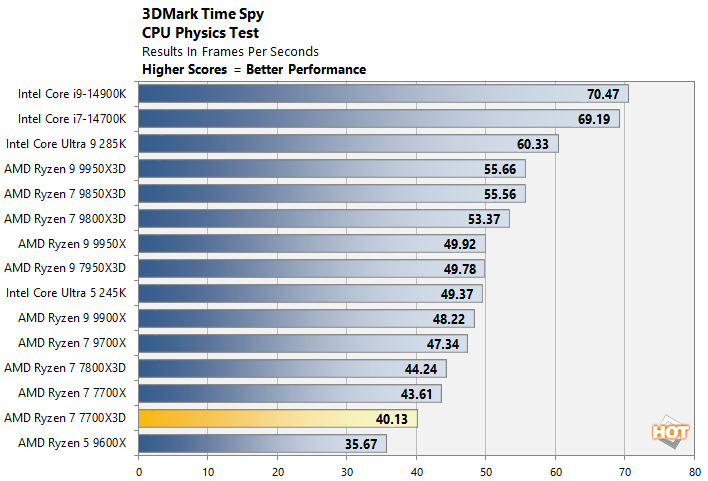
3DMark's Physics test doesn't benefit for the additional 3D V-Cache on the Ryzen 7 7700X3D, and as a result it trails the standard Ryzen 7 7700X and the 7800X3D. It is able to outrun the Ryzen 5 9600X, though.
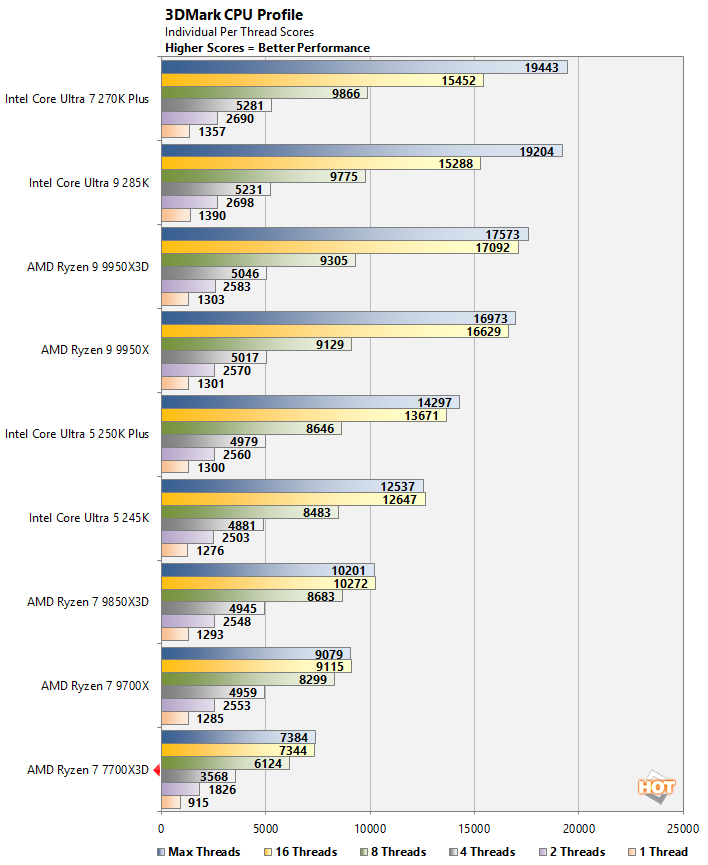
3DMark's CPU profilers runs through an array of tests, with various settings that hit one or all cores / threads on a processor. The Ryzen 7 7700X3D performs as expected here, finishing behind the higher core count processors.
Graphics And Game Tests With The Ryzen 7 7700X3D
We also ran some mid and high-resolution game and graphics benchmarks on our test rigs with 3DMark, F1 25, and The Talos Principle 2. We used 3DMark's default Steel Nomad test (DX12), and the games were run in two different configurations — either 1080p with Medium/High details, or 4K with High/Extreme details. The lower resolution tests are designed to be more CPU bound to better isolate processor performance, while the higher resolution tests are more GPU bound, where the CPU should have less of an impact. Steel Nomad is up first.

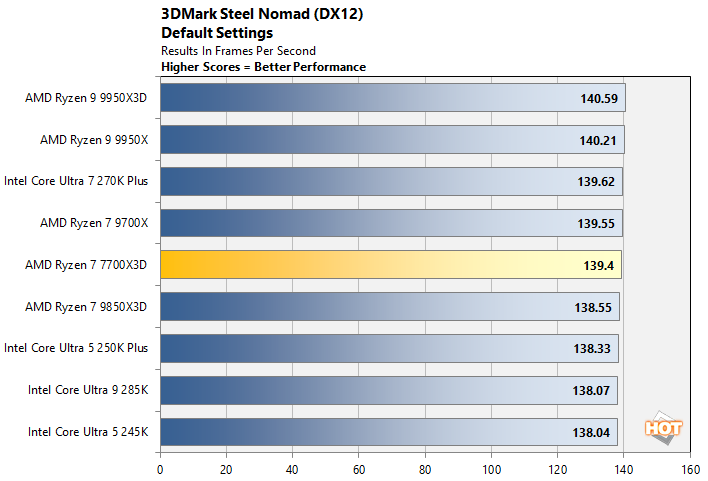
AMD's 3D V-Cache is most beneficial for gaming workloads, and it shows in Steel Nomad where the Ryzen 7 7700X3D lands about in the middle of the pack. This test is almost completely GPU bound though, and less than 1.5% separates the highest and lowest performers here. That's basically just noise and falls within the margin of error for the benchmark. Things change with a less demanding graphics workload, though...
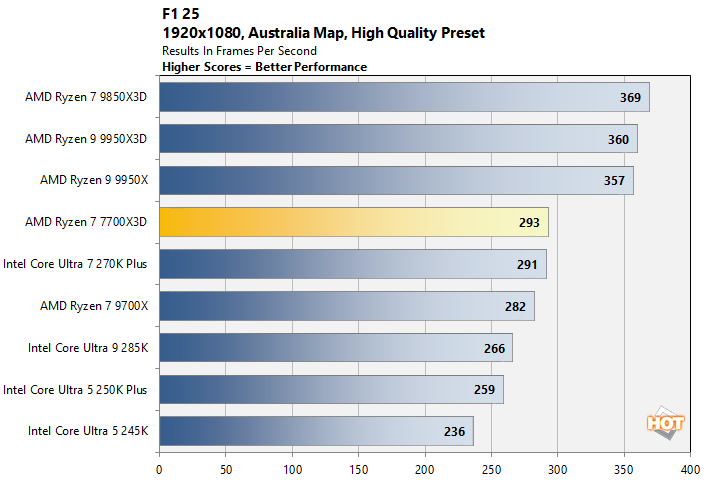
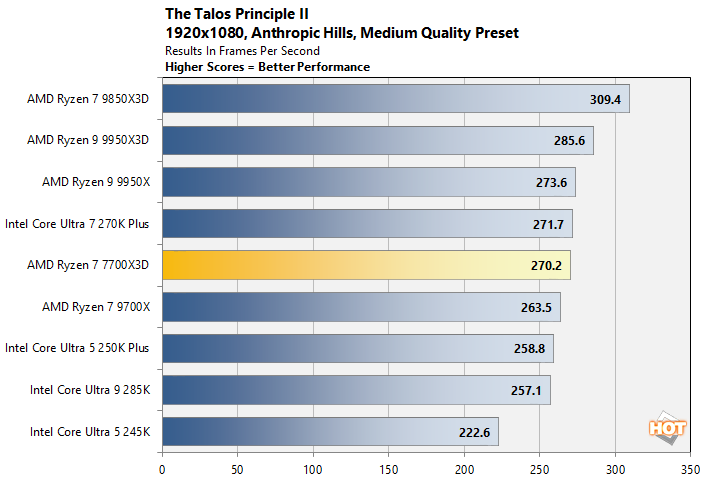
As you can see, the Ryzen 7 7700X3D still lands about in the middle of the pack in our 1080p game tests, which is very good result all things considered. The Ryzen 7 7700X3D trails only the Zen 5-based processors, which perform particularly well in F1 25. In the Talos Principle II the Ryzen 7 7700X3D and Intel's fastest current-gen gaming processor are effectively tied.
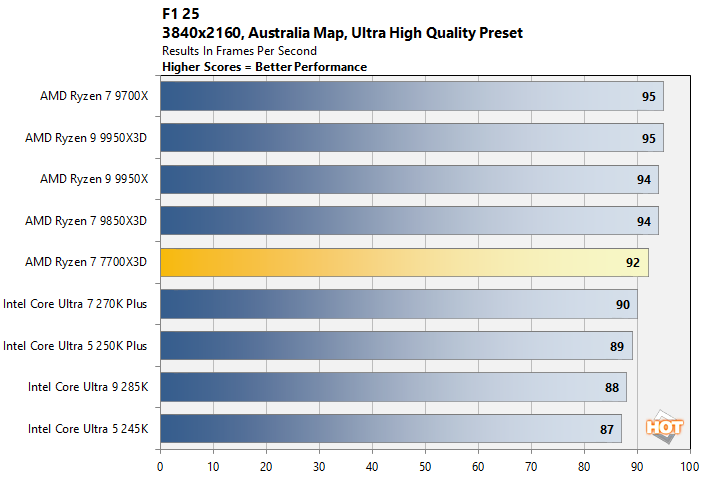
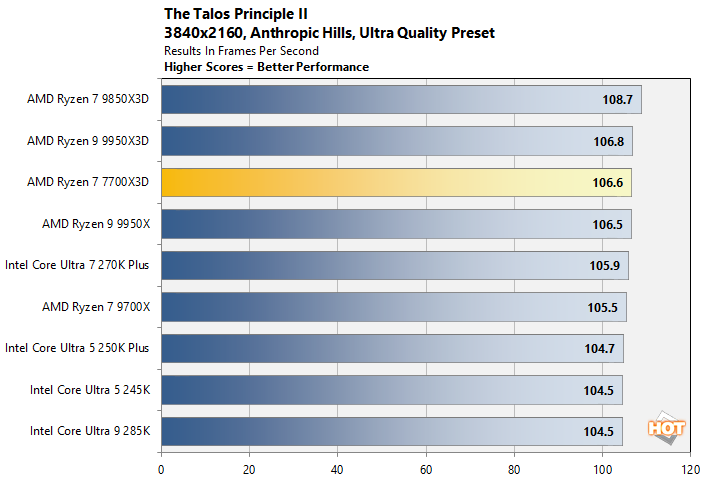
With higher image quality settings and the game resolution increased to 4K, the frame rates are more compressed as the GPU becomes the limiting bottleneck. All of the platforms we tested performed within a couple of frames per second of each other. That said, the new Ryzen 7 7700X3D still finishes at (or near) the top of the charts, trailing only the Zen 5 CPUs and outrunning Intel's Core Ultras.
AMD Ryzen 7 7700X3D Total System Power Consumption
Throughout all of our benchmarking and testing, we also monitored how much power our test rigs were consuming with a power meter connect at the electrical outlet. Our goal was to give you an idea as to how much power each configuration used while idling at the Windows desktop and while under taxing CPU workloads, that lit up one or all cores. Keep in mind, this is total system power consumption being measured at the wall and not the the individual power being drawn by the CPUs alone.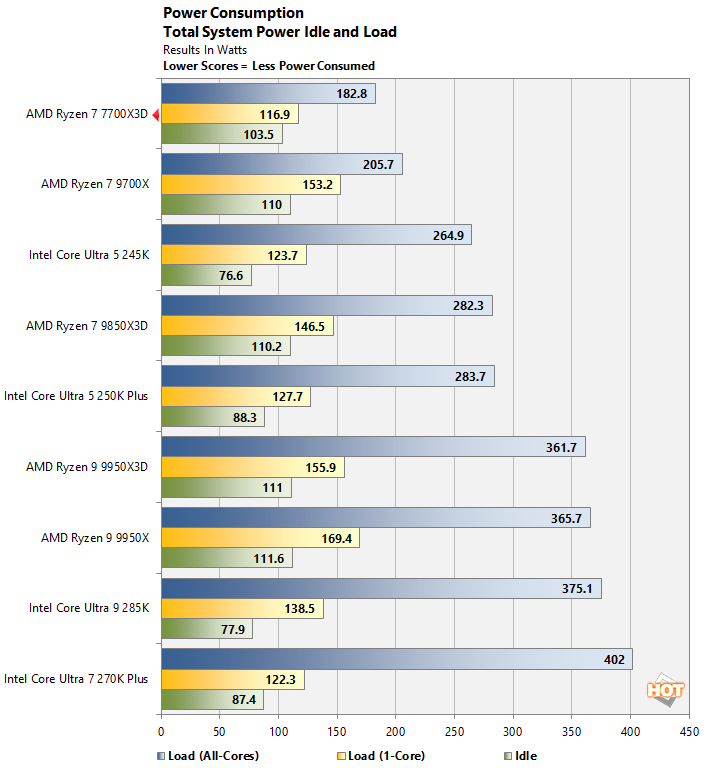
AMD's current socket AM5 platform consumes somewhat more power than Intel's competitive offerings when using a high-end X870E-based motherboard (like we did), but that's mostly a non-issue in the real world. Power consumption under load is what really separates the processors and in this regard, the new Ryzen 7 7700X3D is a winner. When fully taxed with a multi-threaded workload, the Ryzen 7 7700X3D consumed the least amount of power of the bunch. In fact, the 7700X3D pulled over a 100W fewer watts from the wall than the recently released Intel Core Ultra 5 250K Plus and over 200W fewer watts than the Ultra 7 270K Plus.

Ryzen 7 7700X3D Hardware Health Data During PCMark
How power, frequencies, and thermals are affected in a variety of workloads with the Ryzen 7 7700X3D is represented in the chart above. What you see here are frequencies, temps, and utilization over the course of a PCMark 10 Applications benchmark run. The CPU clock shows relatively small variations, and remains in the 4.2GHz - 4.5GHz range whenever the CPU is under load, but it dips lower when not fully taxed. CPU temperatures also remain relatively low, and vacillate mostly in the 50°C to 60°C range, with peaks in the low 70's. With a decent cooler installed (our test rig has a 360mm AIO water cooler), temperatures will absolutely not be an issue for the Ryzen 7 7700X3D.