AMD Ryzen 7 7700X3D Review: 3D V-Cache Gaming Performance For Less


LAME XP Audio Encoding
For this test, we created 16-copies of a large 223MB WAV file (of an 11 minute Grateful Dead jam) and converted it to the MP3 format using the multi-thread capable LAME XP tool. Processing times are recorded below, listed in minutes:seconds. Shorter times equate to better performance.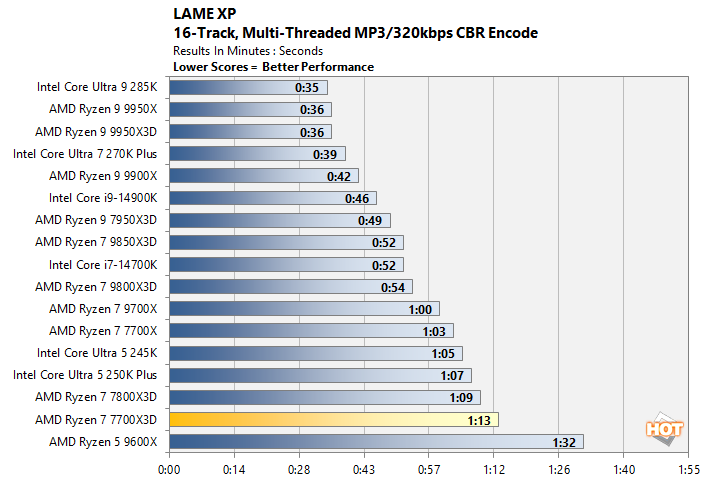
The Ryzen 7 7700X3D lands near the bottom of the stack in our custom LAME MT benchmark, and outruns only the 6-core Ryzen 5 9600X.
Blackmagic RAW Video Encoding Speed
The Blackmagic RAW Speed Test is a CPU and GPU benchmarking tool that tests full-resolution Blackmagic RAW video decode performance. The tool can be used to evaluate the performance at various resolutions and bitrates on the CPU or using OpenCL on a GPU. We're reporting two results here, both using 8K resolution, but at differing bitrates and compression levels.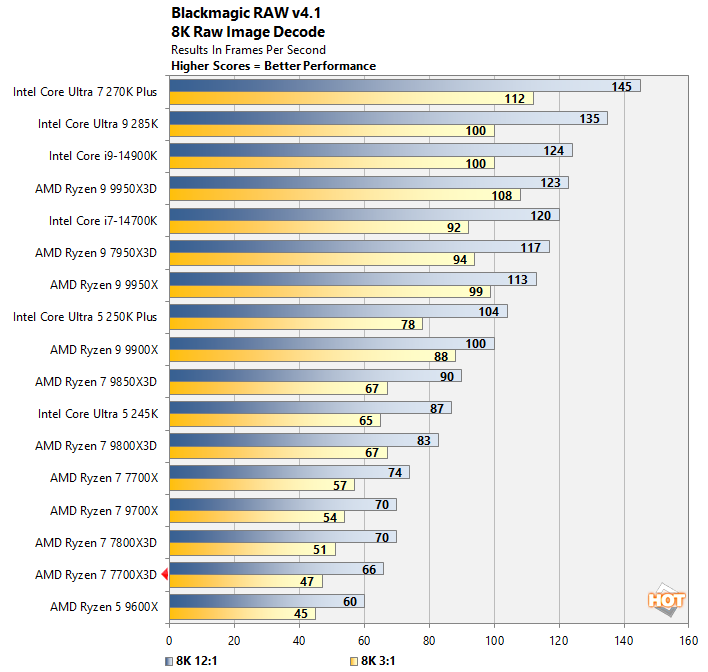
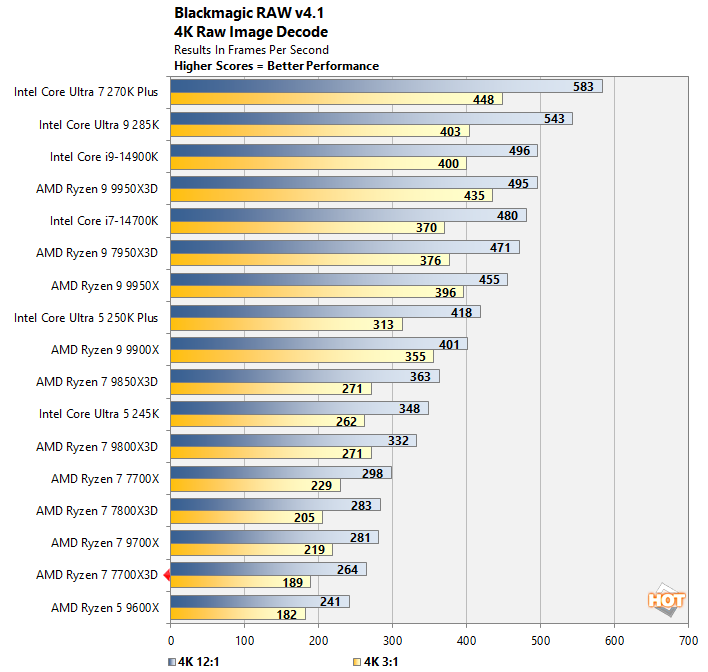
The Blackmagic Raw Speed test doesn't reveal any new information. As we've seen in most benchmarks up to this point, AMD's Ryzen 7 7700X3D is able to outwork the lower core count Ryzen 5 9600X, but it ultimately trails the 7800X3D.
x265 Video Encoding
The multi-threaded HWBOT x265 Benchmark is based on the open source x265 video encoder that leverages modern CPU instructions to accelerate video encoding. We tested the CPUs represented here with the 64-bit encoder using the default 1080p and 4K workloads.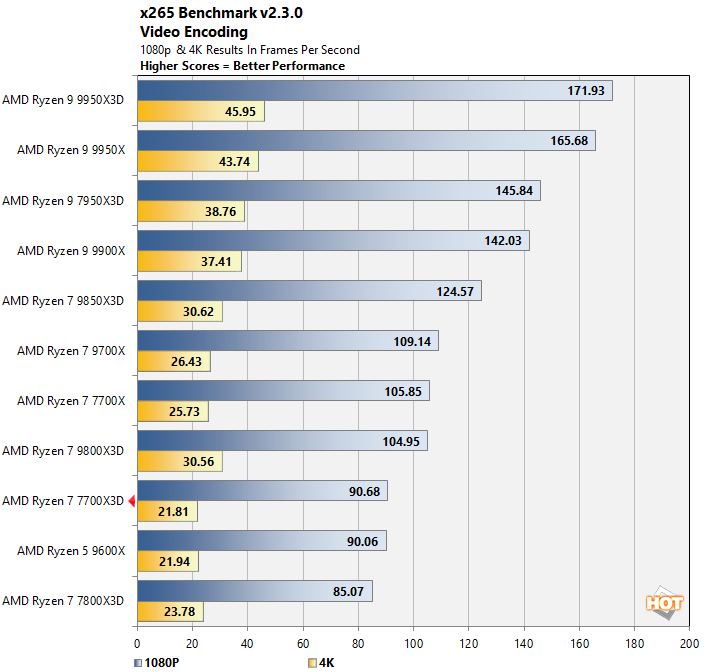
You'll notice there are only AMD systems in the chart above. The MSI motherboards we used in our Intel test rigs don't perform as expected when HPET (the High Precision Event Timer) is enabled, and HPET is required to run this test. HPET works properly on the Socket AM5 motherboards though, hence all of the Ryzen results above. Here we see the Ryzen 7 7700X3D trading blows with the 9600X and 7800X3D depending on the video resolution, but its overall performance remains near the bottom of the chart.
Cinebench Rendering Benchmark
Cinebench 2024 and 2026 are 3D rendering performance tests based on Cinema 4D from Maxon. Cinema 4D is a 3D design and animation tool suite used by animation houses and producers like Sony Animation and many others. It's very demanding of processor resources and can utilize any number of threads, which makes it an excellent gauge of CPU throughput. This is a multi-threaded, multi-processor aware benchmark that renders a scene and tracks the length of the entire process. The rate at which each test system was able to render the entire scene is represented in the graphs below.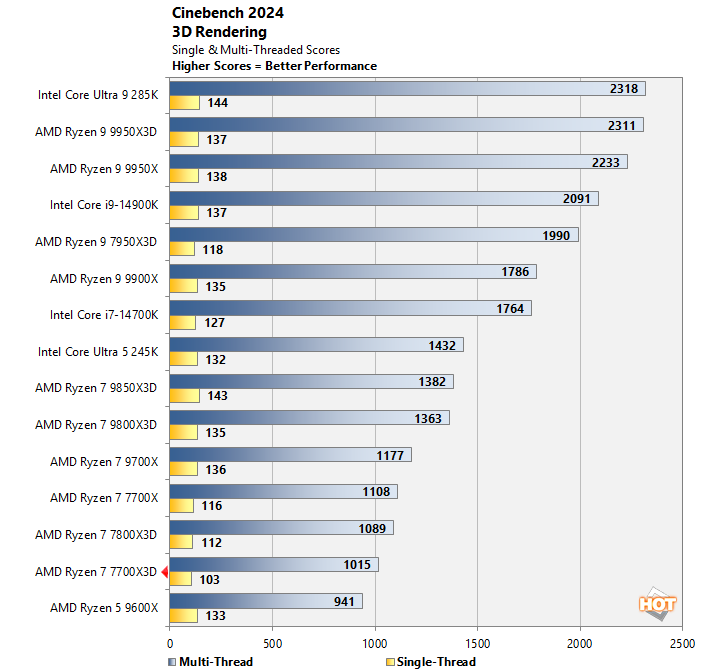
Cinebench 2024 has the Ryzen 7 7700X3D finishing in a familiar position, between the Ryzen 7 7800X3D and Ryzen 5 9600X. There's just no catching the higher clocked, higher core count processors in a heavily threaded workload like this one.
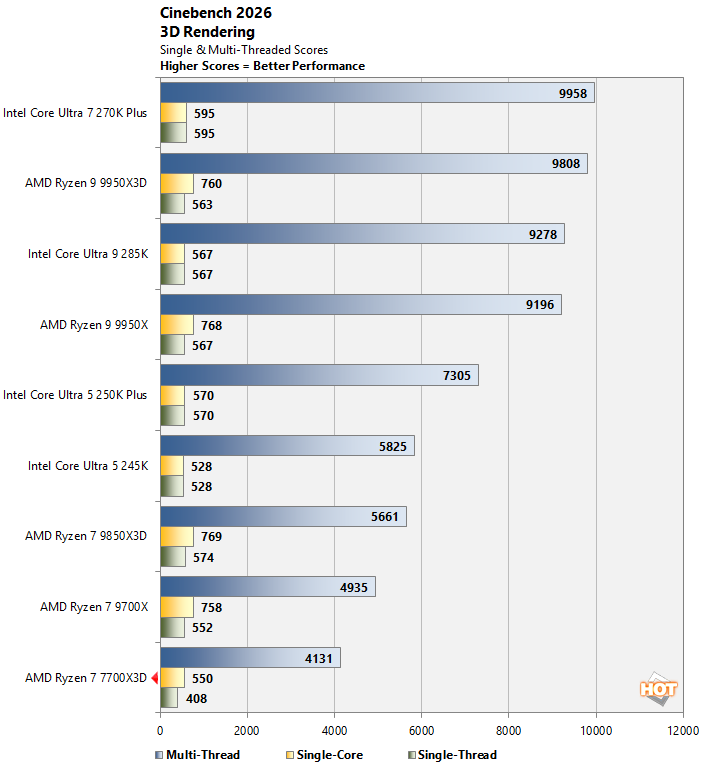
With the newer Cinebench 2026 test, we have less reference data, but the story is still the same. The Ryzen 7 7700X3D's additional cache doesn't help it here and it's not able to catch the higher clocked processors that are also based on newer architectures.
POV-Ray CPU Ray Tracing Benchmark
POV-Ray, or the Persistence of Vision Ray-Tracer, is an open source tool for creating realistically lit images. We tested with POV-Ray's standard 'one-CPU' and 'all-CPU' benchmarking tools on all of our test machines and recorded the scores reported for each. Results are measured in pixels-per-second throughput; higher scores equate to better performance.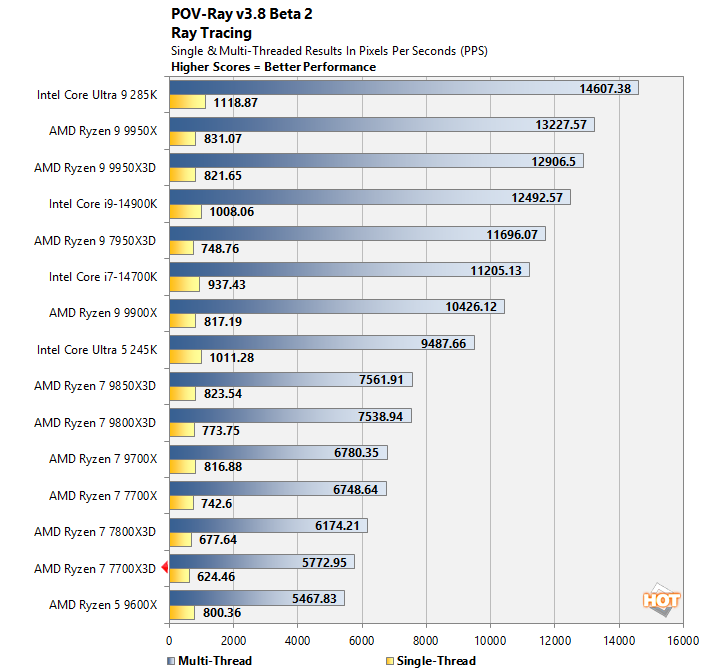
Our results with POV-Ray looks very similar to Cinebench. The Ryzen 7 7700X3D performs as you'd expect an 8-core / 16-thread processor would, and the CPU lands in the same position we've seen throughout most of our tests.
Blender Rendering Benchmarks
Blender is a free and open source 3D creation suite that can handle everything from modeling, rigging, and animation to simulation, rendering, compositing and motion tracking. It has a purpose-built benchmarking tool that will track the time it takes to complete rendering a particular model (or models). We used the CPU-focused benchmark with all three models currently available...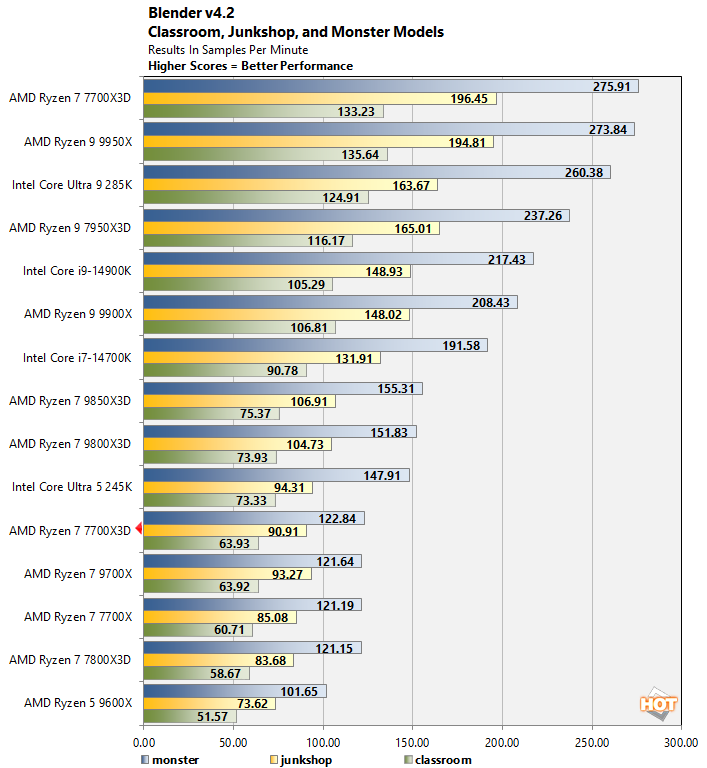
The Blender benchmark had all of the AMD 8-core processors finishing within a few points of each other. The Ryzen 7 7700X3D climbs a couple of rungs, but its position would change depending on which model we used to sort the graph. This new AMD CPU effectively finishes right on top of the 7800X3D, within the margin of error for this test.
Corona 10 Render Benchmark
The Corona Benchmark is built on the Corona 10 rendering core and assesses system performance by rendering a scene using Corona 10. It determines the color of each pixel by sending rays into the scene and analyzing the materials, lights and other components and then shows a machine's performance in rays per second (rays/s), where higher values equal better performance.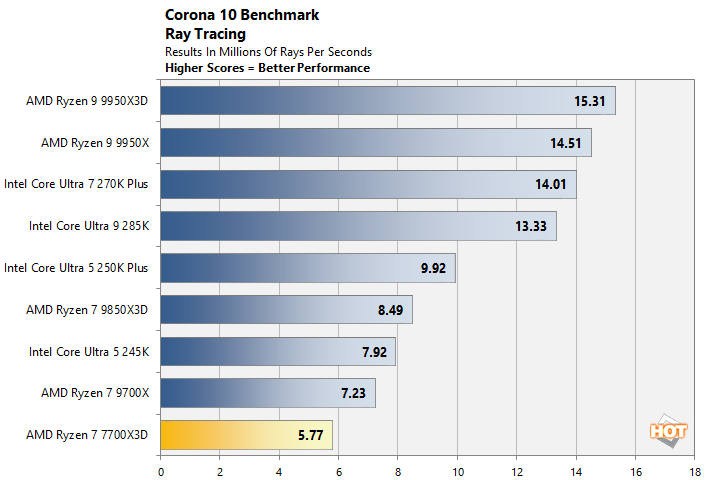
As you would expect, the new Ryzen 7 7700X3D trails the higher clocked, higher core count processors in this multi-threaded ray tracing benchmark. What's perhaps the more important takeaway to consider at this point is where it ranks versus similarly or lower-priced processors like the Core Ultra 7 270K Plus or Ryzen 7 9700X.
Y-Cruncher Multi-Threaded Pi Calculator
Y-Cruncher is a multi-core-capable tool that calculates the value of pi to a specified number of digits. In this case, we ran the tool on all threads and had the application calculate the value of pi to 1 billion digits. The values below are the time required to perform the calculation expressed in seconds. As a result, lower values indicate better performance.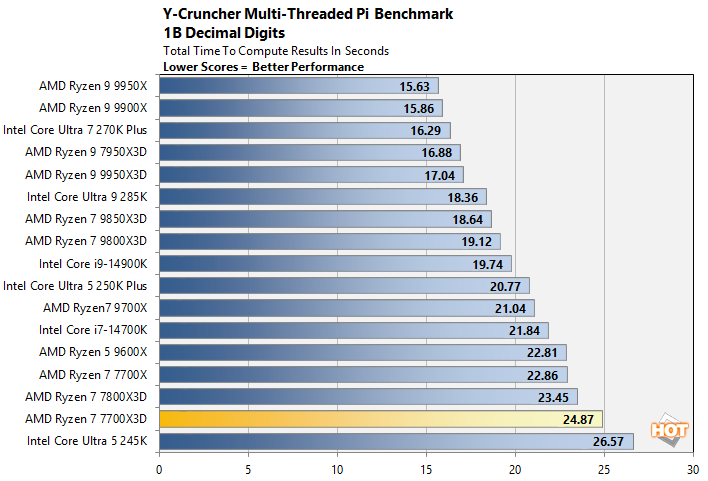
In yet another highly threaded workload, but one that's also heavily influenced by cache and memory bandwidth, we once again see the Ryzen 7 7700X3D finishing in line with expectations, relative to the other Ryzen processors. Here, the Ryzen 7 7700X3D outruns the Core Ultra 5 245K, but slots in just behind its big brother, the 7800X3D.