AMD Radeon RX 9070 GRE Review: Great 1440p Gaming, With Caveats

radeon 9070 gre angle 2
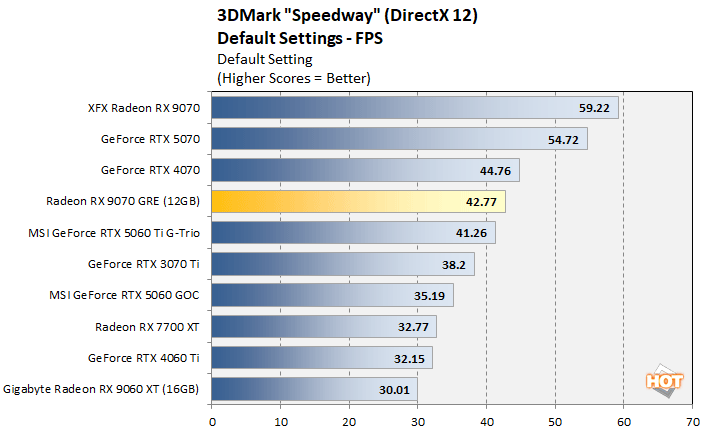
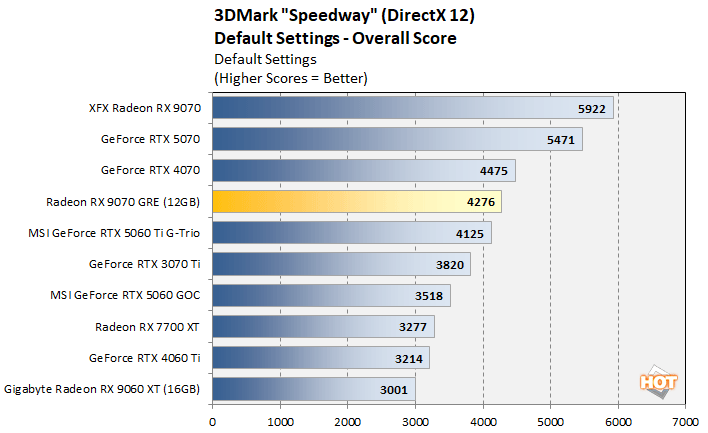
Speed Way is the most recent addition to the UL 3DMark graphics test suite. Speed Way uses the DirectX 12 Ultimate API and leverages advanced features like DirectX Ray Tracing tier 1.1 for real-time global illumination and ray traced reflections, Mesh Shaders, and high resolution textures and artwork. All of the graphics cards here were testing using the default benchmark options should you want to compare the performance of your system to our test rig...

UL 3DMark Speed Way DX12 Ultimate Benchmarks

3dmark speedway benchmarks
3DMark Speed Way

speedway1 radeon 9070 gre


speedway2 radeon 9070 gre

In 3DMark's most demanding DX12 test, which features ray tracing, the Powercolor Radeon RX 9070 GRE performs relatively well. In this benchmark, the Powercolor Radeon RX 9070 GRE crushes the RX 9060, outruns the GeForce RTX 5060 Ti, and lands just behind the GeForce RTX 4070. The GeForce RTX 5070 and the Radeon RX 9070 with its additional cores / ray accelerators finish well ahead.

UL 3DMark Steel Nomad DX12 Benchmarks

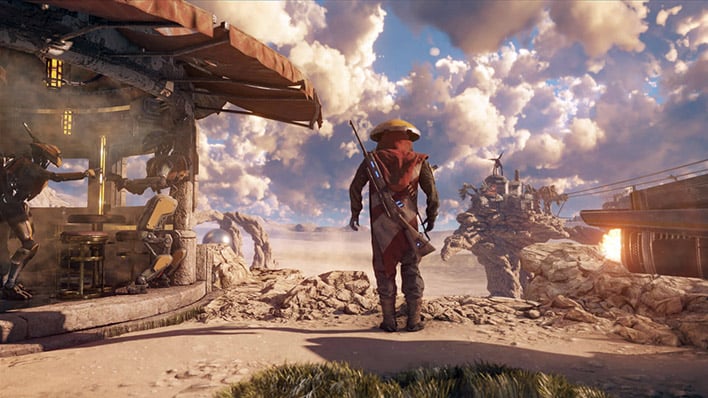
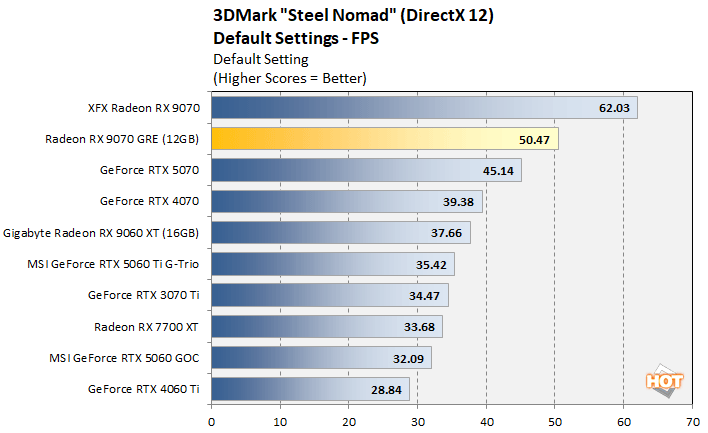
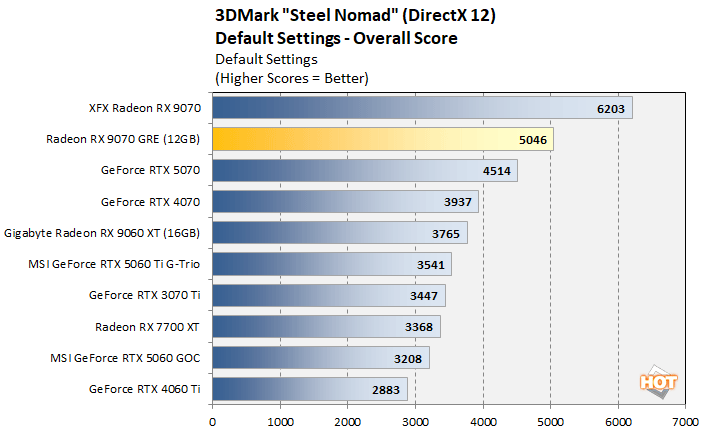
3DMark Steel Nomad is one of the newer cross-platform GPU benchmarks developed by UL Solutions as part of the 3DMark suite. This test is designed to evaluate the performance of modern gaming hardware in non-ray-traced scenarios, but using otherwise advanced rendering techniques with DX12.
3dm steel nomad
3DMark Steel Nomad

steel1 radeon 9070 gre


steel2 radeon 9070 gre

3DMark's Steel Nomad is one of the benchmark's newer DX12 tests, but this one removes ray tracing from the equation. In this traditional rasterization benchmark, the Powercolor Radeon RX 9070 GRE performs particularly well and trails only the higher-end Radeon RX 9070.

VR Benchmarks: VR Mark & Unigine Superposition

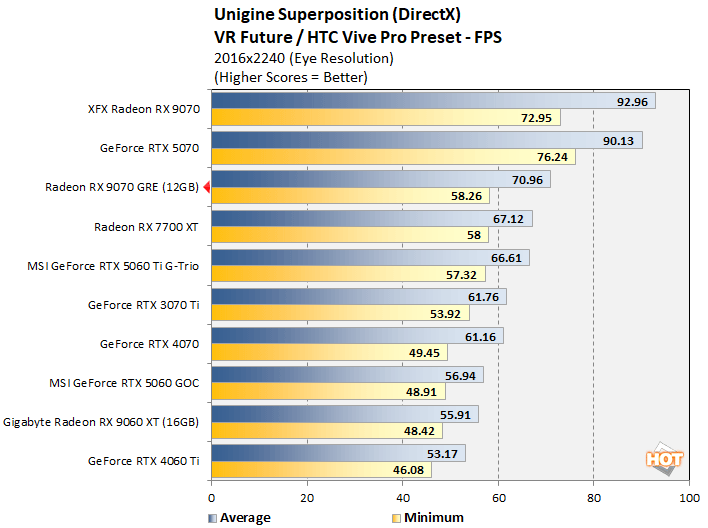
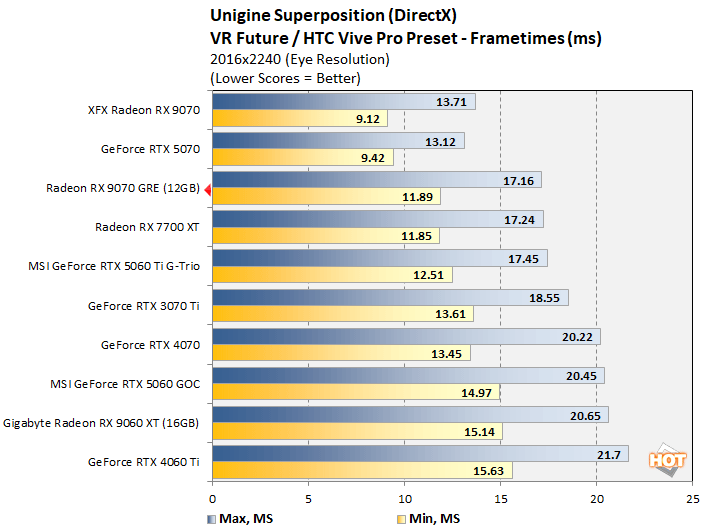
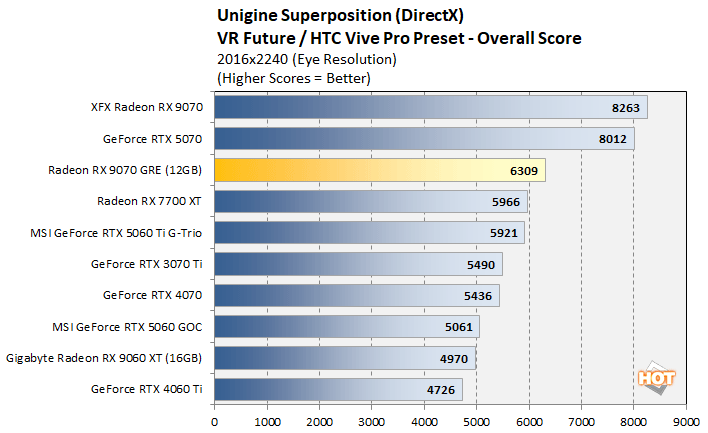
Superposition is an aging benchmark from Unigine, powered by the UNIGINE 2 Engine. It offers an array of benchmark modes, targeting gaming workloads as well as VR, with both DirectX and OpenGL code paths. There is an extreme hardware stability test built-in too. Unigine Superposition uses the developer’s unique SSRTGI (Screen-Space Ray-Traced Global Illumination) dynamic lighting technology, along with high quality textures and models, to produce some excellent visuals. We ran Superposition's VR Future benchmark to compare the performance of all of the graphics cards featured here.

unigine superposition
Unigine Superposition VR Future Test
uni1 radeon 9070 gre


uni2 radeon 9070 gre


uni3 radeon 9070 gre

Unigine's VR Future benchmark has the Powercolor Radeon RX 9070 GRE winning bronze, behind only the Radeon RX 9070 and GeForce RTX 5070. It has no trouble dispatching the GeForce RTX 5060 Ti, however, and leave the Radeon RX 9060 XT well behind.

UL VR Mark Blue Room Benchmarks

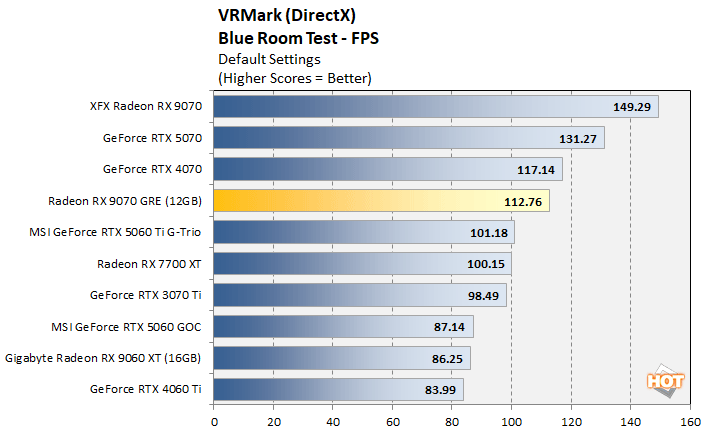
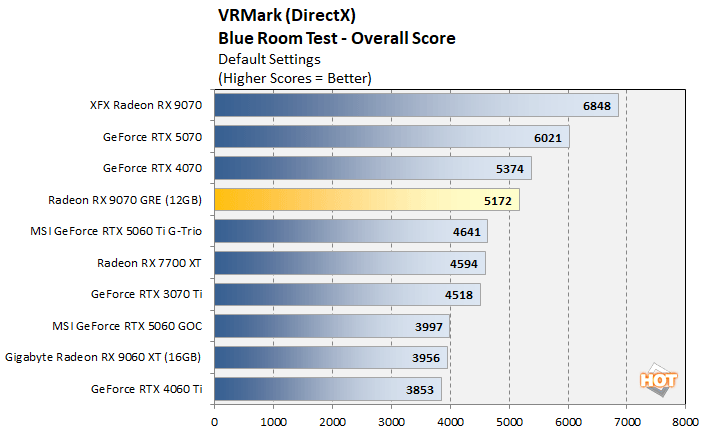
UL's VRMark was designed to test a PC’s readiness for HMDs like the HTC Vive and Oculus Rift. The benchmark does not, however, require that one of the headsets is attached to the PC to run and it uses an in-house graphics engine and content to ensure comparable results between different platforms. We ran the "Blue Room" VRMark test at defaults settings here, which is the most taxing test offered by the tool.

vr mark thumb
UL VRMark

vr1 radeon 9070 gre


vr2 radeon 9070 gre

The Powercolor Radeon RX 9070 GRE drops down a run in VR Mark, but still performs well. Here the GeForce RTX 4070 is able to edge past the Powercolor Radeon RX 9070 GRE, but the GRE still manages to beat the GeForce RTX 5060 Ti by a fair margin.

Marco Chiappetta

Marco Chiappetta

Marco's interest in computing and technology dates all the way back to his early childhood. Even before being exposed to the Commodore P.E.T. and later the Commodore 64 in the early ‘80s, he was interested in electricity and electronics, and he still has the modded AFX cars and shop-worn soldering irons to prove it. Once he got his hands on his own Commodore 64, however, computing became Marco's passion. Throughout his academic and professional lives, Marco has worked with virtually every major platform from the TRS-80 and Amiga, to today's high end, multi-core servers. Over the years, he has worked in many fields related to technology and computing, including system design, assembly and sales, professional quality assurance testing, and technical writing. In addition to being the Managing Editor here at HotHardware for close to 15 years, Marco is also a freelance writer whose work has been published in a number of PC and technology related print publications and he is a regular fixture on HotHardware’s own Two and a Half Geeks webcast. - Contact: marco(at)hothardware(dot)com

Related content