AMD Radeon RX 9070 GRE Review: Great 1440p Gaming, With Caveats


| Powercolor Radeon RX 9070 GRE: MSRP $549 AMD is bringing its former China-exclusive Radeon RX 9070 GRE to the U.S. and we've put one of these relatively affordable GPUs through its paces versus the competition.
|
|||

|

|
||
AMD launched the Radeon RX 9070 GRE a little over a year ago as a China exclusive. Like previous-gen GRE-branded cards, the Radeon RX 9070 GRE is somewhat scaled down from its namesake – the Radeon RX 9070 – and it targets mainstream resolutions at a mid-range price point. To date, the Radeon RX 9070 GRE was unobtainium in the US and most other regions, but at Computex 2026, AMD announced the Radeon RX 9070 GRE would be made available worldwide. So here we are.
The Radeon RX 9070 GRE will be offered exclusively by AMD’s board partners and will come in a variety of form factors and trim levels. For the purposes of this article, we got our hands on a Powercolor Reaper Radeon RX 9070 GRE, which is a modest two-slot / triple fan solution, sans any fancy lighting or other features. There will be larger cards with beefier cooling and RGB lighting available as well, though at varying price points of course.
The cards’ base feature set and specifications will be similar, save for the maximum boost clock which will be somewhat higher on some cards, depending on OEM board partner.
AMD Radeon RX 9070 GRE Specifications
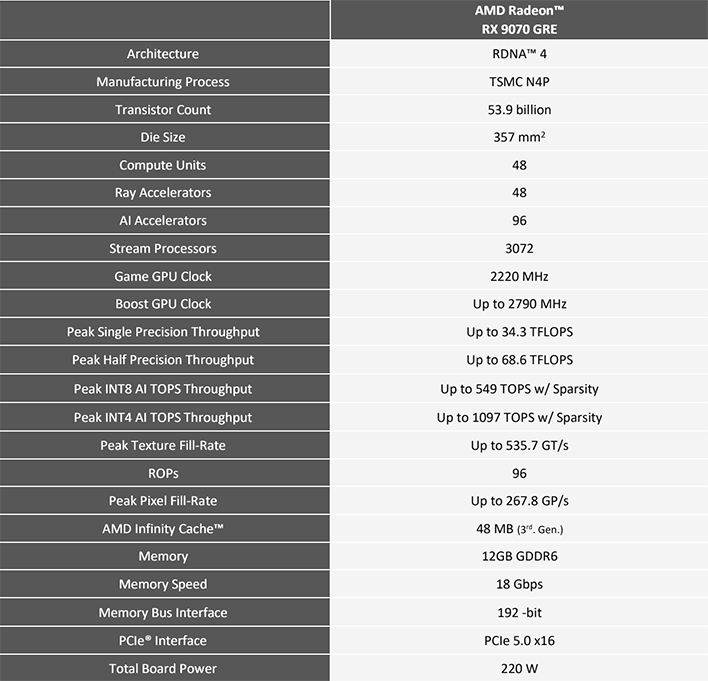
We have already covered the finer details of AMD’s current RDNA 4 GPU architecture and its new features, so we won’t rehash too much of that again here. Suffice it to say, if you want to understand what makes cards like the Radeon RX 9070 GRE tick, you should read this article. To quickly summarize, RDNA 4-based Radeon GPUs offer a significant performance uplift per Compute Unit versus RDAN 3, for better rasterization, ray tracing, and machine learning performance. The Radeon RX 9070 series also features a new media engine for faster, higher-quality transcoding.
The Radeon RX 9070 GRE's reference specifications are outlined in the table above. The cards use the same Navi 48 GPU built on TSMC's 4nm node as other Radeon RX 9070 series cards, but fewer compute units are enabled and the card's 12GB of GDDR6 memory is connected to the GPU over a narrower 192-bit interface. The memory's effective clock rate is lower too--18Gbps vs 20Gbps. Architecturally, the GPUs are identical, though.
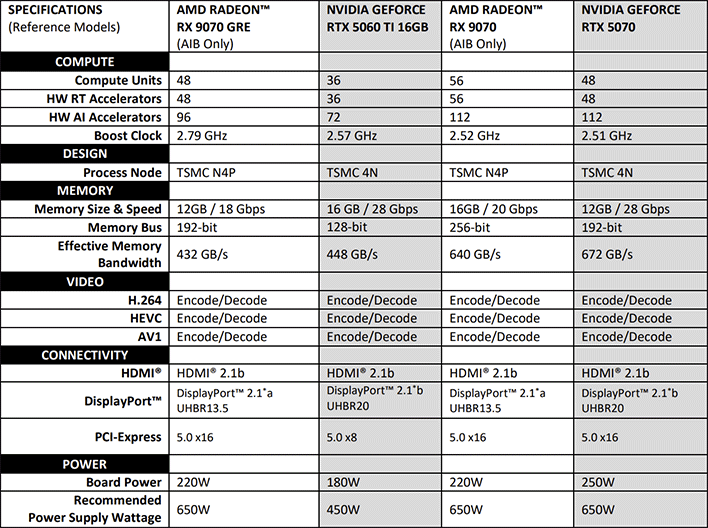
This table will help you understand how the Radeon RX 9070 GRE's scaled-down specs compare to some other cards in its class. Memory bandwidth is below the other cards, at 432GB/s and it's got 48CUs versus 56 in the proper Radeon RX 9070, but the GRE has a somewhat higher boost clock, which will help offset that deficiency with some workloads.
Let's Check Out The Powercolor Radeon RX 9070 GRE
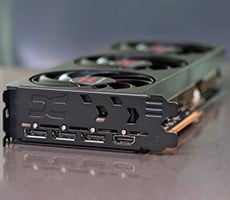
The PowerColor Reaper Radeon RX 9070 GRE is a modestly sized graphics card. Although it’s packing a triple-fan cooler, the card measures only 304mm x 127mm x 42mm and is only two-slots wide. The PowerColor Reaper’s physical dimensions are much more in-line with smaller, dual-slot cards of the past.

The Reaper is packing a 14-phase VRM (8+1+3+2) design with DrMOS power modules and IMON real-time digital hardware-health monitoring. The cooler features triple 90mm fans and the underlying fin-stack is equipped with 5 x 6mm heat pipes to help wick heat away from the GPU and power circuitry. Honeywell PTM7950 thermal pads are also used were applicable, for better thermal conductivity and heat dissipation.


In terms of its max boost clocks and memory configuration, game clocks should hover around the 2,400MHz mark out-of-the-box, with boost clocks as high at 2,0970MHz. The card is outfitted with 12GB of GDDR6 memory operating at an effective data rate of 18Gbps (connecter over a 192-bit interface) and it requires dual 8-pin PCIe power connectors. That should be PLENTY of power for the card, even while overclocking. Typical board power is rated at 220W, but it'll have 375 watts at its disposal through those dual PCIe 8-pin connections and the slot itself.

The outputs on the Powercolor Radeon RX 9070 GRE are composed of a trio of DisplayPorts (2.1a, UHBR13.5) and a single HDMI port (2.1b). And with that, what do you say we get to some benchmarks?