



AMD Goes All-In On AI At CES 2026 With Ryzen AI 400 And MI455X


That's not to say there are no new announcements, but if you're hoping for new GPUs, Zen 6 CPUs, or anything of that nature, you'll have to wait a bit longer. Instead, we've got the long-leaked "Gorgon Point" Ryzen AI 400 series, a new 3D V-Cache desktop CPU, and a whole lot of software—all for AI, of course.
Gorgon Point Emerges As The Ryzen AI 400 Series

If these are hard to read, you can click for the big version.
We'll start with the Ryzen AI 400 series. The chart above lays out the models, which will look familiar to those who are well-acquainted with the Ryzen AI 300 series SoCs. They're not exactly identical, but there don't appear to have been any silicon changes. Instead, the Ryzen AI 9 HX 475, HX 470, and Ryzen AI 7 450 each get an extra 100 MHz of boost clock and a bump in official memory support from 8 MT/s to 8533 MT/s.

The two top-end "HX" models also get boosts to their NPU speed, with the Ryzen AI 9 HX 475 hitting 60 TOPS and the HX 470 getting a bump to 55, like the extant HX 375. Those top-end configurations also get GPU boost clock increases of 200 MHz, offering speeds up to 3.1 GHz versus the 2.9 GHz of last-gen. That's a decent bump, although these chips are generally already power-limited or bandwidth-bound, so we wonder whether the changes will really make any difference in real-world application or game performance.

Interestingly, AMD says that the Ryzen AI 400 Series will also include the "first desktop Copilot+ processor." That's not particularly surprising; we have been expecting Strix Point to come to desktop for a while now. That hasn't happened yet, but apparently Gorgon Point will be appearing on desktop in some form in the near future. However, we asked AMD about this and the company had zero details for us at this time.

Naturally, the emphasis on AI is strong in this presentation. We'll be talking about that just a bit more down the page, but AMD claims that using AI in your workflow can radically accelerate your productivity, content creation, and software development tasks.

AMD says that devices sporting Ryzen AI 400 series processors will be available this quarter. Laptops from the vendors listed aren't exactly surprising, although we hope more companies make quality laptops with high-end screens and allow the AMD APU to handle graphics duties without a power-thirsty discrete GPU alongside. We find ourselves deeply curious about whatever that cyberdeck device over on the right side of the slide is, too. [Ed. That's the HP EliteBook G1a! Check out our coverage of it over here.]
Two New Strix Halo SoCs Join The Family

AMD's also talking up its Ryzen AI Max 300 series of processors, described succinctly in the slide above. If you're feeling déjà vu, that's because these parts have already been available for most of 2025; we've reviewed three separate machines sporting them. There's no refresh like with the Ryzen AI 400 series above, although there are a couple of new models coming to the family.

As previously rumored, the Ryzen AI Max+ 392 and Ryzen AI Max+ 388 drop in alongside the extant models with desynchronized detuning of CPU and GPU core counts, which is to say that both models drop some number of CPU cores from the top Max+ 395 configuration, yet keep the full-fat 40-CU GPU. The Ryzen AI Max+ 388 thus arguably becomes the best choice for a gaming-focused single-chip system, although it naturally depends on pricing.

AMD compares the HP Z2 Mini G1a that we reviewed against NVIDIA's DGX Spark machine, which we also reviewed. AMD claims advantages of "1.5x" and "1.7x" in LM Studio using the open-source GPT-OSS 20B and GPT-OSS 120B AI models, but the metric in question is the unconventional "Tokens Per Second per Dollar". We suppose it's fair enough; we did find that the Ryzen AI Max+ 395 is capable of producing usable performance with the GPT-OSS 120B model—albeit with an extremely small context window. Of course, with the same amount of RAM, you'll run into the same issue on the DGX Spark.

AMD also compares the Ryzen AI Max+ directly against the Apple MacBook Pro M5 and finds it to offer superior performance in local AI, content creation, multitasking, and gaming. These results are plausible considering our own testing, although we don't have a MacBook Pro M5 on hand to compare against just yet.

In a surprise announcement, AMD also showed the Ryzen AI Halo development platform, based on these same Strix Halo chips. Dr. Su didn't give a ton of details, but at a surface level, speaking plainly, this seems to be essentially an AMD version of NVIDIA's DGX Spark development platform. Where DGX Spark is based on the same GPU architecture as NVIDIA's Blackwell datacenter GPUs, though, Ryzen AI Max 300 series isn't, so we're not sure this device will hold the same value. We might find out when it launches in Q2 of this year.
AMD's New Desktop CPU Tightens Its Grip On Gaming Dominance

Aside from those BGA CPUs, AMD also has a single LGA CPU to announce—but first, a bit of crowing about its top position in the PC gaming world (at least, as far as CPUs go.) AMD fairly points out that its Ryzen 7 9800X3D is the fastest gaming CPU in the world, and that its Ryzen 9 9950X3D gives you the best of both worlds, with 16 cores for multicore workloads as well as 3D V-Cache for top-tier gaming. The company also points out its recent FSR Redstone announcements and boasts "200+ ML Accelerated Games"—a somewhat dubious figure that relies on driver-level replacement of FSR 3 with FSR 4 upscaling.

The new chip is the rumored Ryzen 7 9850X3D. We won't mince words; it's a Ryzen 7 9800X3D with an extra 400 MHz of boost clock. This will give you a little extra "oomph" in lightly-threaded games, but the TDP isn't any higher, so multi-core performance won't move much. Frankly, it's a little hard to be terribly excited about this one given that the Ryzen 7 9800X3D was already the fastest gaming CPU—as AMD pointed out above. Still, that 400 MHz clock speed boost may help overall system responsiveness and kick lightly threaded games -- which is most of them -- a nice kicker.

AMD compares the Ryzen 7 9850X3D against Intel's Core Ultra 9 285K as well as its own predecessor, and unsurprisingly the comparison against Intel is absolutely brutal. We could make the point that comparing two >$500 CPUs in games running at 1080p "High" is exaggerating the differences, but these differences are definitely discernible at higher resolutions, and result in real improvements in worst-case frametimes on the faster system. Here's hoping Intel's next parts complete more favorably in games. As for the generational comparison, AMD claims an approximate uplift of around 3%, which is probably about right.
There's no mention of the rumored Ryzen 9 9950X3D2. It's possible AMD is holding it for a later launch, or that the company decided not to launch the part at all.
AMD's Accelerating AI Through Software Advancements

Let's talk about AI a bit, because nearly half of AMD's deck is dedicated to the technology. Love it or hate it, AI is still the buzzword du jour, and AMD is trying hard to combat the perception that NVIDIA is the only game in town. All of the product announcements we just covered include at least one page talking about AI and AMD's making some real improvements to its ROCm compute stack, and we should talk about that.

Historically, there have been two perceived weaknesses with ROCm: poor hardware support, and sub-optimal performance. AMD is specifically addressing both of those limitations, and furthermore, it has just recently added Windows support to the ROCm stack. AMD says that the recent 7.1.1 release of ROCm offers five times the image generation performance in ComfyUI local image diffusion, and that it supports twice as many Ryzen and Radeon products as before.

AMD emphasizes repeatedly the value of local AI computing versus cloud services. In this slide, the company compares GPT-OSS 120B, running in quantized form on a Ryzen AI Max+ processor, against OpenAI's ChatGPT o4-Mini in a pair of popular AI benchmarks. The open-source model comes pretty close to GPT o4-Mini on these two benchmarks, but we recall from the launch of these GPT-OSS models that they have extremely high hallucination rates, which makes the actual utility of these models somewhat questionable despite their high benchmark performance.

AMD also demonstrates image generation performance using the latest ROCm with a variety of common image generation models, although the company didn't provide any context for this data, so if you're not already familiar with local image generation tools, it probably won't mean much to you. Here's a few data points to help: on a GeForce RTX 4080, the older SDXL model takes around 10 seconds per image, while Z-Image takes around 9 seconds, so the values that AMD is offering here are quite good. We tested the original Flux model on the Ryzen AI Max+ 395 in our review of the HP Mini Z2 G1a and found it to take over ten minutes to generate an image; we'll have to re-test with ROCm 7.1.1 (not available at that time) and see if it improves things.

At CES, AMD is announcing that ROCm 7.2 will bring along support for the new Ryzen AI 400 processors, and potentially that it will be included with AMD Software: Adrenalin Edition 26.1.1. If that's accurate, it's an interesting move, because the ROCm package is pretty sizable, and AMD already ships the largest driver package of the three GPU major vendors. Many users are not likely to make use of ROCm, so including it in the driver download is a lot of extra space and data used for questionable merit.
All told, this is one of the more iterative CES showings from AMD in recent memory. No truly new hardware, and a heavy emphasis on AI, which still dominates the tech industry despite mounting frustration among users at the knock-on effects of the industry's AI obsession. AMD strongly emphasizes the capabilities of its chips at processing AI locally, which does help to resolve one of the major complaints with the technology (that it's sapping up energy resources from communities), but that's just one of many issues detractors raise.
We don't need to retread that ground here, though. Remember that this is the Consumer Electronics Show, and while AMD may not have brought much new technology this time around, it's not as if Team Red isn't quietly cooking in the background. We'll see EPYC 'Venice' before you know it, and we're expecting details on the company's MI400-series accelerators any day now, so stay tuned.

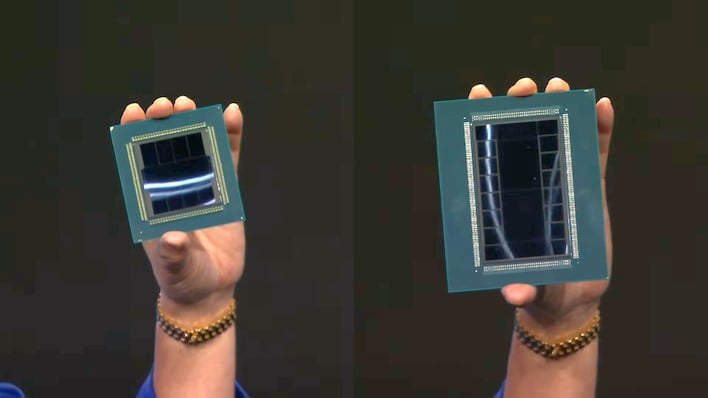
UPDATE: In fact, AMD actually had some enterprise hardware to show off, despite this being CES and not Computex. Besides the two chips above, AMD also brought along a node of its massive Helios compute servers, which you can see below, dramatically illuminated for effect:

Apparently this rack weighs over 7,000 pounds.

That server is made up of eighteen individual blades that are liquid-cooled for space. Each blade comprises four Instinct MI455X GPUs (over 250 compute units each), a dozen "Vulcano" 800 AI NICs, a Pensando Salina 400 DPU, and an EPYC Venice CPU with up to 256 CPU cores—truly a monstrous piece of kit, developed in tandem with Meta.

Thanks in part to architectural upgrades and in part due to simply being a much more massive chip, the Instinct MI455X purportedly delivers ten times the performance of the just-launched MI355X, which has to feel great if you've just purchased one of those. What's more, Dr. Su says that she expects the MI500 series to deliver an even larger jump in AI performance, which is incredible.





