



AMD FSR Redstone Tested: Four Big Radeon Gaming Upgrades Incoming


If you're thinking, "didn't FSR Redstone come out a while back in Call of Duty," you're not wrong. AMD and Activision previewed the first new technology of FSR Redstone, FSR Ray Regeneration, in Call of Duty: Black Ops 7. However, that was just a preview release, while today's release is the real deal. Let's take a look at the four technologies in FSR Redstone before we check out a couple of performance comparisons.
What Exactly Is FSR Redstone?
FSR used to stand for "FidelityFX Super Resolution," but that doesn't appear to be the case anymore. Instead, FSR is an umbrella term that encompasses an array of graphics technologies, and 'Redstone' is the current version of it. Where previously, FSR was primarily an upscaling solution with frame generation added later, FSR Redstone is a suite of four distinct technologies that are all augmented by AI.
Only three of these technologies are actually new. FSR Upscaling is the same FSR 4 technology that we know and love already. You might be casting a raised eyebrow at FSR Frame Generation too, but this is actually a new version of the tech that is enhanced by AI, rather than the analytic method used before.
The other two new technologies are FSR Ray Regeneration and FSR Radiance caching, and they both have to do with ray-tracing. Ray Regeneration uses AI to perform ray-tracing denoising, and it can produce cleaner, more-resolved results. Meanwhile, Radiance Caching uses a neural network that observes the way light bounces in a scene and can then infer it early in later interactions in the same scene; this has the potential to dramatically increase path-tracing performance—a key detail for the PlayStation 6.

We'll start with FSR upscaling, because it'll be brief. For those unfamiliar, FSR is AMD's smart upscaler, analogous to DLSS from NVIDIA, XeSS from Intel, and PSSR from Sony, among others. The way these work is by taking a low-resolution input that requires less horsepower to render and then intelligently upscaling it and outputting something that looks similar to native rendering, yet at a much lower performance cost.

Low resolution performance was a particular weak point of FSR3, so this is great to see.
In our testing, AMD's FSR4 is legit, offering competitive results with Intel's XeSS and often, NVIDIA's DLSS. While Team Green's new transformer-based DLSS does better in certain areas (like animated textures, which are hard for temporal upscalers because there's no motion data), FSR4 still produces excellent results overall, even when upscaling from very low resolutions as shown above. FSR 'Redstone' Upscaling is based on FSR4, so we have no complaints here.

The extant version of AMD's FSR Frame Generation is pretty good too. If you're the type to use frame generation at all, the company's Fluid Motion Frames, which are a driver-integrated version of frame generation, offers acceptable results. However, when artifacts happen, they can be pretty apparent. With today's FSR Redstone release, AMD is releasing a new ML-powered frame generation method that promises radically reduced artifacting.

The example that AMD gave is in F1 25, where the classical, analytic frame generation method produces considerable flickering artifacts on car shadows, which can be severe to the point that we would say they render FSR3.1 frame generation unusable in this title. FSR Redstone cleans all of that up, with proper, temporally-stable shadows maintained across frames. If you've got a high-refresh-rate monitor that you're not making full use of, frame generation could get you that extra visual fluidity. We probably wouldn't use it in a racing game regardless, though, due to the extra input latency.

FSR Ray Regeneration is probably the hardest to explain despite being the simplest feature from the perspective of an end-user. The long and the short of it is that even the most powerful GPUs of today are simply not fast enough to perform ray-tracing anywhere near as fast as they need to, to produce a stable, high-quality image. Instead, they cast far fewer rays than are really needed—sometimes just one ray per pixel—and then use algorithms to turn the horribly noisy render into a clear, visually coherent image.

Well, what if we had an AI do that instead? This is exactly the perfect case for AI interpolation because AI models are essentially prediction machines; finding the signal from the noise is something they're very good at. As you can see from AMD's results above, ray generation radically improves the quality of noisy reflections in Call of Duty: Black Ops 7, and as it comes to more games, the benefits will be clear.

Finally, we come to FSR Radiance Caching. This is exactly what it sounds like from the name: an AI "learns" the pattern of light bounces in a scene, and then future frames in that scene don't need to have their rays fully traced. Instead, the AI can 'guess' what the bouncing light should look like. While that sounds dubious, we're going to have to see it in action first hand to make any judgment calls, but it's not available in any games just yet. Expect to see games that support FSR Radiance Caching arrive next year.

To be clear, neural radiance caching is not a new idea; the foundation for the concept was laid in 2021, and NVIDIA already supports it in its RTXGI SDK. Still, as we rush headlong toward a path-traced future for AAA games, this technology is going to be critical to maintaining performance. As far as we know, the only release currently featuring this technology (NVIDIA's version, of course) is Half-Life 2 RTX, but we expect it to become commonplace in the next generation of games.
AMD FSR Redstone Performance Testing

The goal in all of this is to enable improved game performance without sacrificing visual fidelity, because ray tracing is just too darn demanding at native 4K resolution. AMD says FSR Redstone offers a 4.7x performance uplift over enabling ray-tracing effects at native 4K resolution in Call of Duty: Black Ops 7.

AMD presents these game benchmarks to prove its point. The titles that see the smallest improvements are the ones that use the fewest ray-tracing effects, like God of War: Ragnarok that doesn't have any. Of course, these results include frame generation; if you halve the "FSR Redstone" frame rate, the gains become considerably less impressive. There's also no discussion of image quality here.
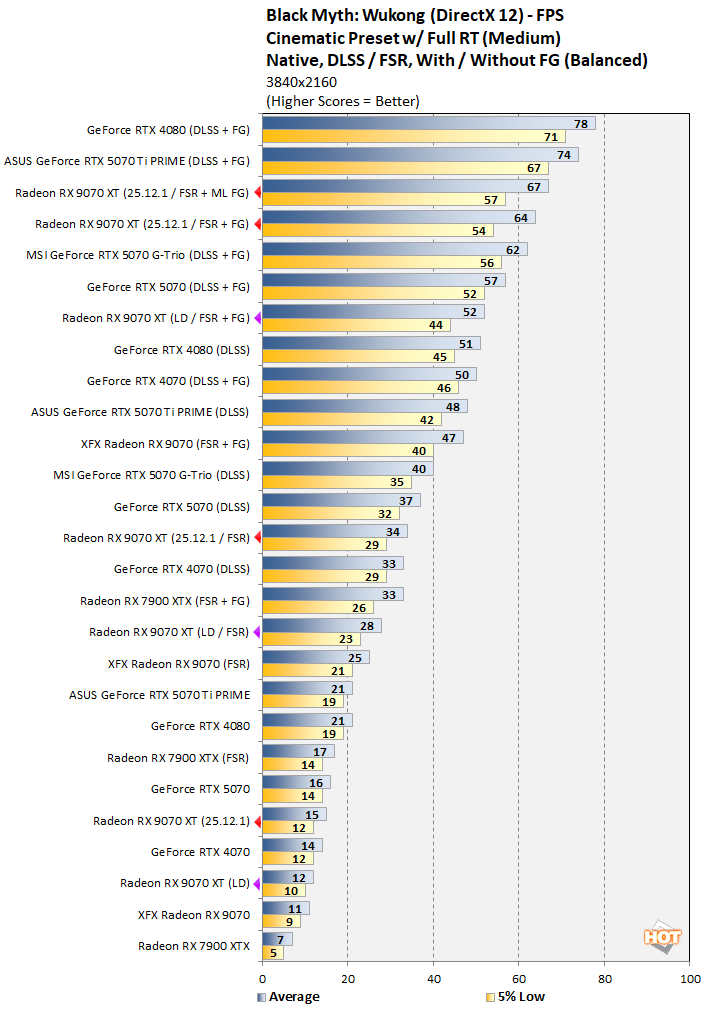
LD = Launch Driver, v25.12.1 = New Release
We decided to run some benchmarks to both verify AMD's findings and also confirm any performance tuning that the company has done since the launch of its latest graphics cards. In Black Myth: Wukong on its incredibly taxing 'Cinematic' preset, we see frankly very low performance without any upscaling or frame generation technologies, but cranking FSR upscaling to 'Balanced' puts us somewhere near playable with a 34 FPS average.
Then, enabling FSR Redstone Frame Generation improves both performance and image quality over the older analytic frame-gen. Good stuff all around, although we'd probably still lower settings a bit to play this title. Worth noting that driver optimizations since launch have drastically improved performance in this game, and the RX 9070 XT now rides much closer to the RTX 5070 Ti rather than the RTX 5070 as it did at launch. Not bad.
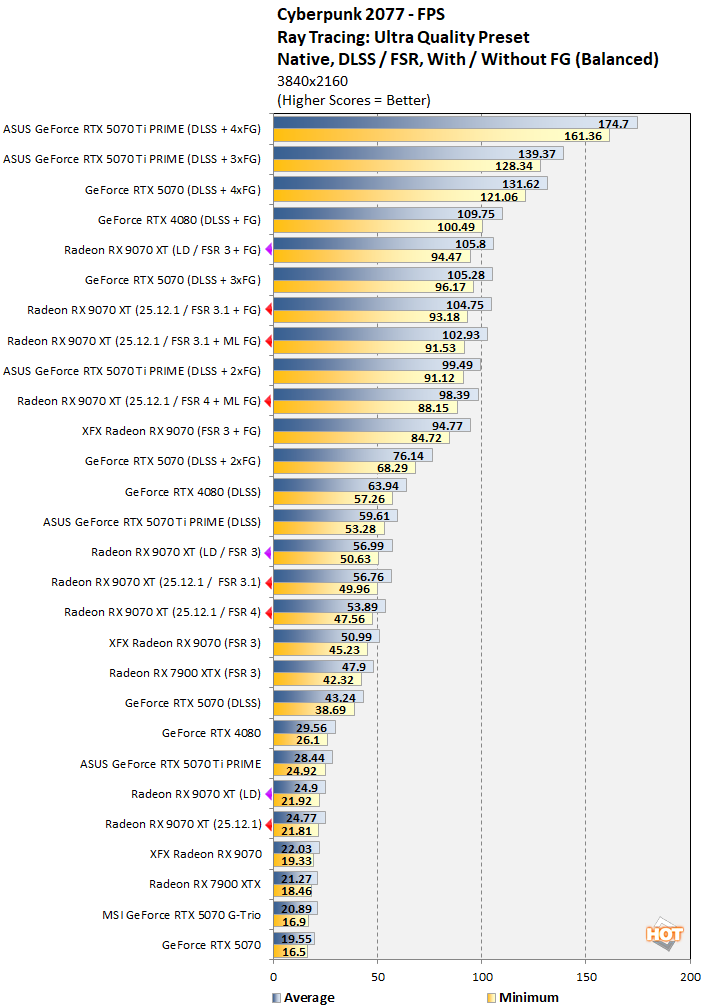
LD = Launch Driver, v25.12.1 = New Release
In this very long and cluttered Cyberpunk 2077 chart, we're testing AMD's finest graphics card along with its new FSR Redstone technologies against a multitude of other graphics cards, including NVIDIA GPUs with multi-frame generation enabled. While the FSR Redstone result—that's the "FSR 4 + ML FG" result—is a bit slower than the results with FSR 3, that's to be expected, as FSR 4 is a bit heavier than the older method. However, it also delivers superior image quality results. In our testing, we see a 3.9x uplift from FSR Redstone in Cyberpunk 2077, but the difference comes down to the fact that our test results aren't using the same settings that AMD was.
Sounds Great, Now How Do I Use It?

If you're playing one of the games in the image above, at least one of AMD's FSR Redstone features should be available right through the game menu. However, the list above is nowhere near comprehensive, and none of the games above include all of the features, because FSR Radiance Caching requires game integration and is only just releasing for developers today. As such, we won't be able to test the full suite of FSR Redstone features until a game actually comes out supporting all of them.

If you're not playing one of the games above, you'll probably have to make use of the overrides built into the AMD Software. This allows you to upgrade games that use FSR 3 upscaling to the superior FSR4 (now FSR Redstone) upscaling, and it also allows you to replace the older analytic frame generation with the new ML variation.
The bad news is that all of this is exclusive to AMD's Radeon RX 9000 series GPUs. RDNA 3 and older architectures, including the brand-new RDNA 3.5 architecture found in both extant APUs as well as the new chips AMD is expected to launch at CES, are all limited to the analytic upscaler and frame generation methods. AMD's support matrix makes it clear: all of these ML-powered features are only available for RDNA 4 GPUs. At least you can still hack your way into a version of FSR4 upscaling, anyway.

Truth be told, this launch as it stands today is probably more interesting for game developers than for gamers. The only thing launching today that will immediately benefit AMD Radeon gamers in the short term is the AI-enhanced frame generation. Instead, this launch is really about getting the new FSR Redstone SDK out there and into the world. That way, developers can start implementing all of this fancy AI-powered technology into their games.
It's a bit of a shame that Microsoft hasn't stepped up to make a unified API for these functions, though. Game developers are left with little choice but to implement each company's upscaler individually, and while much of the work can be reused (AMD famously said that implementing FSR2 in a DLSS game was "a five-minute job"), it still means that AMD and Intel, with their smaller market share, sometimes get left out.
In any case, we're very pleased to see AMD implementing more advanced graphics technologies. If the future really is path-traced games, then these features are going to be critical to keeping performance at a playable level while the GPU is busy extrapolating the paths of photon beams.





