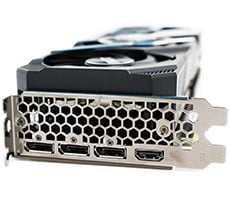
NVIDIA GeForce 7800 GTX


 |
|
;) Doom 3 |
The first round of Doom 3 tests on the previous page focused on single-player performance. This time around, though, we'll take a look at a few test results using a custom multi-player demo to see how things unfold. These tests were taken with our custom "HH_Frag2" demo, which is a recording of a five-player online deathmatch that took place in the "Frag Chamber" map. Like the single-player tests, we ran this batch of benchmarks with Doom 3 set to its "High-Quality" mode. The timedemos were run at resolutions of 1,280 x 1,024 and 1,600 x 1,200 without anti-aliasing enabled and then with 4X anti-aliasing and 8X anisotropic filtering enabled concurrently. |


Our custom multi-player Doom 3 benchmark is a bit less demanding on the graphics sub-system than the single player test from the previous page, and as such, it hit a CPU bottleneck much earlier. In this round of tests, the GeForce 7800 GTX configurations, and the 6800 Ultra SLI rig, were essentially CPU bound until we enabled 4X anti-aliasing (8X anisotropic filtering is enabled by default when running Doom 3 in "High Quality" mode). This wasn't the case with the other system configurations though.
The same things that helped the 7800 GTX surge ahead of the pack on the previous page (fill rate, bandwidth, compute performance) help it here as well. The GTX was up to 93% faster than any other single card configuration in our Doom 3 multi-player test, and the GTX SLI rig just crushed the competition by as much as 190%. Also note that the GeForce 7800 GTX SLI configuration was the only one able to consistently break the 100 FPS mark at 1,600 x 1,200 with anti-aliasing and anisotropic filtering enabled.