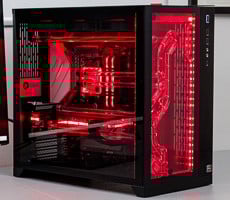
CyberPower Trinity Xtreme Gaming PC Review: 'Unique' Is An Understatement

Power consumption is an important consideration  if you’re particularly eco-conscious, but it’s not on the radar of most gamers. We expect our high-end hardware to chew up more power than lesser powered systems. Still, it doesn’t hurt to know what you’re getting into, so we put the CyberPower Trinity under load and compared its power consumption to other heavy-duty systems. We also tested the Trinity’s power use when idle.

trinity power

We booted up the Trinity and gave it plenty of time to settle down, then tested its power consumption for the idle score. Then, we fired up Prime95 and FurMark to give the Trinity something to chew on and took another reading. At idle, the system pulled 54 Watts, which is much lower than we've seen from recent systems. But when we kicked things up a notch, the Trinity jumped to the high 300's and settled on 404 Watts. That makes the Trinity a fairly power-friendly system, at least as far as muscle-bound gaming machines go.

As for noise, the CyberPower Trinity struck us as a little louder than desktop systems we've tested recently. The system uses air cooling except for the processor, though that too has a fan (thanks to its radiator). When idle, the system is on par with other gaming PCs. But under load, the Trinity’s fans were audible. We don’t think the noise will bother most gamers, but it’s worth noting.

Joshua Gulick

Joshua Gulick

Josh cut his teeth (and hands) on his first PC upgrade in 2000 and was instantly hooked on all things tech. He took a degree in English and tech writing with him to Computer Power User Magazine and spent years reviewing high-end workstations and gaming systems, processors, motherboards, memory and video cards. His enthusiasm for PC hardware also made him a natural fit for covering the burgeoning modding community, and he wrote CPU’s “Mad Reader Mod” cover stories from the series’ inception until becoming the publication editor for Smart Computing Magazine.  A few years ago, he returned to his first love, reviewing smoking-hot PCs and components, for HotHardware. When he’s not agonizing over benchmark scores, Josh is either running (very slowly) or spending time with family. 

Related content