CyberPower Trinity Xtreme Gaming PC Review: 'Unique' Is An Understatement

Gaming is the CyberPower Trinity Xtreme’s priority, but it clearly has the hardware to handle business on the nights you bring work home. To see how it stacks up against other gaming systems in office tasks, we kicked off testing with Futuremark’s PCMark 8 and Maxon Cinebench.

PCMark 8
General System Performance

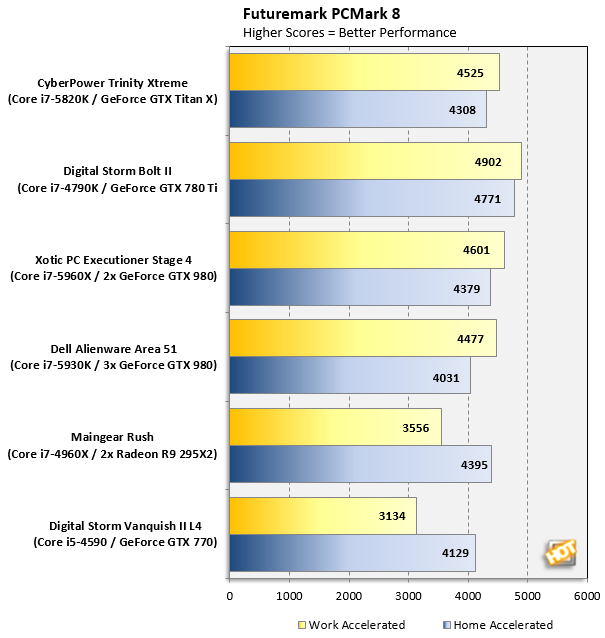
PCMark 8 simulates the workloads computers face in several different settings, including home and office use. The benchmark also has a test that simulates a creative professional’s usage, as well as battery and storage tests. We ran the tests with OpenCL acceleration enabled to leverage the power of the CPU and GPU.
trinity pcm8

The CyberPower Trinity’s Core i7-5820K processor does the heavy lifting here, and it’s clear that the system can handle ordinary work and home tasks with ease. Its performance is in the upper echelon here, though not class leading. 

Cinebench R15 64-bit
Content Creation Performance

Based on Maxon Cinema 4D software, this test uses a 3D scene and polygon and texture manipulation to assess GPU and CPU performance. We run the Main Processor Performance (CPU) test, which builds a still scene containing about 2,000 objects, for total polygon count above 300,000.

trinity cinebench

The system’s Cinebench score isn’t a knockout, but that’s not necessarily a problem. The Trinity is a gamer, so the following tests will have a bigger say in its value in our opinion. 


Joshua Gulick

Joshua Gulick

Josh cut his teeth (and hands) on his first PC upgrade in 2000 and was instantly hooked on all things tech. He took a degree in English and tech writing with him to Computer Power User Magazine and spent years reviewing high-end workstations and gaming systems, processors, motherboards, memory and video cards. His enthusiasm for PC hardware also made him a natural fit for covering the burgeoning modding community, and he wrote CPU’s “Mad Reader Mod” cover stories from the series’ inception until becoming the publication editor for Smart Computing Magazine.  A few years ago, he returned to his first love, reviewing smoking-hot PCs and components, for HotHardware. When he’s not agonizing over benchmark scores, Josh is either running (very slowly) or spending time with family. 

Related content