ASUS ROG Xbox Ally X Review: Excellent But Evolutionary Handheld PC Gaming


ASUS ROG Xbox Ally X Thermal And Acoustic Performance Testing
This section is going to be relatively short because there's not really much to say. Much like the previous two ROG Ally devices, the Xbox Ally X is inaudible in essentially all cases. ASUS knows how to do thermal design--just look at the ROG Flow z13, which cools up to 80W in a chassis not much bigger than this. Unless you're sitting in an anechoic chamber, you're not going to be bothered by fan noise from this device.
This result was captured while looping the Cyberpunk 2077 benchmark for more than 20 minutes with the machine on 'Turbo' mode (handheld, unplugged.) As you can see, we're simply not approaching any kind of thermal limit, and the system remained utterly silent. You can get the temperatures up into the spicy 90-degree range if you really go hard with it plugged in, but it never throttles, and the fans remain inaudible if you have any kind of background noise at all.
ASUS ROG Xbox Ally X Battery Life Testing
Battery life is almost always a sore spot for handhelds. Gaming on the go wants a lot of power, and PC gaming is primarily targeted at more powerful desktop systems that can burn as much power as the user is willing to pay for. Flipping that paradigm on its head to enable portable PC gaming has been a challenge, and it's one the industry still hasn't exactly solved. Hybrid game consoles like the Nintendo Switch absolutely destroy even the most long-lived handhelds, in terms of battery life. So how does the ASUS ROG Xbox Ally X do?Well, we don't actually know just yet, because the benchmark hasn't completed yet. Here's what we can tell you: in 3 hours and 45 minutes of playing back Full HD video with sound with brightness calibrated to 110 nits, the machine drained 15% of its battery. If it continues at that rate, the ASUS ROG Xbox Ally X will run for about 25 hours. It's possible that battery drain will pick up in the back half, but that's not usually how it goes. We'll report back once the test finishes sometime tomorrow, probably.
We haven't had a chance to test gaming battery life either, but we suspect it's going to be at least as good as the ROG Ally X, given that it uses more efficient architectures on the same fabrication process. If you're not wringing every big of performance out of the Ryzen Z2 Extreme, it should actually be even more efficient than the Ryzen Z1 Extreme.
UPDATE: The battery life tests have concluded, and we have the results for you. First up, video playback battery life, where, well, just see for yourself.
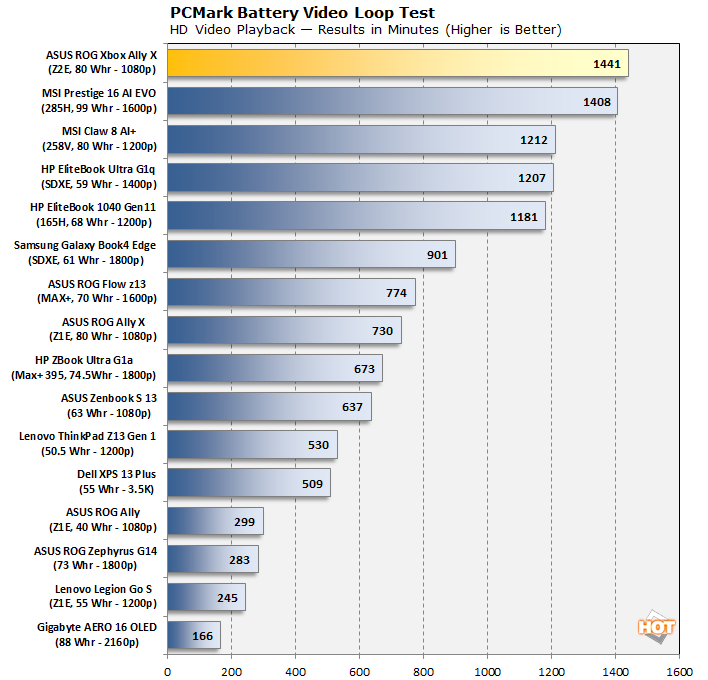
That's right, we have a new record at exactly one minute past 24 hours. It goes without saying that this is a frankly preposterous amount of time, but the machine really did achieve this result. As we noted above in our original review, we started the benchmark the night before we posted the review, and it was still going.
Of course, nobody is watching videos for 24 hours straight on a gaming handheld. What about gaming battery life?
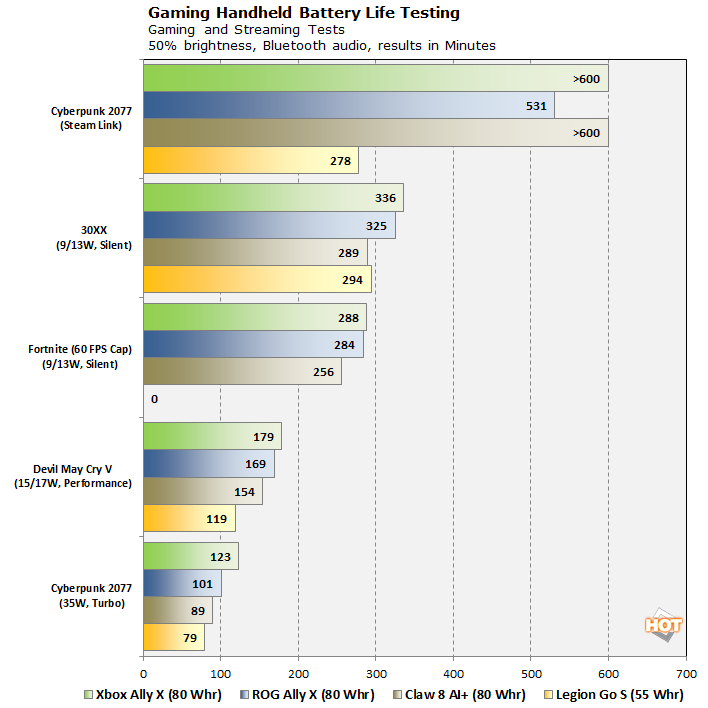
Results are excellent here, too, although not nearly as dominating as in the video playback test. It's clear that AMD has made some significant improvements to the power efficiency of its video decode hardware, but the larger GPUs and more advanced CPUs of the Ryzen Z2 AI Extreme allow for small improvements in power efficiency over the Ryzen Z1 Extreme. Actually, it's entirely possible that these differences are simply down to the Xbox Full Screen Experience, which is where we did our testing. Either way, the gaming battery life of this system is fantastic.
ASUS ROG Xbox Ally X: Our Final Thoughts
There's no getting around it--the ASUS ROG Xbox Ally X mostly succeeds because it is a ROG Ally X, and that device was fantastic. This one is also fantastic. If you were considering that device, you don't mind (or prefer) the extra handgrips, and you have the extra $200, then this is the one to go for. It's pretty much that simple. Of course, that's a lot of conditionals.Plainly speaking, the Ryzen AI Z2 Extreme doesn't particularly impress versus its predecessor. As we said earlier in the review, if you were hoping for a big performance uplift due to the 33% larger GPU, well it's just not there. Some games do actually benefit pretty significantly, and if you take into account the gains from playing in the Xbox Full Screen Experience, then this machine can be as much as 40% faster than the original ROG Ally X. That's an outlier case, though.
Much more impressive are the battery life and the Xbox Full Screen Experience. Even though we didn't do most of our testing using it (because we couldn't), the Xbox Full Screen Experience seems to offer a considerable upgrade in consistency for some games. We're definitely going to explore this further, so stay tuned.
Lastly, we really would have liked to have seen 32GB of RAM in this machine, especially at this price point. 24GB isn't necessarily limiting, but large local memory is one of the main advantages of integrated graphics, and this system only really lets you commit 8GB to the graphics adapter before your system RAM starts running a bit short, especially considering how many background processes are running here.
Indeed, the only real sticking point in our recommendation of this gaming device is that $1,000 price tag. This is undoubtedly a premium product for people who will appreciate it. Still, a thousand US dollars is a lot of money, and you can buy a whole lot more computer for that money if you're willing to go with a larger form factor. We've seen GeForce RTX 5060 laptops going for this kind of money recently as well. Of course, they're completely different form factors and target different users, but it illustrates the point—you have to really want this type of device, specifically for it to be worth it. For those to whom it makes sense, you can't beat the ROG Xbox Ally X.