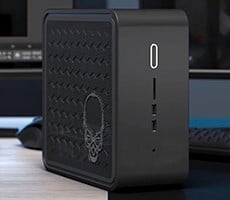
Soltek's QBic EQ3901-300P SFF PC


The Soltek QBic EQ3901-300P is equipped with a Phoenix / Award BIOS, that is similar to the vast majority of motherboards currently available. If you've entered the system BIOS on a system in the last few years, these menus will likely be very familiar to you...
 |
|
;)
;)
;)
;)
;)
;)
;)
;)
If you take a look at the screenshots above, you'll probably be familiar with most of the menu items listed in the EQ3901's BIOS. We did not find anything revolutionary there, but the usual assortment of options for manipulating and tweaking all of the on-board components, memory and other features were there. Because this is a small form factor system, with lots of integrated features, there are more toggles available than some motherboards, but there was nothing surprising to be found. In the "Frequency and Voltage Control" section of the BIOS we found all of the system's overclocking options.
 |
|
;)
;)
;)
;)
;)
;)
;)
;)
;)
;)
;)
Looking at the frequency and voltage options, you'd think the EQ3901-300P was geared for overclockers, but there is one major limitation. The EQ3901-300P's BIOS gives users the ability to alter their processor's multiplier and select any processor bus speed between 200MHz and 250MHz, in 1MHz increments. The AGP bus speed can be set to "Auto" or locked at 66MHz or 75.4MHz and memory can be run asynchronously from the bus speed. And the HT link speed can be set to 200MHz, 400MHz, 600MHz, 800MHz, or 1GHz. Processor, AGP, and memory voltages are also user configurable. The CPU voltage can be increased up to 1.7v, AGP voltages range from 1.5v to 1.8v (.1v increments), and memory voltage can also be altered, with a range of 2.6v to 2.9v available.
The EQ3901-300P had no problem reaching a 250MHz FSB, which makes the system's motherboard a good overclocker, but temperatures could get out of hand quickly in this system. Our FX-53 processor idled at about 46oC - 48oC. Under load, at stock speeds, temperatures climbed into the high 50s / low 60s. And overclocking the CPU obviously pushed temperatures even higher, which is a little too warm for an A64 in our opinion.