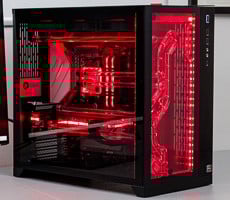
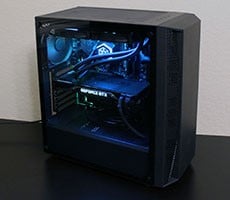
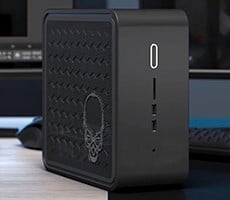
Soltek's QBic EQ3901-300P SFF PC


How we configured our test systems: When configuring the test systems for this review, we first entered the system BIOS and set each board to its "Optimized" or "High-Performance Defaults." We then manually configured our RAM to run at 200MHz (DDR400), with the timings set by the SPD. The hard drives were then formatted, and Windows XP Professional was installed. When the installation was complete, we hit the Windows Update site and downloaded all of the available updates, with the exception of the ones related to Windows Messenger. Then we installed all of the necessary drivers and removed Windows Messenger from the system altogether. Auto-Updating, drive indexing, and System Restore were also disabled, and we set up a 768MB permanent page file on the same partition as the Windows installation. Lastly, we set Windows XP's Visual Effects to "best performance," installed all of our benchmarking software, defragged the hard drives, and ran all of the tests...
 |
|
| SYSTEM 1: S939 - AMD Athlon FX-53 (2.4GHz) Soltek QBic EQ3901-300P VIA K8T800 Pro 2x512MB Corsair PC3200 CL2 Radeon 9800 Pro Onboard 10/100 Ethernet Onboard Audio WD "Raptor" 36GB Hard Drive 10,000 RPM SATA Windows XP Pro VIA Hyperion 4.53 DirectX 9.0c |
SYSTEM 2: S939 - AMD Athlon FX-53 (2.4GHz) WinFast 755FXK8AA-8EKRS SiS 755FX 2x512MB Corsair PC3200 CL2 Radeon 9800 Pro Onboard 10/100 Ethernet Onboard Audio WD "Raptor" 36GB Hard Drive 10,000 RPM SATA Windows XP Pro SiS Gart 1.17E DirectX 9.0c |
SYSTEM 3: S939 - AMD Athlon FX-53 (2.4GHz) MSI K8N Neo2 Platinum NVIDIA nForce3 250GB 2x512MB Corsair PC3200 CL2 Radeon 9800 Pro Onboard 10/100 Ethernet Onboard Audio WD "Raptor" 36GB Hard Drive 10,000 RPM SATA Windows XP Pro nForce Driver 4.27 DirectX 9.0c |
SYSTEM 4: S939 - AMD Athlon FX-53 (2.4GHz) MSI K8T Neo2-FIR VIA K8T800 Pro 2x512MB Corsair PC3200 CL2 Radeon 9800 Pro Onboard 10/100 Ethernet Onboard Audio WD "Raptor" 36GB Hard Drive 10,000 RPM SATA Windows XP Pro VIA Hyperion 4.53 DirectX 9.0c |
 |
|
We began our testing with SiSoftware's SANDRA, the System ANalyzer, Diagnostic and Reporting Assistant. SANDRA consists of a set of information and diagnostic utilities that can provide a host of useful information about your hardware and operating system. We ran three of the built-in subsystem tests that partially comprise the SANDRA 2004 suite (CPU, Multimedia, and Memory). All of these tests were run with our processor set to its default clock speed of 2.4GHz (12x200MHz). (Note: Some of these boards ran the processor with an FSB higher than 200MHz. Where necessary, we manually set the FSB to 200MHz to keep the playing field level.)


From this point forward, we'll be comparing the performance of Soltek's QBic EQ3901-300P to three other systems, each powered by different chipsets. MSI's K8N Neo2 Platinum is based on the nForce 3 Ultra chipset, the Winfast board is based on the SiS 755FX, and the K8T Neo2-FIR is powered by VIA' K8T800 Pro.
The Soltek QBic EQ3901-300P performed on par with the full sized systems in all three of the SANDRA performance modules we tested with. In the CPU benchmark, the EQ3901 performed in-line with the K8T Neo2-FIR, which was to be expected considering both systems use the same motherboard chipset. The same held true in the Multimedia and Memory benchmarks, where the EQ3901 and K8T again performed similarly.