Inside A Simulated Steam Machine: 27 Games Tell The Real Story


Fast forward to 2025. Valve decides to try again. It announces, alongside the Steam Frame VR headset and second-generation Steam Controller, another Steam Machine. This time it's different, though. The Steam Deck came out a few years ago as a pilot program to see if anyone wanted to play Steam games on Linux, and boy did they. Not only has Valve—flush with cash given Steam's de facto monopoly on the PC gaming distribution market—been pouring money into making Windows-games-on-Linux a reality through its Proton project, but the House of Half-Life is also making the machines itself this time, rather than relying on third-party partners.

So it goes that we now have the Steam Machine, affectionately known to many as the "GabeCube" named after beloved Valve founder Gabe Newell and the new box's resemblance to the revered Nintendo Gamecube. Well, we don't actually have it yet. In fact, nobody does, because it's not launching until next year. Critically, Valve also hasn't announced a price point for the system yet. That could be due to complications arising from the memory market's RAMageddon, or it could be that Valve never intended to announce the price before they went on sale.
Either way, we find ourselves curious over the actual capabilities of the diminutive Steam Machine. There's been quite a lot of discussion on this point. Many folks feel that the system is too slow for modern games. Others take issue with Valve's statement that the system is 4K ready, even though the company itself admits that it means "with upscaling."
Given our curiosity and wide selection of hardware at hand, there was no way we could resist. We put together a PC using standard desktop PC parts that comes pretty darn close to the configuration of the Steam Machine. Here, check out these specifications:
HotHardware's Simulated Steam Machine PC Build
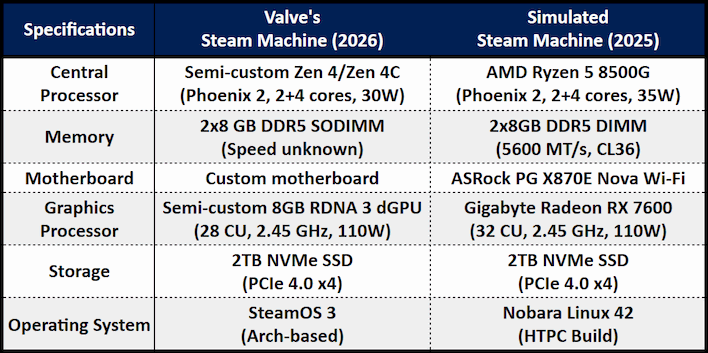
There are a few significant ways that our machine deviates from the Steam Machine's specs. First of all, our system is a desktop PC and has some of the advantages therein. For example, despite that its Ryzen 5 8500G processor is based on the same Phoenix 2 design as Valve's chip, it will merrily boost to 5 GHz on its two Zen 4 CPU cores, while Valve's machine is apparently capped at 4.8 GHz. It also has a 30W TDP, while our chip is 35W.

We're not sure about the memory configuration on Valve's system, so we chose an acceptable mid-range for ours. Likely the biggest difference in the two, though, at least in terms of game performance, is in the GPU. We were able to use LACT to set our GPU to a 110W power limit and limit the clock rate to 2.45 GHz, but there's no getting around that our chip has four extra compute units versus Valve's, though. In theory, given the power limit, this shouldn't matter that much, but in practice we expect that our machine will be a smidge faster than Valve's.
Even still, this gives us a reasonable approximation of Valve's system. Having set it up with Nobara Linux (which was quite painless as these things go), we quickly took to downloading games and trying them out. If you are in a hurry, here's the very short version: yes, it plays just about everything, and it plays very well, even in 4K—with some settings accommodations for the relatively meager GPU. If you want to skip to the "build your own simulated Steam Machine" step right now, here are some parts recommendations:
- AMD's Ryzen 5 8500G provides the CPU for our machine; it's just $156.50 at Amazon.
This six-core CPU boosts to 5GHz and includes a CPU cooler in the box. - We used a fancy board from our workbench; get the ASRock B650M-HDV/M.2 for $109.99
It has 2.5 Gigabit Ethernet and BIOS Flashback, which you'll need for the Ryzen 5 8500G. - It's expensive, but you won't beat this DDR5-5600 Kingston FURY 16GB kit for $189.99.
- This Titanium Micro 2TB NVMe SSD is well-priced for a Phison E18 drive at $161.99.
- We used a Radeon RX 7600 because it's like Valve's GPU. Here's one from ASUS for $274.99.
- However, the Radeon RX 9060 XT is much newer and faster. It's just $287.99.
Obviously, the Radeon RX 9060 XT is what we recommend if you're buying parts today. - The chassis we put it all in was the Zalman S2, which is available on Amazon for just $59.95.
- To round out your build, check out this 650W modular power supply from MSI for $79.99
Now, without further ado, let's talk about performance.
Simulated Steam Machine PC Gaming Benchmarks
If you're looking for the traditional Hot Hardware benchmark graphs, you won't find them here. This is because we didn't have anything to directly compare against, and also, because our system isn't exactly like the Steam Machine, presenting exact numbers doesn't really serve any purpose over subjective experience. Instead, we're going to talk about each game briefly, the settings we found to work best, and any quirks or notable features of the experience with that title.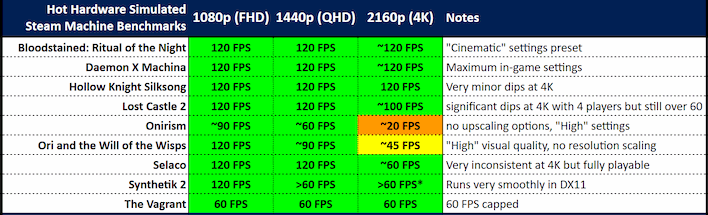
Titles marked with an asterisk required upscaling to hit that performance level.
This first set of games is exactly the sort of thing you'd expect to play on the Steam Deck or similar handhelds. They're indie games, and lower-budget titles that aren't as demanding as your typical AAA releases. We'll go over them quickly, since they're mostly very easy to run.

Bloodstained: Ritual of the Night
Bloodstained: Ritual of the Night is basically a modern-day take on Castlevania: Symphony of the Night. Unlike that classic title from 28 years ago, though, Bloodstained is fully 3D, at least in terms of the graphics. It uses Unreal Engine 4, and it has the full settings menu you'd expect from that engine, yet the game content is pretty simplistic. Even in native 4K resolution, with high-quality "Cinematic" settings, our simulated Steam Machine has no problem pushing this game over 100 FPS.

Daemon X Machina
Daemon X Machina could unfairly be described as "Great Value Armored Core". We say 'unfairly' because it really does have plenty of its own sauce going on, but it does also hew very close to the Armored Core mold. Originally developed for the Nintendo Switch, this game is no trouble at all for our Ryzen-and-Radeon desktop setup.

Hollow Knight: Silksong
Hollow Knight Silksong is a 2D game through and through, although it does make more use of 3D than its predecessor; not that there are many 3D models, but the game runs in a 3D engine (Unity) and uses that fact to have many, many layers of parallax scrolling in both fore- and backgrounds, as well as using things like depth of field for distant blur. Despite all the fancy effects, the poly counts number in the hundreds and so this game runs at a locked 120 FPS no matter what.

Lost Castle 2
You probably haven't heard about this game, and that's a darn shame. Lost Castle 2 is kind of like Golden Axe by way of Dead Cells. It's a classic beat-'em'up game that is also a Rogue-lite RPG, with color-coded itemization and equipment upgrading, multiple layers of meta-progression, and even a cute character customization system. While it primarily uses 2D sprites for characters, objects and the game environment are rendered in full 3D. Still, it's not really a problem for a recent-generation desktop PC, even in native 4K.

Onirism
Now, Onirism is a different story. This Unity-engine first-and-third-person shooter/brawler hybrid is a tour de force of game genres, from the core shooter/brawler hybrid gameplay, to straight up 3D platforming, to kart racing, tank battles, and more. It's sort of like a classic Rare platformer, if the main character were an adorable little girl who thinks she is Duke Nukem. Onirism was buggy for us until we swapped over to Proton-GE, at which point it worked well but unfortunately lacks any sort of smart upscaling. As a result, native 4K is simply too taxing for the Radeon RX 7600, but it plays very well in 1440p and below.

Ori and the Will of the Wisps
The second Ori game takes the linear structure of Ori and the Blind Forest and blows it out into a full-fledged Metroidvania. We set the game to native 4K with "High" visual settings and were surprised that it was struggling the way it was; this game is surprisingly demanding. You can claw back some performance by dropping the visual preset, but we actually recommend just enabling the game's dynamic resolution feature, which will get you to 60 FPS (or more) with some tuning of the minimum and maximum resolution values.

Selaco
The woefully underappreciated Selaco is a very modern FPS that uses the ZDoom game engine. This game, which has fully 3D levels, slopes, breakable transparent glass, voxel objects, advanced gore, iron sighting, off-hand melee attacks, interactive security systems and computers, and more—is all running on an evolution of the classic DOOM engine. It's actually remarkably heavy in 4K, but while performance can be pretty inconsistent on the max settings as we had it set, it's fully playable on this system. It also has a native Linux version, which probably helps.

Synthetik 2
The sequel to the awesome Synthetik: Legion Rising abandons the interesting-but-visually-confusing isometric 2D perspective of the previous game in favor of full 3D graphics that look fantastic. This is another Unity engine title, and while it can be pretty demanding, it's easy to configure it in a way that runs well on this system, even in 4K. We did have to use resolution scaling; the game has a slider instead of presets, and we used a 67% resolution scale to achieve an average frame rate over 60 FPS in 4K, with "High" settings.

The Vagrant
The Vagrant is another title that you've probably never heard of. A gorgeous 2D side-scrolling adventure in the vein of Vanillaware's Muramasa, it was developed by a team of just three people out of Beijing. It's a horribly overlooked release, likely because it was published by SakuraGame, well-known for publishing many 18+ adult games. This could have caused people to avoid The Vagrant for fear that it was an 18+ release. It's not, though, despite the design of the main character. Visually, this is a relatively basic 2D side-scrolling action adventure title, and so it should be no surprise that it runs at its 60 FPS cap quite consistently.
Don't care about indie games? Well then head over to the next page where we'll talk about some more demanding, bigger-budget titles...