We started testing with two benchmarks that have been in our repertoire for quite a while:
Cinebench and SiSoft SANDRA. We compared the HP Z1 Workstation to several AIOs we have recently tested, but keep in mind that these systems are generally targeted at consumers, whereas the Z1 is a pro workstation-class rig. Although this isn’t an apples-to-apples comparison, it should paint a pretty good picture of the Z1’s capabilities.
 |
| Cinebench R11.5 64-bit |
| Content Creation Performance |
|
|

Cinebench R11.5
|
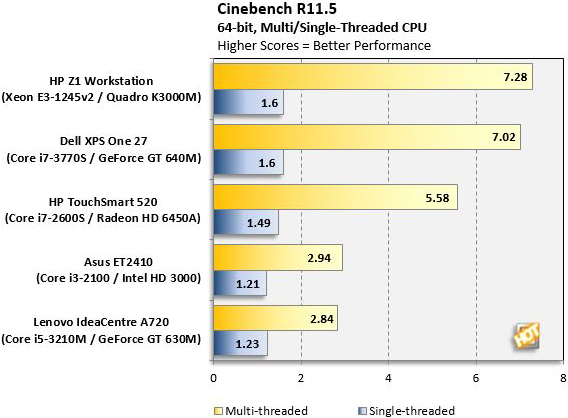
Cinebench R11.5 is a 3D rendering performance test based on Cinema 4D from Maxon. Cinema 4D is a 3D rendering and animation suite used by animation houses and producers like Sony Animation and many others. It's very demanding of processor resources and is an excellent gauge of pure computational throughput. |
The Z1 kicked off our benchmarks by putting up some strong numbers in Cinebench. The 7.28 Multi-threaded score is tops for the AIOs we’ve tested and the rig also took the top spot in OpenGL test.
|
| SiSoft SANDRA |
| Synthetic General Performance Metrics |
|
|
SANDRA
|
We like SiSoftware SANDRA (System Analyzer, Diagnostic and Reporting Assistant) because its suite of benchmark tools lets us get a look at the performance of individual subsystems.We selected the CPU Arithmetic and Multimedia tests, as well as the benchmarks that stress system memory and storage capabilities.
|
The Z1's Xeon processor finished just behind the Core i7-3770K in SANDRA's processor and multimedia tests. Versus previous AIO systems we've tested, the Z1 fared well in the physical disks and memory benchmarks, besting all of the other AIOs we've looked at to date.