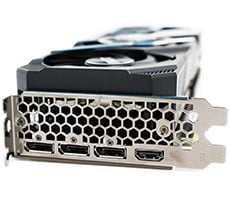
ATI All-In-Wonder Radeon X1800 XL


 |
|
;) 3DMark05 |
3DMark05 is the latest installment in a long line of synthetic 3D graphics benchmarks, dating back to late 1998. 3DMark05 is a synthetic benchmark that requires a DirectX 9.0 compliant video card, with support for Pixel Shaders 2.0 or higher, to render all of the various modules that comprise the suite. To generate its final "score", 3DMark05 runs three different simulated game tests and uses each test's framerate in the final tabulation. Fillrate, Memory bandwidth, and compute performance especially all have a measurable impact on performance in this benchmark. We ran 3DMark05's default test (1,024 x 768) on both of the cards we tested, and have the overall results posted for you below. |

The All-In-Wonder X1800 XL and XFX GeForce 7800 GT were evenly matched in the default 3DMark05 benchmark. Less than 30 points separated the two cards, a difference of less than 1%. Needless to say, a difference that small falls well within the margin of error in this test.
 |
|
;) SC: Chaos Theory |
We've recently added Ubisoft's Splinter Cell: Chaos Theory, to our suite of game benchmarks. Based on a heavily modified version of the Unreal Engine, enhanced with a slew of DX9 shaders, lighting and mapping effects, Splinter Cell: Chaos Theory is gorgeous with its very immersive, albeit dark environment. The game engine has a shader model 3.0 code path that allows the GeForce 6 & 7 Series of cards, and the new X1000 family of cards, to really shine, and a recent patch has implemented a shader model 2.0 path for ATI's X8x0 generation of graphics hardware. For these tests we enabled the SM 3.0 path on both cards, but High Dynamic Range rendering was disabled. We benchmarked the game at resolutions of 1,280 x 1024 and 1,600 x 1,200, both with and without anti-aliasing and anisotropic filtering enabled. |


Both cards also performed similarly in the Splinter Cell: Chaos Theory benchmark. Without any additional pixel processing enabled, the XFX GeForce 7800 GT finished well ahead of the All-In-Wonder X1800 XL, but with anti-aliasing and anisotropic filtering enabled, performance between the two cards was very close. At the lower resolution, the GeForce had an approximate 2.5 FPS lead that shrunk to just over 1 frame per second once we raised the resolution to 1600x1200. Had the XFX GeForce 7800 GT been clocked at NVIDIA's reference specs, this test would likely have gone in ATI's favor.