Asus CrossHair NF590 SLI: Republic of Gamers

To see how the Asus CrossHair fared in a high-end gaming scenario, we also tested the motherboard with some popular games at high-resolution settings that taxed the graphics sub-system of each of the platforms.

Performance Comparisons with F.E.A.R
More Info: www.whatisfear.com/us


F.E.A.R

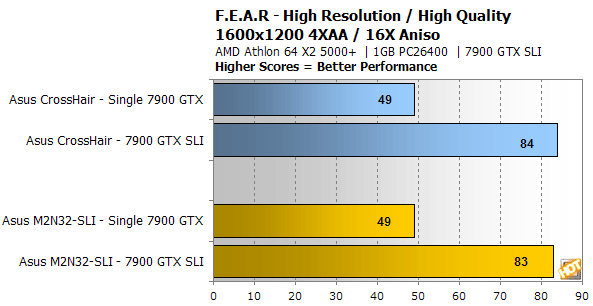
One of the most highly anticipated titles of 2005 was Monolith's paranormal thriller F.E.A.R. Taking a look at the minimum system requirements, we see that you will need at least a 1.7GHz Pentium 4 with 512MB of system memory and a 64MB graphics card, that is a Radeon 9x00 or GeForce4 Ti-class or better, to adequately run the game. Using the full retail release of the game patched to v1.03, we put the graphics cards in this review through their paces to see how they fared with a popular title. Here, all graphics settings within the game were set to the maximum values, but with soft shadows disabled (Soft shadows and anti-aliasing do not work together currently). Benchmark runs were then completed at a resolution of 1600x1200 with anti-aliasing and anisotropic filtering enabled.


In a high-resolution gaming scenario, where the graphics cards become the bottleneck as opposed to the CPU and memory, the M2N32-SLI and CrossHair perform identically.  There was technically a 1 FPS difference in the SLI tests, but F.E.A.R. doesn't report the framerate with fractions, so the real difference here is likely less than 1 FPS.

Performance Comparisons with Quake 4
Details: www.quake4game.com

Quake 4
id Software, in conjunction with developer Raven, recently released the latest addition to the wildly popular Quake franchise, Quake 4. Quake 4 is based upon an updated and slightly modified version of the Doom 3 engine, and as such, performance characteristics between the two titles are very similar.  Like Doom 3, Quake 4 is also an OpenGL game that uses extremely high-detailed textures and a ton of dynamic lighting and shadows, but unlike Doom3, Quake 4 features some outdoor environments as well. We ran these Quake 4 benchmarks using a custom demo with the game set to its "High-Quality" mode, at a resolution of 1600x1200 with 4X AA and 8X aniso enabled simultaneously.

Once again the CrossHair and M2N32-SLI performed at virtually the same level in our high-res Quake 4 benchmark. With a single card installed, the CrossHair was a bit faster, but with dual cards installed running in SLI mode, the M2N32-SLI pulled out in front.  In both test configurations though, the performance delta was less than 1 frame per second.


Marco Chiappetta

Marco Chiappetta

Marco's interest in computing and technology dates all the way back to his early childhood. Even before being exposed to the Commodore P.E.T. and later the Commodore 64 in the early ‘80s, he was interested in electricity and electronics, and he still has the modded AFX cars and shop-worn soldering irons to prove it. Once he got his hands on his own Commodore 64, however, computing became Marco's passion. Throughout his academic and professional lives, Marco has worked with virtually every major platform from the TRS-80 and Amiga, to today's high end, multi-core servers. Over the years, he has worked in many fields related to technology and computing, including system design, assembly and sales, professional quality assurance testing, and technical writing. In addition to being the Managing Editor here at HotHardware for close to 15 years, Marco is also a freelance writer whose work has been published in a number of PC and technology related print publications and he is a regular fixture on HotHardware’s own Two and a Half Geeks webcast. - Contact: marco(at)hothardware(dot)com

Related content