

iPhone Duo Review: Apple's First Foldable Impresses Despite Flaws

iPhone Duo Max Reception And Sound Quality
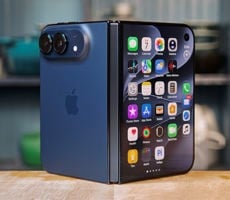
On the audio front, the iPhone Duo packs excellent-sounding stereo speakers that support Dolby Atmos content via Apple Music. And, unlike Samsung’s Galaxy Z Fold8, the Duo’s diagonal speaker placement delivers stereo sound regardless of screen orientation when the handset is open. It’s a small detail, but it makes a big difference when watching landscape videos without the built-in speakers.
Considering the Duo doesn’t even have a SIM tray, it’s not surprising that it also lacks a headphone jack. Instead, it supports wired audio accessories over USB (digital only) and wireless audio devices via WiFi (AirPlay) and Bluetooth (AAC and SBC codecs only). Apple still doesn’t offer LDAC, LHDC, and aptX HD/lossless Bluetooth codecs on any iPhone, which is unfortunate considering these are widely available on Android handsets.
iPhone Duo Performance
The iPhone Duo shares Apple’s flagship 2nm A20 Pro SoC with the iPhone 18 Pro and 18 Pro Max. It features six CPU cores (two performance cores, four efficiency cores, 4.93 GHz max clock speed), seven GPU cores with Neural Accelerators and hardware-accelerated ray tracing), and dual 16-core Neural Engines. The Duo pairs its A20 Pro chip with 12GB of unified memory (in-wafer RAM), and 256GB, 512GB, 1TB, or 2TB of storage.As you’d expect from a handset running Apple’s highly optimized iOS 27 on the company’s flagship A20 Pro SoC, the iPhone Duo feels extremely quick and responsive in day-to-day tasks. I put it through my standard ringer of productivity, communication, social media, and entertainment apps and it never skipped a beat. I even played graphically demanding games like Genshin Impact and Death Stranding Director's Cut without trouble.
Subjective performance is one thing, but the iPhone Duo was no slouch running our usual collection of benchmarks. While it throttled more than the iPhone 18 Pro Max when running sustained workloads, it still managed a score of 70.5% in 3DMark’s Steel Nomad Light Unlimited stress test, which isn’t too shabby. This isn’t really surprising, since the iPhone Duo vapor chamber is much smaller than the iPhone 18 Pro Max’s.
iPhone Duo Geekbench 6 Results
GeekBench is a cross-platform benchmark that simulates real-world processing workloads in image processing and particle physics calculation scenarios. We tested all of the smartphones featured here with GeekBench's single and multi-core workloads.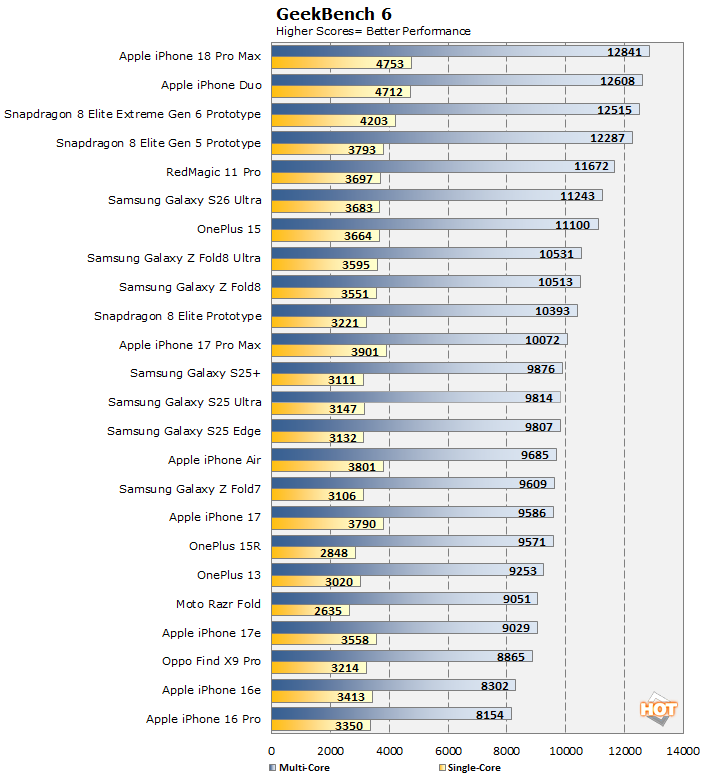
GeekBench 6 includes new ways of testing multi-core configurations and uses higher-resolution assets. As you can see, Apple's A20 Pro (7 GPU cores) beats Qualcomm's Snapdragon 8 Elite Extreme Gen 6 in both single-core and multi-core performance.
iPhone Duo Geekbench AI 1.6 Results
Geekbench AI runs ten separate tests, eight of which fall into the domain of Computer Vision while the remaining two are Natural Language Processing benchmarks. Scores are based not only on how rapidly the machine or component can iterate on the test but also on how accurate the output is compared to a "ground truth" result obtained using full-precision processing.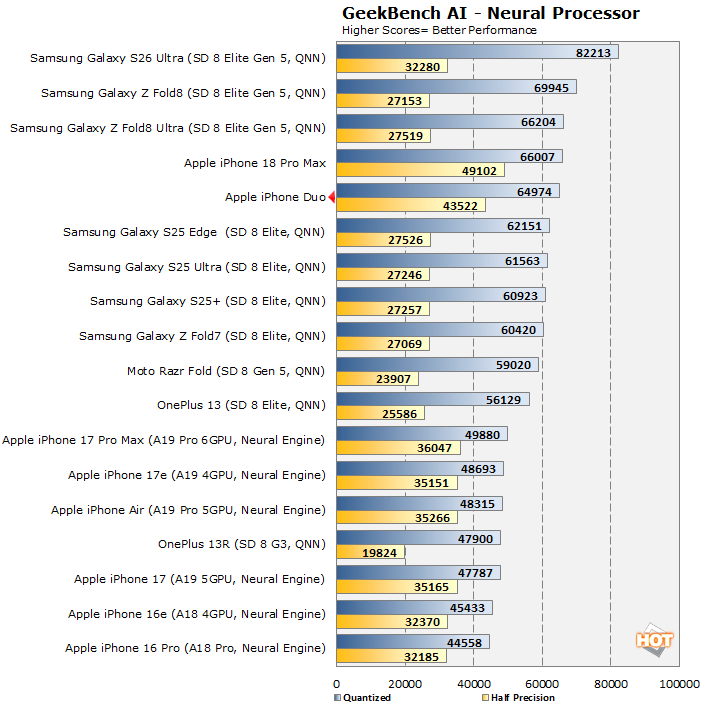
In the half precision test, the iPhone Duo crushes the competition. In the quantized test, however, Apple's A20 Pro (7 GPU cores) can't quite catch Qualcomm's Snapdragon 8 Elite Gen 5.
iPhone Duo AnTuTu 8 Results
AnTuTu’s latest benchmark returns a number of metrics ranked with somewhat nebulous scores, rather than frame rates or time to complete. Here we're running the latest version of AnTuTu across multiple Android devices. AnTuTu returns four top level performance results which are all included here: CPU, RAM, 3D, UX (or User Experience), along with a total score.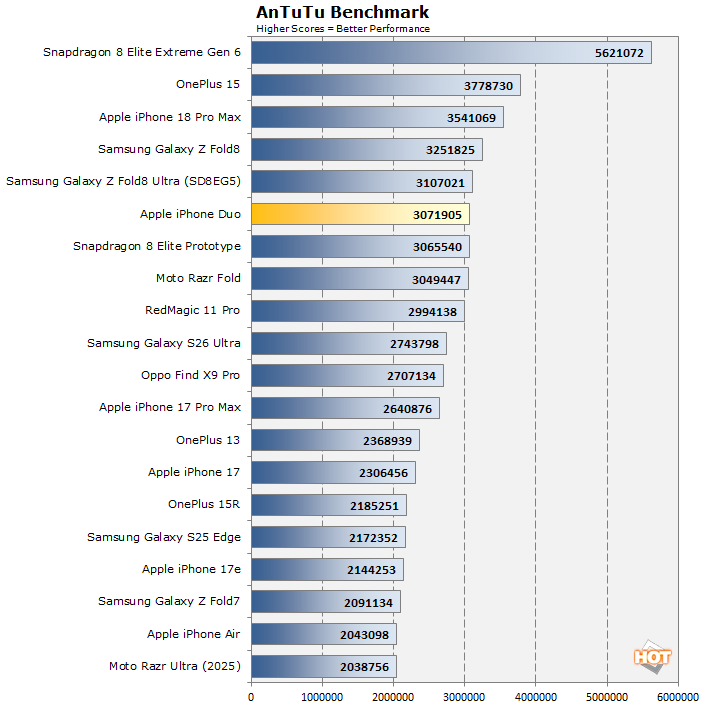
According to AnTuTu, the iPhone Duo basically matches current Snapdragon 8 Elite Gen 5-equipped Android flagships, slotting right below Samsung's Galaxy Z Fold8 Ultra in terms of overall score.
iPhone Duo Speedometer 3.1 Results
We use BrowserBench.org's Speedometer test to take a holistic look at web application performance. This test automatically loads and runs a variety of sample web apps using the most popular web development frameworks around, including React, Angular, Ember.js, and even simple JavaScript. This test is an example of how systems cope with real-world, modern web apps.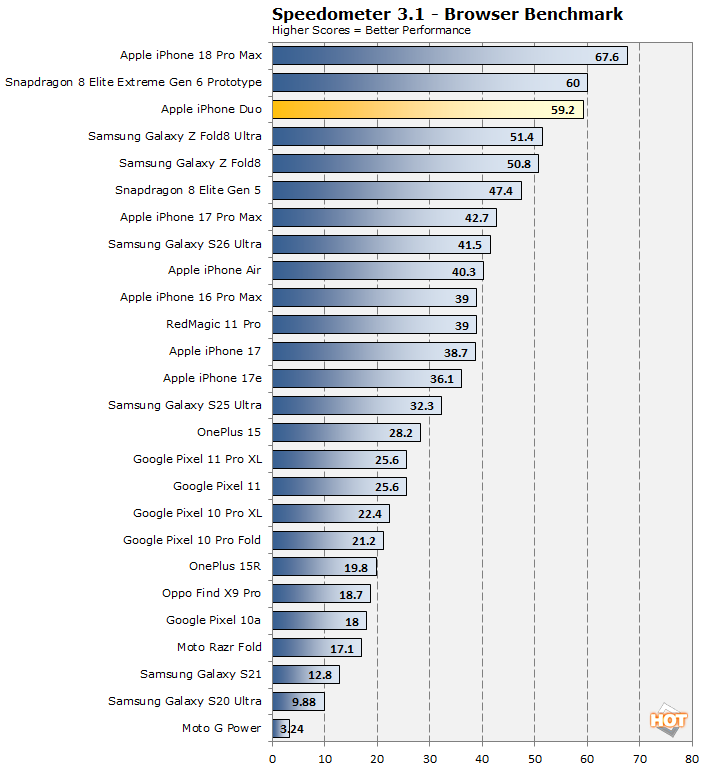
Apple has done a great job optimizing browser and web app performance in iOS. The iPhone Duo takes the third here right below Qualcomm's Snapdragon 8 Elite Extreme Gen 6 prototype. The gen-over-gen increase in performance versus the iPhone 17 Pro Max is particularly impressive.
iPhone Duo 3DMark Results
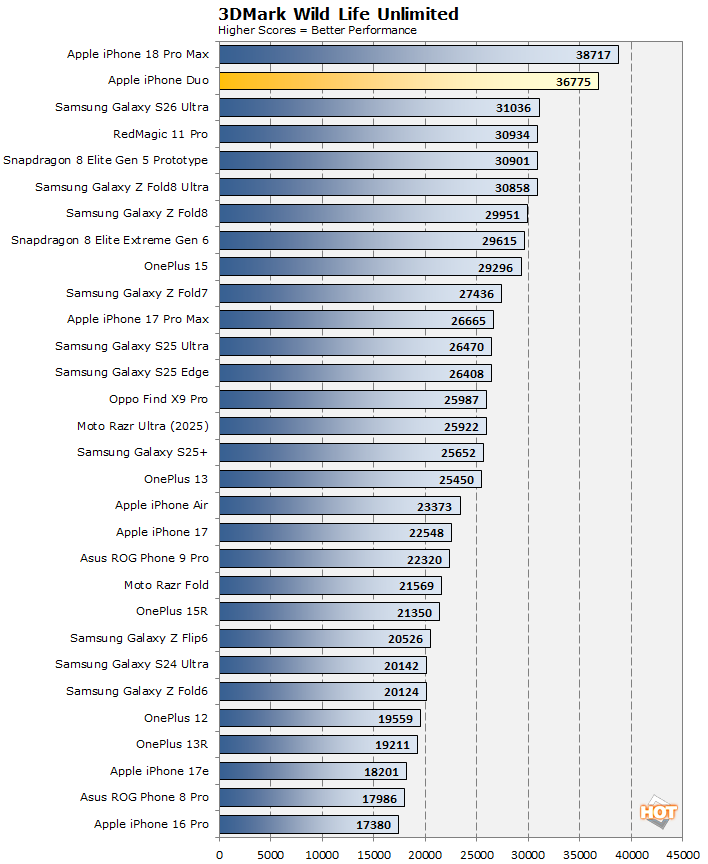
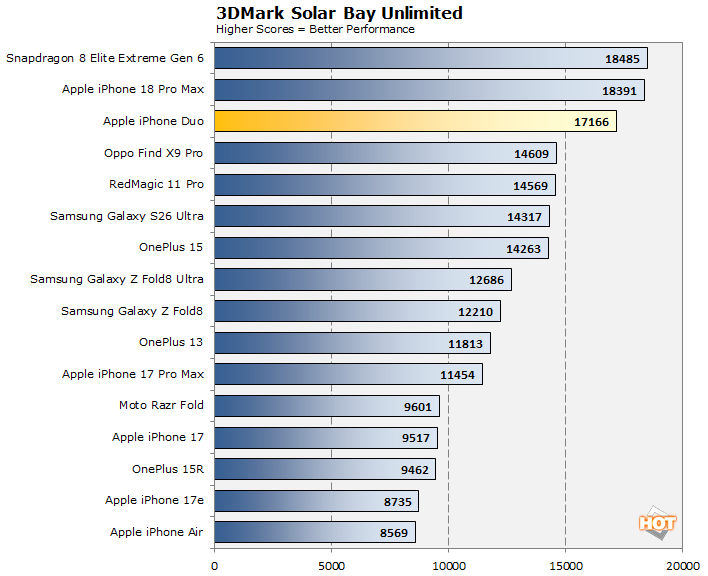
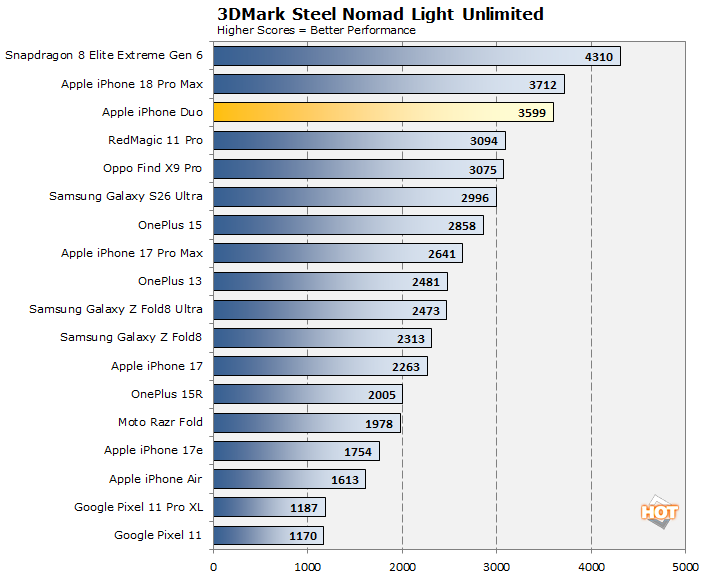
3DMark Wild Life is a cross-platform graphics test from UL. Its primary purpose is to measure GPU performance across platforms, and two distinct tests are available. The standard Wild Life test is designed to give feedback on how a game performs over a short period of time. With mobile games, people typically play in brief spurts when they find some free time; be it on the bus, on the subway, or a quick battle royale session over lunch break. The 3DMark stress tests, on the other hand, shows how a device performs over a longer stretch of time, and takes note of performance degradation that might crop up due to increased heat levels and throttling. In addition to Wild Life, we also ran the more taxing Solar Bay test, which incorporated ray tracing, and the light-duty Steel Nomad Lite.

3DMark stress tests are significantly more taxing graphics benchmarks that employs cutting-edge mobile game engine technologies to deliver impressive visuals -- as you can see in the screen shot above.
In these benchmarks, the iPhone Duo makes a strong showing, with Apple's A20 Pro (7 GPU cores) slotting just below Qualcomm's Snapdragon 8 Elite Extreme Gen 6 and beating it in the Wild Life test.

The iPhone Duo exhibits more throttling than the iPhone 18 Pro Max in the Wild Life stress test, netting a stability score of 58.7%. This is likely due to the iPhone Duo's smaller vapor chamber. It fares better in the Solar Bay Stress test, managing a stability score of 64.1%, and in the Steel Nomad Light stress test, with a respectable stability score of 70.5%.
iPhone Duo Battery Life, Additional Features, And Touch ID
The iPhone Duo packs a 4,883mAh battery. It supports 45W wired charging (PD 3.2, 0-50% in 20 minutes) and 25W Qi2-compatible wireless charging, and includes MagSafe magnets like all modern iPhones. Since our PCMark battery test isn’t available for iOS, I don’t have any results to share, but in my experience the Duo delivers impressive battery life, and will easily last a full day on a charge with normal use, and two days with light use.In practise, the iPhone Duo delivers similar battery life to Oppo’s Find N6, a book-style folding phone that boasts a 6,000mAh silicon-carbon battery, and consistently outlasts Samsung’s Galaxy Z Fold8, which features almost the same battery capacity as the Duo (4,800mAh). As usual with iPhones, there’s no charger in the box, but Apple includes the usual braided fabric USB Type-C to Type-C cable.
The iPhone Duo’s remaining specs match the iPhone 18 Pro and 18 Pro Max, and include sub-6GHz and mmWave 5G, 4G LTE, satellite SOS, WiFi 7 (802.11be), Bluetooth v6.0 + LE, Thread, NFC, UWB, plus dual-band A-GPS, GLONASS, Galileo, QZSS, BeiDou, and NavIC positioning. Haptics are top notch thanks to Apple’s Taptic Engine, but Touch ID is problematic, mostly because of the way it’s implemented on the Duo.

I have no issues with side-mounted capacitive fingerprint sensors. They are extremely fast and reliable nowadays, so I didn’t expect Touch ID on the iPhone Duo to be as frustrating as it is. See, most Android phones with a fingerprint sensor mounted on the power/lock key (like the Galaxy Z Fold8) take you directly to the home screen as soon as you brush the sensor with a registered finger. You skip the lock screen, and you’re in. There’s zero delay.
Many Android headsets have a setting you can toggle that requires you to press the power/lock key instead of just touching the fingerprint sensor, to make unlocking the device more intentional. That’s not what I prefer, but it’s fine. On the iPhone Duo, unlocking is a two-step process. First, you have to press the power/lock key with a registered finger to get to the lock screen; there’s no option to simply touch the fingerprint sensor.
Second, once on the lock screen, you have to swipe up from the bottom of the display to get to the home screen, just like you would on an iPhone with Face ID. Alternatively there’s a setting you can toggle that allows you to skip swiping if you keep your registered finger on the fingerprint sensor after pressing the power/lock key. With this setting enabled, it takes about a second to get to the home screen after pressing the power/lock key.

If, like me, you’re used to simply brushing the fingerprint sensor with a registered finger to unlock the phone and immediately access the home screen, unlocking the iPhone Duo will test your patience. You have to press the power/lock key to get to the lock screen, then keep your registered finger on the fingerprint sensor for about a second to get to the home screen. This adds unnecessary friction.
Apple should add settings to (1) bypass the lock screen completely, thus removing the one-second delay and (2) make pressing the power/lock key optional so you can just touch the fingerprint sensor with a registered finger instead. But there is hope. The company seems aware that Touch ID on the iPhone Duo is problematic, and iOS 27.3 beta adds a face unlock feature to the Duo. It won’t be as secure as Face ID, but it should help.
Next up: software, AI, and my review conclusion...