

iPhone Duo Review: Apple's First Foldable Impresses Despite Flaws


|
Apple iPhone Duo (starts at $1,999, as tested $2,199)
The iPhone Duo is Apple’s first folding phone that’s hampered by questionable hardware and software decisions and a challenging user experience. While it might be a viable option for iOS pros, it won’t sway Android veterans. |
|||

|

 |
||
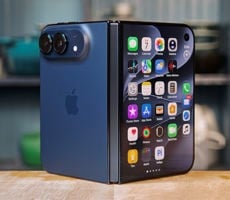
The iPhone Duo has landed. It’s Apple’s first (and long-awaited) folding phone, and there’s a lot to unpack here. This handset features the same passport-style wide form-factor and 4:3 aspect ratio as Samsung’s Galaxy Z Fold8, with similar specs, including a 5.4-inch outer display, 7.6-inch folding inner screen, plus a pair of 48MP rear cameras. It’s powered by the same A20 Pro SoC as the iPhone 18 Pro and packs a 4,883mAH battery.
Compared with the Galaxy Z Fold8, the iPhone Duo is thicker (5.2 vs. 4.5mm open, 11.3 vs. 9.7mm closed) and significantly heavier (254 vs. 201g), but it boasts MagSafe magnets, a matte inner screen, an under-display camera, and Apple’s signature Camera Control which are all absent from Samsung’s device. Plus the Duo is D-shaped when closed, with four rounded corners when open, in contrast to the Galaxy Z Fold8’s rectangular design.
I’ve been using folding phones since Samsung introduced them in 2019, and while I’m primarily an Android user, I’m also a long-time Mac user and I regularly create content on iPhones. As such, I wasn’t expecting the iPhone Duo’s first-generation hardware to match the Android competition, but I expected Apple’s software and user experience to stand out. Was I right? Is Apple’s first folding phone the one to beat? Read on to find out...
iPhone Duo Hardware And Design
The first thing you’ll notice when picking up Apple’s iPhone Duo is that it’s heavy. At 254g, it’s about 26.4% heavier than Samsung’s Galaxy Z Fold8 (201g) and even 18.1% heavier than Samsung’s larger Galaxy Z Fold8 Ultra (215g). Personally, this didn’t bother me much, but after using the Galaxy Z Fold8 extensively over the past three months, I definitely noticed the Duo’s extra heft when holding the phone for longer periods of time.On the plus side, this extra heft gives the iPhone Duo a reassuring sense of durability and makes it feel more premium. This is further reinforced by Apple’s use of titanium for the Duo’s frame, unlike the competition’s use of aluminum. At 5.2/11.3mm (open/closed) the Duo is also notably thicker than the Galaxy Z Fold8 (4.5/9.7mm) or the current state-of-the-art – Oppo’s Find N6 (4.2/8.9mm) and Honor’s Magic V6 (4.1/8.8mm).

The second thing you’ll notice after picking up the iPhone Duo is how refined the hinge feels when you open or close the phone. Apple designed a complex variable torque mechanism that changes the amount of resistance you feel throughout the opening and closing motion, and it feels like no other folding phone I’ve used. This makes it easier to open when closed, more stable when partially open, and locked-in but still easy to close when fully open.
Another thing that sets the iPhone Duo apart from the competition is its design. This handset is D-shaped when closed, with familiar iPhone-like rounded corners on the right side and right-angle corners on the left. But unlike other folding phones with asymmetric designs, it's not just the frame that’s D-shaped, but also the 5.4-inch outer screen. Not only does this look odd, but it results in some usability issues (more on this and the software later).

The outer display is covered in Apple’s Ceramic Shield 2 glass and includes a punch hole in the top right corner for the 12MP selfie camera. Open the iPhone Duo, and symmetry is restored thanks to four equally rounded corners. Aside from a small circular area above the 4MP under-display camera in the top right, the 7.6-inch inner screen is covered in a matte nano-texture film that reduces glare and cleverly helps hide the crease.
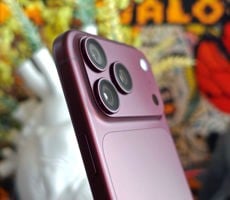
Unlike the optional nano-texture coating on Macs and iPads, this nano-texture film isn’t optional, and results in some compromises (more on this and the crease later). Close the iPhone Duo, and the back resembles the iPhone Air’s. It’s made of Ceramic Shield glass and features a horizontal camera bar, or “plateau”, that rises seamlessly along the top edge of the rear glass and incorporates two 48MP shooters, an LED flash, and a microphone.

Build quality is top notch, and the iPhone Duo offers one of the best dust and water ingress ratings among folding phones. It matches the Pixel 11 Pro Fold’s IP68 rating and beats the Galaxy Z Fold8’s IP48 rating, but falls short of the Magic V6’s IP68+IP69 rating, which adds protection against high-pressure and temperature water jets. The Duo is available in two colorways: Night Sky (like my review unit) and Star White.
The iPhone Duo’s buttons, ports, and openings deviate from the standard iPhone layout. When open, this handset features a power/lock key (which doubles a capacitive fingerprint sensor) and Camera Control on the right side; a pair of mic and speaker grilles and the USB Type-C port (USB 3.2) along the bottom edge; nothing but antenna bands on the left; plus another mic and speaker grille and the volume rocker on top.

It’s a somewhat odd layout. The placement of the volume rocker on the top edge is particularly awkward (especially during phone calls) and I find Apple’s decision to include the Camera Control but omit the Action button puzzling. It’s not like real-estate is lacking: the entire left side is empty. I would have placed the volume rocker on the left, and positioned it between the existing right-side power/lock key and Camera Control.
Perhaps Apple could combine the Camera Control and Action button by making the existing Camera Control programmable in a future software update, so it could function as an Action button? The iPhone Duo is eSIM only worldwide, so there’s no SIM tray. Face ID is also missing here, replaced with Touch ID. That would be fine, but unfortunately, Apple’s fingerprint unlock implementation is frustrating (more on this later).
Phone Duo Specs And Features
| Processor & 5G Platform |
Apple A20 Pro SoC (7 GPU cores), Apple C2 5G Modem, Apple N1 Networking Chip |
| Display | 7.6" 4:3 matte LTPO OLED (Super Retina XDR), 2670x1878 res, 1-120Hz + 5.4" 4:3 LTPO OLED (Super Retina XDR), 2034x1398 res, 1-120H |
| Memory | 12GB |
| Storage | 256GB/512GB/1TB/2TB |
| Rear-Facing Cameras | 48MP 1/1.56” f/1.6 Dual-Pixel PDAF, sensor-shift OIS - 48MP 1/2.55" f/2.2 120º Ultrawide PDAF |
| Front-Facing Cameras | 4MP f/1.8 22mm (inner) - 12MP f/2.2 23mm (outer) - Center Stage |
| Video Recording | Up to 4K @ 120fps, 1080p @ 120fps, 1080p slow-mo |
| Battery | 4883mAh, 45W wired charging, 25W wireless charging (with MagSafe magnets) |
| OS | iOS 27 |
| Dimensions | Unfolded: 117.8 x 164.6 x 5.2mm - Folded: 117.8 x 84.1 x 11.3mm |
| Weight | 254g |
| Connectivity | 802.11be Wi-Fi 7, Bluetooth 6.0, NFC, UWB, Thread, USB-C 3.2, LTE, 5G (sub-6GHz and mmWave) |
| Colors | Night Sky, Star White |
| Pricing | Starting At $1,999 |
iPhone Duo Display Quality
The iPhone Duo’s 5.4-inch outer display uses a 1-120Hz LTPO Super Retina XDR OLED panel (2034x1398 pixels, 460ppi, HDR10), while the 7.6-inch inner screen consists of a 1-120Hz folding LTPO Super Retina XDR OLED panel (2670x1878 pixels, 430ppi, HDR10). Both displays feature the same 4:3 aspect ratio, reach 3,000 nits of peak brightness, and support Dolby Vision. Needless to say, these are gorgeous screens.As you’d expect, colors are punchy, blacks are inky, and viewing angles are wide. The outer panel benefits from an antireflective coating, but what really makes the iPhone Duo stand out from every other folding phone is the matte nano-texture film applied to the folding inner display. This film, which can be replaced by Apple, serves two purposes: reducing glare and making the already minimal crease even less visible. And that’s pretty clever.

But in practice, this nano-texture film has some drawbacks. First, in brightly lit conditions, like in direct sunlight, this film washes out the display, significantly reducing contrast and making blacks look grey. This defeats the benefits of OLED. Second, while this film gives the entire inner screen a matte appearance, it excludes the small circular area above the 4MP under-display camera in the top right. This small circular area reflects light.
Why go through all the trouble of hiding the camera under the display only to highlight it with a shiny dot on an otherwise uniform matte surface? It breaks the illusion. Third, this film is difficult to clean, especially from greasy fingerprints. Personally, I would prefer if the iPhone Duo didn’t have this matte nano-coating film on the inner screen, and I think Apple should make it optional, like it does for the nano-texture coating on Macs and iPads.

Alternatively, Apple could sell a non-matte film with a standard anti-glare coating for those who prefer it. Speaking of the 4MP under-display camera, it’s fine for video calls, but not much else (more on this later). The outer screen includes a punch hole in the top right corner for the 12MP selfie camera. Apple should have replicated this setup for the inner display. That would have made the transition between the inner and outer screen even more seamless.
The crease on the iPhone Duo is minimal and matches the crease on Samsung's Galaxy Z Fold8. This makes perfect sense considering Samsung manufactures the folding OLED panel to Apple’s specifications. Plus, I wouldn’t be surprised if Apple benefited from Samsung’s expertise in reducing the crease. And yes, the matte nano-texture film really does make the crease less obvious since it minimizes reflections, but it’s unnecessary.

That being said. Oppo’s Zero-Feel Crease on the Find N6 still holds the crown for least visible crease on any folding phone, and it doesn’t resort to a matte nano-texture film to achieve it. Finally, it’s worth mentioning that the iPhone Duo supports the $79 Apple Pencil (USB-C) on both the inner and outer displays, but not the Apple Pencil Pro, so there’s no pressure sensitivity, tilt/squeeze/double-tap gestures, or haptics.
iPhone Duo Camera Performance And Image Quality
The iPhone Duo inherits the iPhone 17’s dual rear shooters. As such, it lacks a telephoto camera, which is disappointing for a handset that costs $1,999. I understand that space inside the Duo is at a premium, but telephoto shooters are standard on the vast majority of book-style folding phones. To be fair, Samsung’s Galaxy Z Fold8, which costs $1,899 and is the Duo’s most direct competitor, also lacks a telephoto camera.In the back, the iPhone Duo packs a 48MP 1/1.56-inch 1.0-micron main sensor and 26mm f/1.6 lens with PDAF and sensor-shift OIS, alongside a 48MP 1/2.55-inch 0.7-micron sensor and 13mm f/2.2 120-degree ultrawide lens with PDAF. Like other modern iPhones, the Duo supports in-sensor cropping for “optical-quality” 2x zoom with the main shooter, alongside 4-in-1 pixel binning on both rear cameras for better low-light performance.

By default, both shooters capture 24MP photos which blend multiple pixel-binned 12MP images for dynamic range with a 48MP shot for detail. You also have the option to shoot at 48MP or 12MP, but night mode and zoomed pictures are always 12MP. Apple’s Photonic Engine (computational photography imaging pipeline), enables features like Deep Fusion (neural image processing), and the latest version of Photographic Styles, including film grain.
For selfies, the iPhone Duo features a 12MP 23mm f/2.2 outer camera and a 4MP 22mm f/1.8 inner under-display camera. Despite lacking AF and a square (1:1) aspect ratio, these are Center Stage cameras that let you capture selfies in any orientation (portrait or landscape) regardless of how you hold the phone. Center Stage automatically keeps you centered in the frame, and intelligently rotates and zooms out to fit more people into a shot.

Don’t expect much from that 4MP under-display camera, though. It’s fine for video calls, but not much else. Smaller focal length aside (22 vs. 26mm) this shooter appears to be identical to what Samsung used on the Galaxy Z Fold6 and its predecessors, and later abandoned. I’m confused why Apple, which prides itself on image quality, would choose to resuscitate this camera system even if Apple’s image processing delivers acceptable results.
As I mentioned above, I would have liked having the same 12MP punch hole shooter in the inner screen as in the outer display. I understand that Apple chose an under-display camera to keep the inner screen uninterrupted and clutter free, but placing a 12MP punch hole shooter in the top right corner of the inner screen, like Apple did with the outer display, would have maximized screen real-estate without sacrificing image quality.


Photo modes include night, portrait, and panorama (rear only). Night mode is automatic, and can be disabled. Apple’s Next-generation Portrait mode lets you adjust focus and depth after the fact, and features six Portrait Lighting effects. Panorama mode takes ultra-high resolution images (up to an impressive 63MP). Macro mode uses the ultrawide, but pulling back and zooming with the main camera achieves better results.
One feature that’s unique to the iPhone Duo is Smart Take, which automatically captures photos when it detects that you strike a pose, hold still, or change position. Like other folding phones, the Duo supports using the rear shooters to take selfies, lets you preview the inner screen’s viewfinder on the outer display, or show random cartoon animations (starring Snoopy and Woodstock) on the outer screen to keep kids looking in the right direction.


The iPhone Duo records stabilized video at up to 4k 60fps (4k 120fps with the main shooter) and supports Dolby Vision (HDR). Video modes include 24fps (4k), 25fps (4k and 1080p), slow motion (up to 1080p/240fps and 4k/120fps), time lapse, Action (up to 2.8k), Dual Capture (up to 4k 30fps), and Cinematic (portrait video). The iPhone 17’s Spatial mode is missing, however, and the 4MP inner camera tops out at 1080p 60fps.
Audio is captured in mono, stereo, or 3D (Spatial Audio), with audio zoom and optional wind noise reduction. Like on the iPhone 18 Pro and 18 Pro Max, Apple’s camera app now includes manual controls for EV, white balance, and focus (but not shutter speed or ISO), and you can customize which controls are displayed in the viewfinder (up to six). Unfortunately, since it isn’t a “Pro” handset, the Duo lacks ProRAW and ProRes support.

One thing Apple should improve is the outer display’s camera viewfinder. Because of the outer screen’s D-shape, the pictures you capture don’t match what you see when you line up a shot with the viewfinder, so you end up having to open the Duo to use the camera, which is unwieldy. I would add a setting to toggle a black border around the outer display’s camera viewfinder, so that the images you take match what you see.
The iPhone Duo takes lovely pictures no matter the conditions, and it delivers the kind of imaging consistency I’ve come to expect from Apple. Exposure is accurate, colors are natural, and dynamic range is great. Low-light performance is solid, and zooming is pretty clean up to about 4-5x (max zoom is 10x for photos, 6x for videos). Plus, the iPhone Duo leaves most Android phones in the dust when it comes to video recording.


In all, photos and videos shot with the iPhone Duo match those captured with the iPhone 17, and that’s no surprise considering both handsets have identical rear cameras. So basically – lack of telephoto and lackluster 4MP under-display camera aside – I’m happy with the iPhone Duo’s shooters, and I’m pretty sure that most people will feel the same way. If imaging is your top priority, though, stick with the iPhone 18 Pro and 18 Pro Max.
Next up: audio, performance, and battery life...