AMD Ryzen 7 9850X3D Review: The Best Gaming CPU, Boosted


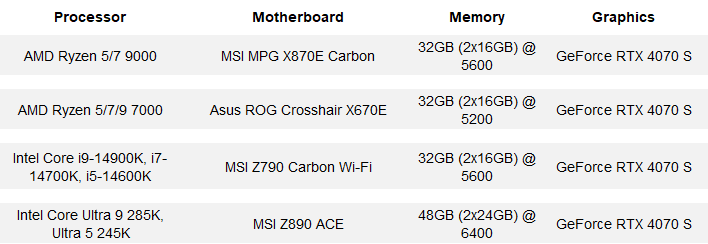
HotHardware's Test Systems:

AIDA64 Memory Bandwidth, Memory Latency & Cache Latency
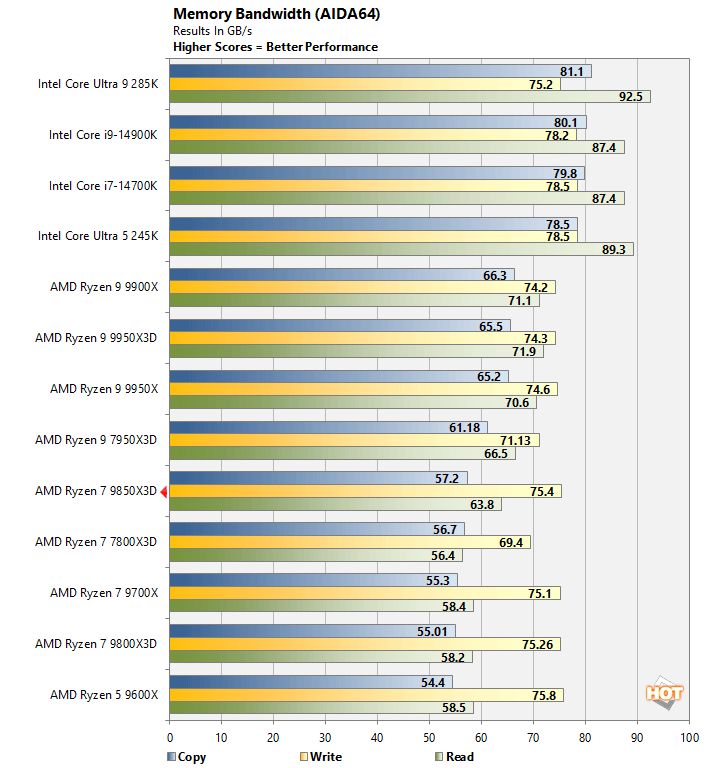
AIDA64's CPU Cache and Memory benchmarks measure memory bandwidth during read, write and copy operations, in addition to memory latency, and cache bandwidth and latency.
The Ryzen 7 9850X3D's memory bandwidth characteristics put it right in the same ballpark as other 8-core 3D V-cache enabled chips, which is to say there's nothing extraordinary to report.
Memory latency is in-line with expectations as well. The Ryzen 7 9850X3D fares slightly better than the Ryzen 7 9800X3D, but the delta separating the two is relatively small.
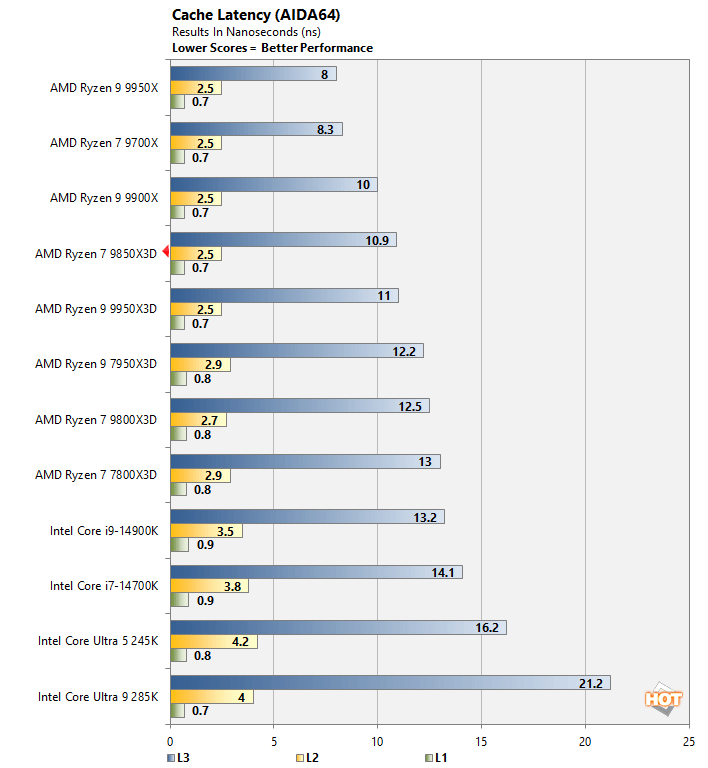
Cache latency with the Ryzen 7 9850X3D, however, is somewhat better than the previous-gen Ryzen 7 9800X3D thanks to those higher clocks. The Ryzen 7 9800X3D's cache latency is also much better than any of the Intel offerings from the last couple of generations.
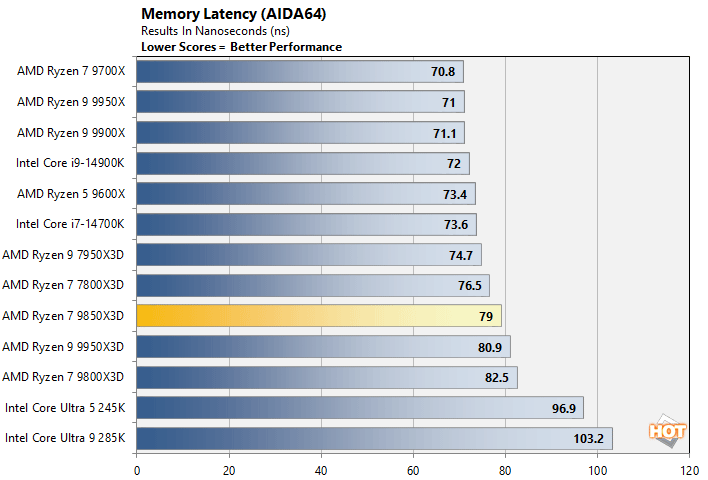
Memory latency is in-line with expectations as well. The Ryzen 7 9850X3D fares slightly better than the Ryzen 7 9800X3D, but the delta separating the two is relatively small.
Geekbench v6.3 CPU Benchmark
The GeekBench CPU tests stress only the processor cores in a system (not the graphics card/GPU), with both single and multi-threaded workloads. The tests are comprised of encryption processing, image compression, HTML5 parsing, physics calculations and other general purpose compute processing workloads.
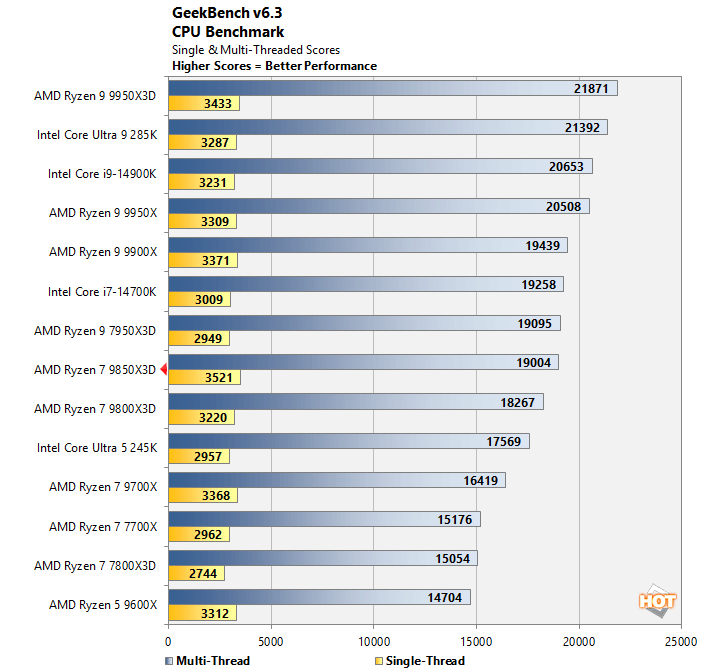
With only 8 cores / 16 threads, the Ryzen 7 9850X3D lands about in the middle of the pack in terms of multi-threaded performance in Geekbench. The chip's single-thread performance is quite good though, and the new chip ends up claiming the top single thread score.
UL PCMark 10 Applications Benchmarks
Next, up we have some full-system testing with PCMark. We're reporting all test results from the PCMark 10 Applications benchmark suite, which uses actual Microsoft Office applications, in addition to the Microsoft Edge browser. The workloads are specific to each Office application (Word, Excel, and PowerPoint), and the Edge tests simulates real-world web browsing.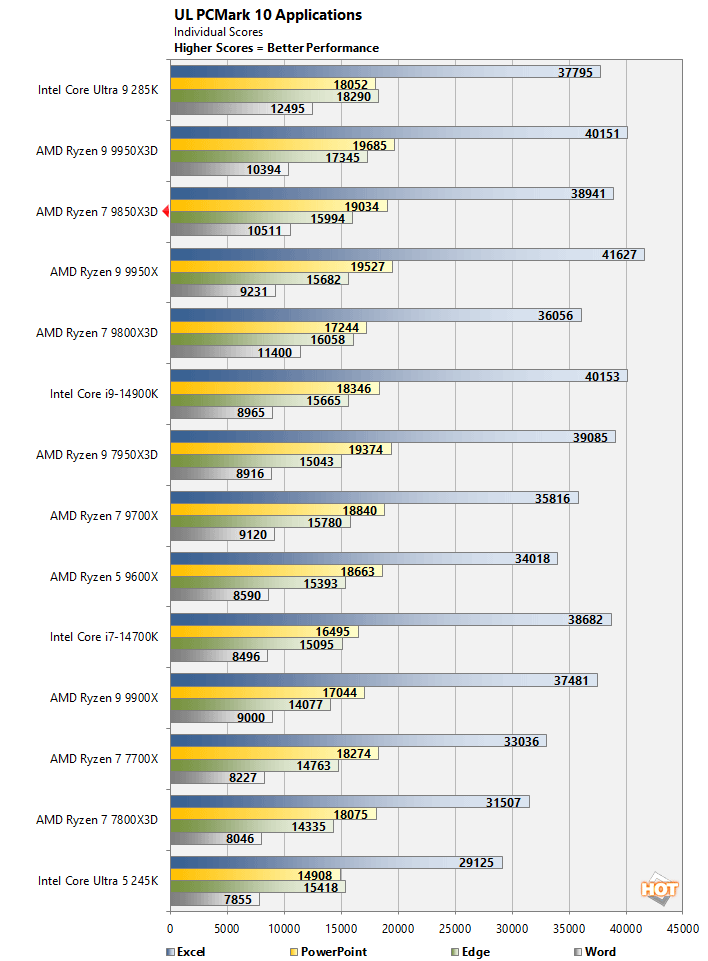
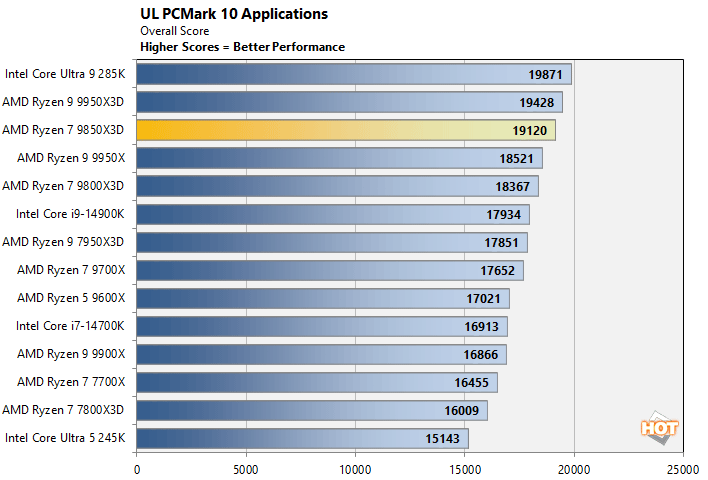
It's single-CCD design (which lowers latency), higher max boost clock, and all of that cache memory push the Ryzen 7 9850X3D near the top of the charts in our PCMark testing. While its 8-cores / 16 threads may not entice demanding creators, this processor is clearly a great CPU for general computing tasks and Microsoft Office applications.
Bapco Crossmark Benchmark
Crossmark is a cross-platform benchmark from Bapco that's available for Windows, Android, iOS and MacOS. Like PCMark, Crossmark measures overall system performance and using real-world applications. It provides an overall score based on the results of its Creativity and Productivity benchmarks and system responsiveness tests.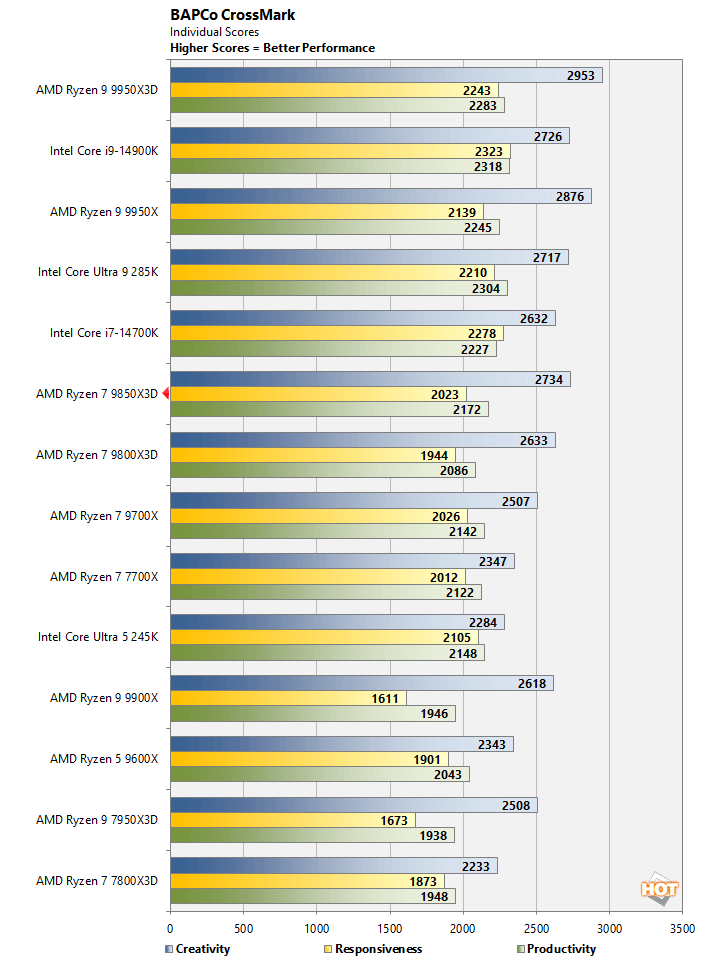
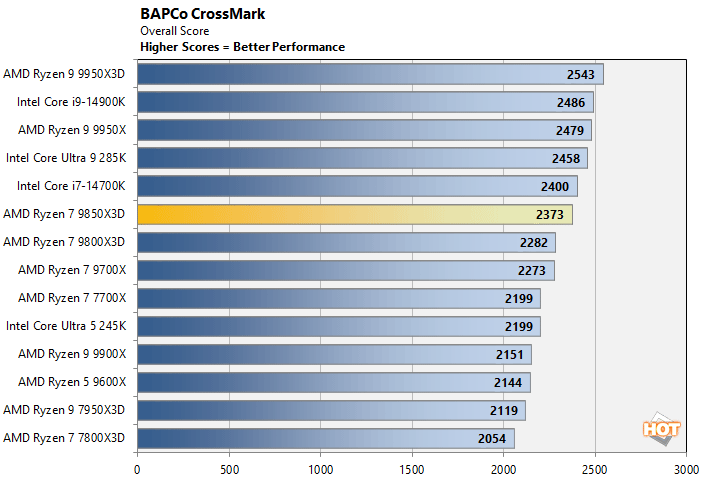
The Ryzen 7 9850X3D landed exactly where you'd expect it to in our Crossmark tests, based on its model number. It slots in just ahead of the Ryzen 7 9800X3D, but behind the higher core count chips.
Browser & Web App Benchmarks: Jetstream 2.2 And Speedometer 3
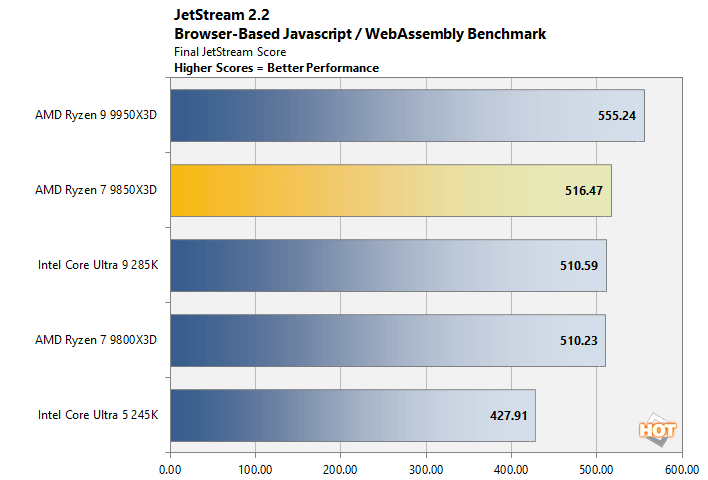
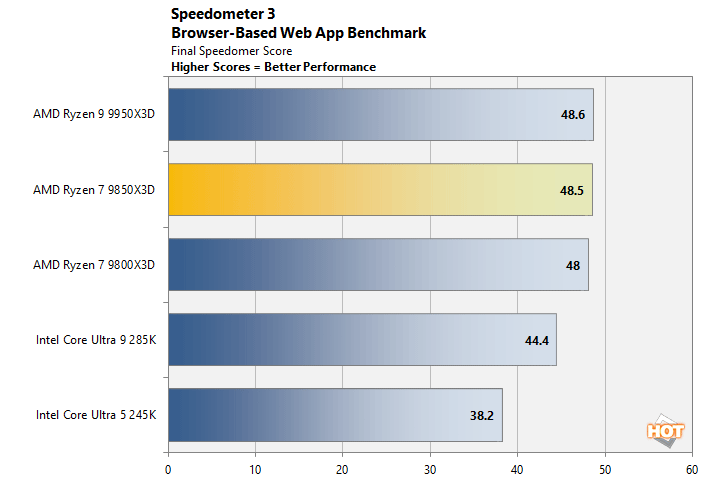
Next up, we have some numbers from the Speedometer 2.0 and Jetstream 2 tests available at Browserbench.org. The Speedometer Benchmark Suite uses a wide array of latency and throughput benchmarks to evaluate web application performance, while Jetstream evaluates Javascript and WebAssembly performance; both tests take all of their individual results and tabulate them into a final score.
These benchmarks measure performance of an array of browser-based technologies used on modern, rich web applications. Scores in these benchmark are an indicator of the performance users would see when browsing the web and running advanced web apps. All of the systems were tested using the latest version of Google Chrome, with default browser settings, on a clean, fully-updated install of Windows 11.
We didn't have time to re-run this benchmark on all of our test platforms, but gathered some new data to reflect accurate performance as it stands today. These two benchmarks are significantly impacted by browser updates and our reference data was no longer relevant. That said, the Ryzen 7 9850X3D performs well here and is right in the mix with the top Ryzen processors in these lightly threaded tests. It outpaces Intel's current flagship as well.
These benchmarks measure performance of an array of browser-based technologies used on modern, rich web applications. Scores in these benchmark are an indicator of the performance users would see when browsing the web and running advanced web apps. All of the systems were tested using the latest version of Google Chrome, with default browser settings, on a clean, fully-updated install of Windows 11.
7-Zip Data Compression / Decompression Tests
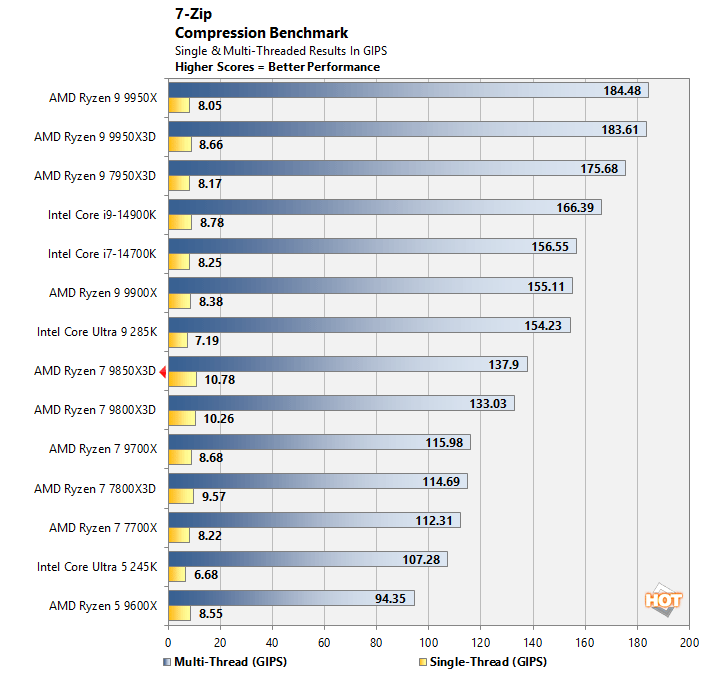
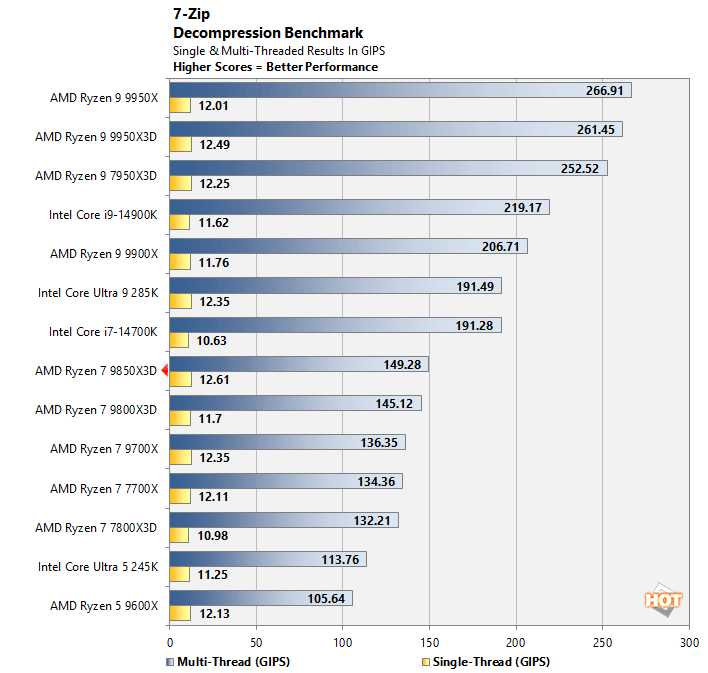
The 7-Zip benchmark measures compression and decompression performance using the LZMA method, which leverages the Lempel–Ziv–Markov chain algorithm to perform lossless data compression. The benchmark produces a final rating in GIPS (giga instructions per second).
Once again, these compression / decompression workloads will utilize any and all available CPU resources, so the Ryzen 7 9805X3D's 8-cores / 16-threads can't hang with the higher-core count chips. Its single-thread performance was great though, and it finishes a notch ahead of the Ryzen 7 9800X3D.
Once again, these compression / decompression workloads will utilize any and all available CPU resources, so the Ryzen 7 9805X3D's 8-cores / 16-threads can't hang with the higher-core count chips. Its single-thread performance was great though, and it finishes a notch ahead of the Ryzen 7 9800X3D.