AMD Ryzen 7 9850X3D Review: The Best Gaming CPU, Boosted


AMD offers an array of tools for overclocking Ryzen 9000 series processors, including "one-click" methods like Precision Boost Overdrive (PBO) and auto-overclocking via Ryzen Master, or manual overclocking via Ryzen Master and/or the system BIOS. Since all Ryzen 9000 series processors are unlocked manual overclocking is only a matter of altering a few multipliers, tweaking voltages, and dealing with the additional heat and power. These processors can be overclocked by adjusting base clock frequencies as well, so it's possible to fine-tune the end result if you so choose. The quickest and easiest gains, however, come by tweaking multipliers or by using one of the "one-click" options in Ryzen Master. If you've got adequate cooling, a good motherboard with power headroom for the CPU socket, and a high-quality PSU, overclocking Ryzen 9000 series processors should be fairly straightforward.
Overclocking The Ryzen 7 9850X3D
We took a straightforward approach to overclocking the Ryzen 7 9850X3D, but using all of the methods available via the latest edition of Ryzen Master, including PBO, PBO Advanced, and Auto Overclocking.
Ryzen 7 9850X3D Vital Signs -- Stock Defaults

After Repeated Cinebench Runs, The Ryzen 7 9850X3D's Temps Peaked In The Low 80°C Range With PBO Enabled...
PBO and PBO Advanced allow the processor to consume more power through the socket and exploit any additional current headroom available on motherboards with robust VRM configurations. AutoOC works similarly to PBO, but adds a small frequency boost override. Using PBO or AutoOC at stock memory speeds, we saw similar results, with small performance improvements in some tests. We also enabled the memory's EXPO profile to increase the memory speed to DDR5-6000, which an additional performance increase as well.
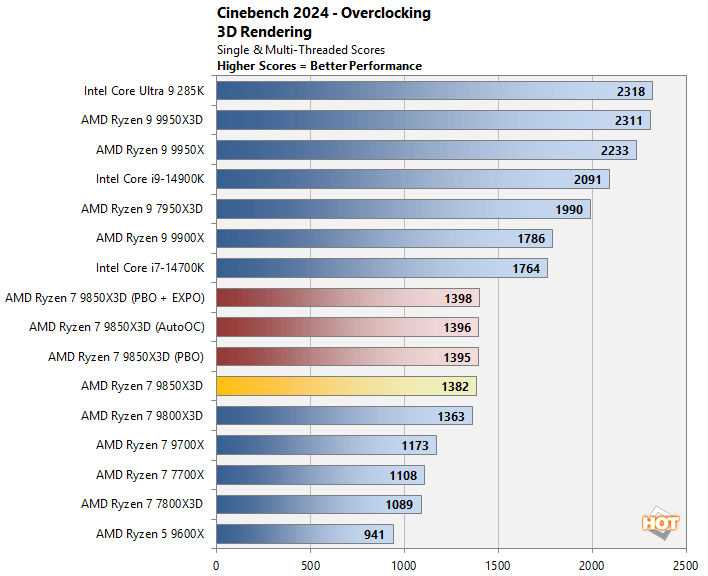
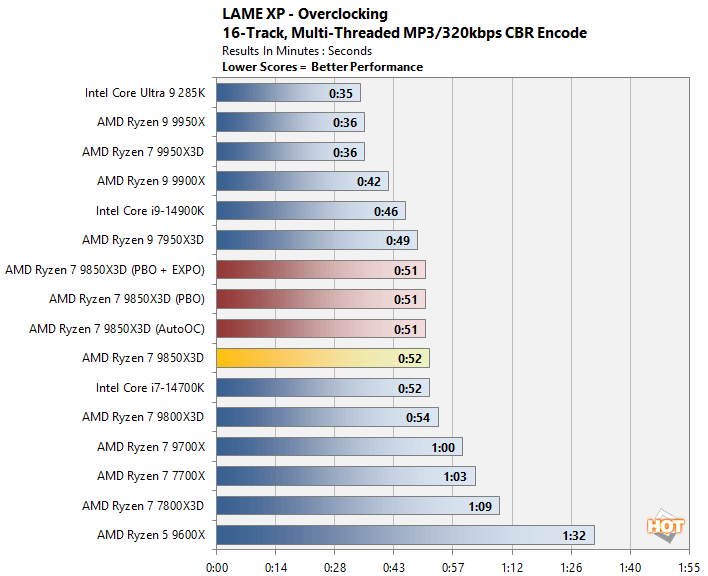
We saw small performance improvements in Cinebench, which loads all cores with to 100% throughout the benchmark run. The LAME MT encoder works on multiple two-thread encodes simultaneously, depending on the number of files being encoded. As a result, there's some time between encodes, when certain cores aren't fully utilized, and the processor has some additional power and thermal headroom. With our custom LAME MT benchmark, we shaved a second off the encode time.
Temperatures and power were non-issues while we experimented with overclocking. The processor typically ran in the high 70°C range, with peaks into the low 80's. And total system power hardly changed at all.
Temperatures and power were non-issues while we experimented with overclocking. The processor typically ran in the high 70°C range, with peaks into the low 80's. And total system power hardly changed at all.
AMD's Ryzen 7 9850X3D: The Verdict
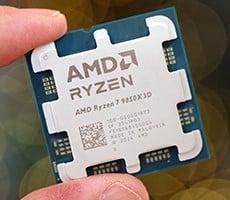
Coming into this review, and knowing what the Ryzen 7 9850X3D was all about, the processor was somewhat of a known quantity. AMD’s X3D processors are targeted gamers, which is where their additional allotment of L3 cache has the largest impact on performance. Couple the Ryzen 7 9850X3D's higher boost clock versus the 9800X3D, some silicon and platform maturity, and that 3D V-Cache together and what you've got is a great all-around processor, that's ideal for gamers.
AMD has set the MSRP for the Ryzen 7 9850X3D at $499, which is $20 more than the 9800X3D's introductory price or about $30 more than its current street price. While that's not a huge price premium, it is about a 6.3% markup for a 7.6% increase in boost clock. That price also makes the AMD Ryzen 7 9850X3D about $120 higher than the 12-core Ryzen 9 9900X, which will perform better with multi-threaded workloads. For what is arguably the best PC gaming processor available today, and an excellent all-around CPU, we suspect most serious gamers won’t balk at its small price premium, but we do wish AMD had come in at the same MSRP of the 9800X3D and slashed the original's price a bit to throw gamers a bone, considering the current market conditions due to the ongoing DRAM shortage.
That said, the AMD Ryzen 7 9850X3D is still an excellent CPU and technically an across the board upgrade over the 9800X3D. Overall performance is strong, it led in our gaming and graphics tests, and its power and thermals are easy to manage--you don't need to drop big coin on a high-end cooler to keep the Ryzen 7 9850X3D happily humming along. For gamers specifically, the AMD Ryzen 7 9850X3D is a clear Editor's Choice winner. Creators that may benefit more from a higher core count processor, however, could save a few bucks going with a Ryzen 9 9900X (currently $389) or jump all the way to the 16-core Ryzen 9 9950X (currently $489) and still save $10.