Asus Maximus Extreme and P5E3 Premium

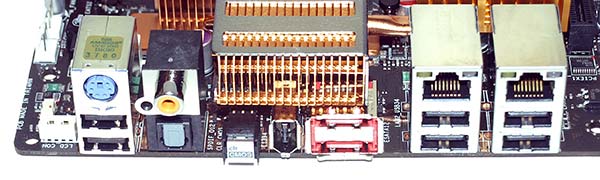
As the current flagship of Asus' R.O.G. - Republic of Gamers - series of motherboard, the Maximus Extreme is loaded with integrated peripherals and sports a gigantic hybrid air / water cooling apparatus. One of the Maximus Extreme's more interesting features that first appeared on Asus' Blitz line of motherboards is dubbed Crosslinx. Crosslinx is essentially a PCI Express switch that takes the some of the boards PCI Express lanes and splits them to two PEG slots in an x8 / x8 configuration when dual graphics cards are installed. With the CrossLinx switch, the Maximus Extreme is capable of running its trio of PCI Express x16 slots in either a PCIe 2.0 x16 / x16 / PCIe x4 configuration, or a PCIe 2.0 x16 / PCIe 1.0 x8 / x8 configuration. The I/O backplane on the Maximus Extreme houses six USB 2.0 ports, a single Firewire port, two Gigabit LAN jacks, Coaxial and optical audio digital audio outputs, a single PS/2 keyboard port, two eSATA ports, and a convenient clear CMOS switch. Take the overclocking a little too far and you simply have to reach around to the back of your system to clear the CMOS - no more fumbling with jumpers inside the machine. The board's audio capabilities are handled by an ADI 1988B HD codec. Its GigE LAN functionality is handled by a Marvell 88E8001 PHY and Firewire support comes by way of a VIA chipset.
;)
;)
;)
The Asus Maximus Extreme is built upon a dark-colored PCB with white and blue slots and connectors. The X38 Northbridge, ICH9R Southbridge, a CrossLinx chip (an IDT PCI Express Switch), and the components in the board's power array are cooled by an innovative, copper and aluminum cooling apparatus, dubbed the Fusion Block System, that's linked together via a heat-pipe and works with either air or liquid-cooling.
The Fusion Block is basically a standard chipset water-block, that happens to be linked to the other heatsinks via a heat-pipe. This is a nice touch on Asus' part and should make the Maximus Extreme board more appealing to fans of liquid-cooling since they'd need to do nothing more than connect a couple of hoses to reap the benefits of a liquid-cooled chipset.;)
;)
;)
Despite the large cooling system, there is ample room around the CPU socket area and overall the layout of the board is quite good. All of the board's various connectors and headers are situated around the edges of the PCB and the DIMM slots are not in-line with the first PEG slot, so installing / removing RAM is possible when a long graphics card is installed. The Maximus Extreme features two PCI Express x1 slots, three PCI Express x16 (PEG) slots, and a pair of standard PCI slots. And they're configured in such a way that when two double-wide graphics cards are installed, an x1 slot and a PCI slot are still accessible. There are also a couple of handy power and reset switches installed on the board, which certainly come in handy during testing.