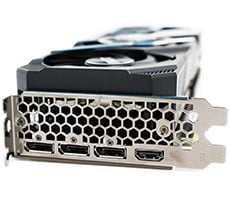


Sapphire Radeon X800 XT - PCI Express


Over the last six weeks, three new chipsets for the AMD processor platform have been announced that all have one very important feature in common. NVIDIA's nForce 4, VIA's K8T890, and ATi's RADEON XPRESS 200 all have support for the emerging PCI Express standard. PCI Express, which was first brought to market with Intel's 900 series of chipsets back in June, is a serial point-to-point communications link for graphics and data, that offers much more bandwidth than AGP 8X and the aging parallel PCI bus. For example, when compared to AGP 8X, which offers a peak bandwidth of 2.1GB/s, the new PCI Express X16 link used for graphics cards has almost four times the peak bandwidth, 8GB/s to be exact. Graphics giants NVIDIA and ATi had been proclaiming support for PCI Express virtually since its inception, but it's not until now that high-end cards have been made available in any meaningful quantity. Mid-range and low-end cards have been available for some time, but high-end cards have been scarce. Now that Intel's platform isn't the only game in town though, we expect PCI Express graphics cards will become increasingly more common, as manufactures increase their output of high-end PCI Express graphics cards to meet demand.
Today, we're going to take a look at a PCI Express graphics card that we're fairly certain many gamers would like to get their hands on, Sapphire's Radeon X800 XT. This card sports ATi's 16-pipe X800 XT GPU and 256MB of high speed Samsung GDDR3 RAM. It's also got a few other niceties thrown in for good measure. Read on and check it out.
;)
;)
 |
|
|
Sapphire Radeon X800 XT 3Dc Compression Technology Smart Shader HD |
SmoothVision HD •_Improved Anti Improved performance •_Temporal Anti Aliasing •_Centroid Sample Anti-Aliasing Mode •_Programmable sparse sample patterns VideoShader HD •_High quality video processing & acceleration •_Real time user programmable video effects •_Video post processing and filtering •_MPEG 1, 2, 4 encode and decode acceleration •_FULLSTREAM Video Deblocking •_WMV9 decode acceleration •_High quality resolution scaling •_Adaptive Per Pixel Deinterlacing •_Motion Compensation •_Noise removal filtering •_Display Rotation
|

;)
;)
;)
;)
Sapphire has historically shipped their high-end video cards with a very comprehensive bundle of software and accessories. And with the PCI Express Radeon X800 XT, they continue that tradition. This card ships with one of the most well rounded bundles we have seen to date. Included with the card, we found a basic user's manual, a driver CD-ROM, and an assortment of other discs that included copies of Cyberlink's PowerDVD and Sapphire's "RedLine" overclocking utility. A copy of Cyberlink's Power Director video editing suite was also included to compliment the card's video in / video out (ViVo) capabilities. In past reviews we've found Power Director to be quite useful and easy to use (see here). There were also two relatively new, full version games included, namely Splinter Cell: Pandora Tomorrow and Prince of Persia: The Sands of Time. Both of these games currently sell for upwards of $30 each, so it was good to see them included, considering the significant price this card commands.
There was also a collection of cables and adapters included with Sapphire's PCIe Radeon X800 XT. There was a standard 6-ft S-Video cable included, a composite video cable, and a DVI-to-DB15 adapter along with a splitter for connecting the card to an HD-TV's components inputs and another adapter equipped with S-Video and composite video inputs and outputs.