

Samsung Portable SSD P9 Review: Pocket-Sized 4GB/s Speed Demon

The Samsung Portable SSD P9 Is A Sleek, Slim, And Ultra Fast USB 4 SSD

| Samsung Portable SSD P9: $339 (1TB), $649 (2TB) The Samsung Portable SSD P9 is thin, light, compact and offers serious performance, with transfer speeds approaching 4GB/s in some tests.
|
|||

|

|
||
Samsung has a new external SSD in its line-up that upstages all of its previous-gen offerings in a number of ways. The Samsung Portable SSD P9, which was announced a few months back, is a USB 4 Gen 3x2 (40Gbps) external drive that’s thinner and lighter than its predecessors and offers significantly higher transfer speeds too. We’ve got a 2TB model on hand for testing and like all of the previous Samsung external SSDs we’ve evaluated to date, we came away impressed—for the most part.
Here’s a look at the Samsung Portable SSD P9’s main specifications and features. Give them a peek, then we’ll take a tour of the drive and see how it performs versus an array of alternative products...

Samsung Portable SSD P9 Specs & Features

The Samsung Portable SSD P9 will be available in four capacities, ranging from 1TB to 8TB. At this point in time, however, it appears only the 1TB and 2TB models have hit store shelves. The higher capacities should be available soon, but Samsung hinted at a staged release timeline when it initially announced the drives. Transfer speeds are rated at up to 4GB/s reads and 3.7-3.8GB/s writes, depending on the capacity (only the 1TB drive has a reduced write average), which makes the P9 the fastest external SSD Samsung has released to date.
Inspecting The Samsung Portable SSD P9


Included with the Samsung Portable SSD P9 is a basic lit pack and a short USB-C cable. This is perfectly adequate for most users, but it would have been great to see some sort of USB-A dongle, cable or adapter included as well, like some of Samsung's previous-gen drives. Samsung also backs the P9 with a full 5 year warranty.
Samsung Portable SSD P9 Performance
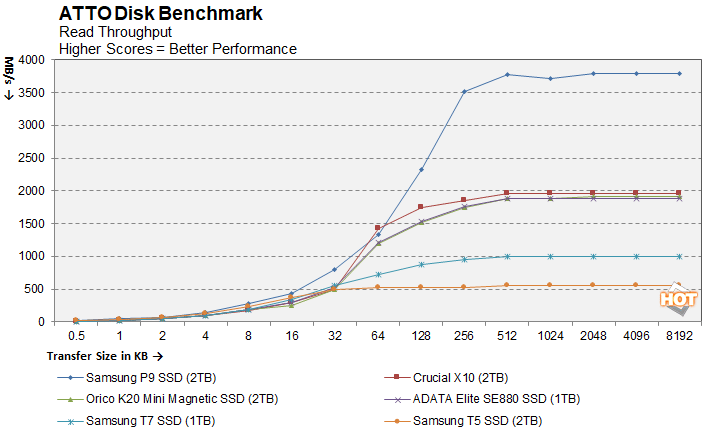
In order to test the performance of the Samsung Portable SSD P9, we enlisted the help of some straightforward benchmarks. First up is ATTO, a disk benchmark that measures sequential transfer speeds across a specific volume length with various block sizes. It measures transfer rates for both reads and writes and graphs them out in an easily interpreted chart. ATTO's workloads are sequential in nature and measure bandwidth, rather than I/O response time, access latency, etc.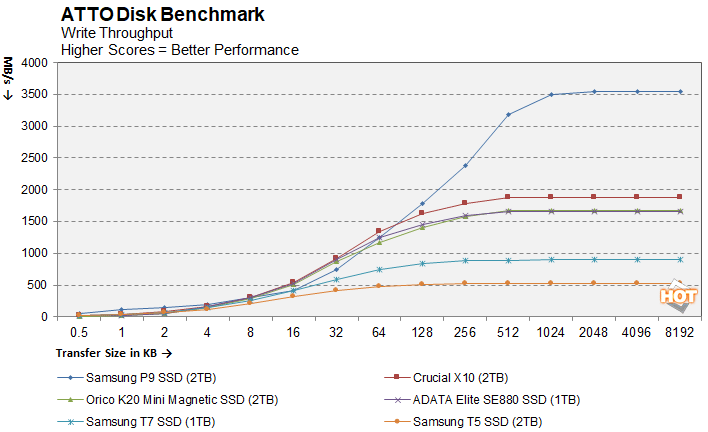
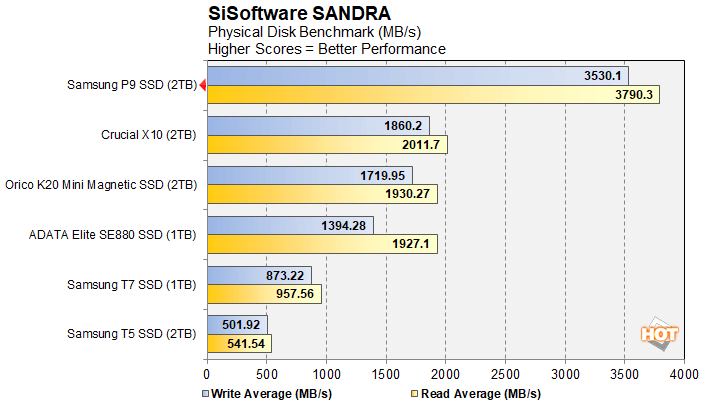
Next up are some numbers with SiSoft SANDRA, the the System ANalyzer, Diagnostic and Reporting Assistant. Here, we used the Physical Disk test suite and provide the results from our comparison SSDs...
CrystalDiskMark is a synthetic benchmark that tests both sequential and random small and mid-sized file transfers using incompressible data. It provides a quick look at best and worst case scenarios with regard to SSD performance, best case being larger sequential transfers and worse case being small, random transfers.
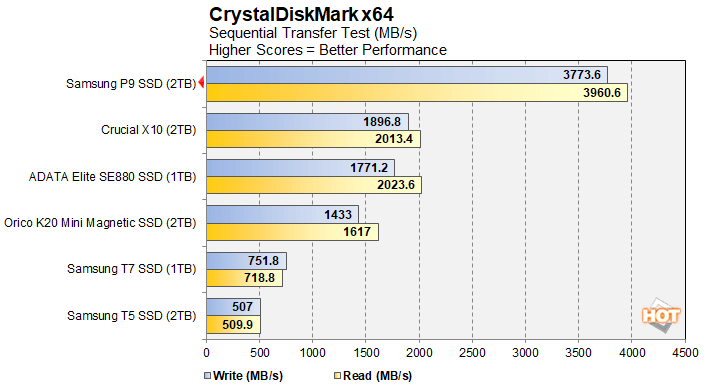
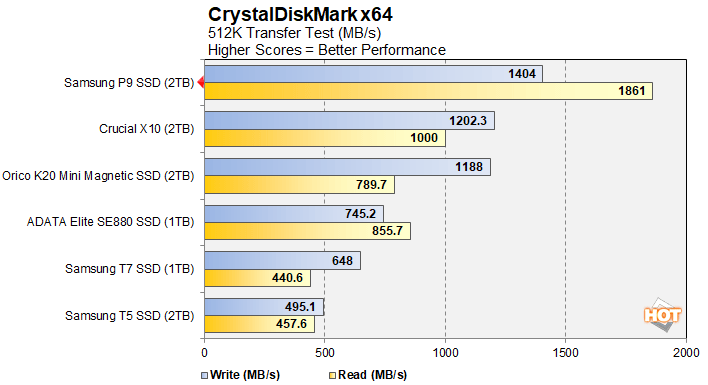
CrystalDiskMark's sequential tests had the Samsung Portable SSD P9 finishing out in front of all of the other drives. With 512K transfers, the P9 doesn't quite double the performance of some of the other drives (the Crucial X10 in particular), but it is still clearly the fastest. With the large sequential test, which is what the P9 is designed for, it once again approaches its peak read and write speed ratings and easily outpaces the previous-gen drives.
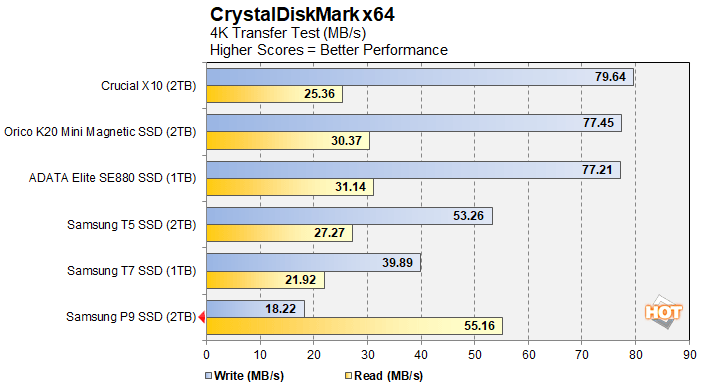
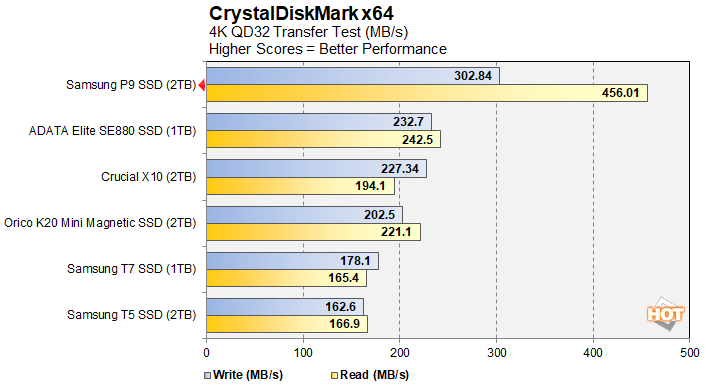
The 4K transfer tests, however, reveal a weakness in the Samsung Portable SSD P9. With 4K transfers at higher queue depths, the P9 leads the pack yet again. At QD1, however, the P9 has the fastest 4K reads by far, but 4K writes trail al of the other drives by a significant margin. We tried secure erasing the P9 and tested it on multiple systems with similar results, but suspect a future firmware may help remedy this at some point.
Samsung Portable SSD P9: Our Conclusion
Externals storage has become indispensable for a wide variety of users, and we have evaluated a myriad of solutions over the years. The Samsung SSD P9 is easily among the best. The Samsung SSD P9 is fast, well-built, and compact, and we've found it to be reliable, high-performing, and widely compatible with a multitude of devices and systems. As we’ve stated in the past, we have tested a number of USB M.2 SSD enclosures previously, and found that compatibility is hit or miss with some drives, chipsets and / or USB controllers. A DIY external SSD may offer reliable performance on one system and behave erratically on the next, and that's if it’s even detected at all. The Samsung SSD P9, however, seamlessly worked everywhere we plugged it in, which included a mix of AMD, Intel and NVIDIA based notebooks and desktops, and Panasonic Lumix cameras with no problems to report.
Ultimately though, with its compact form factor, premium enclosure, 5-year warranty, security features, and excellent overall performance, the Samsung SSD P9 is a killer external, portable SSD, especially for demanding creators that shuffle large files around regularly. If you're in the market for a top-shelf, portable SSD, the Samsung P9 should be on your short list--this is the drive I'd buy today, budget permitting. Just be sure your system has the required USB 4 port to get the most out of it.