Intel Xeon 658X Review: 24 Cores, Massive Memory Bandwidth Tested


UL Procyon AI Machine Vision Benchmark
Let's see how these processors do with the UL Procyon AI Computer Vision benchmark, running solely on the CPU cores using Integer precision. Though many mobile processors like the the Zen 5-based Ryzen AI 300 series, Meteor Lake Core Ultra, and Snapdragon X processors feature an NPU, these workstation processors do not, hence all of these tests are being run on the CPU cores alone.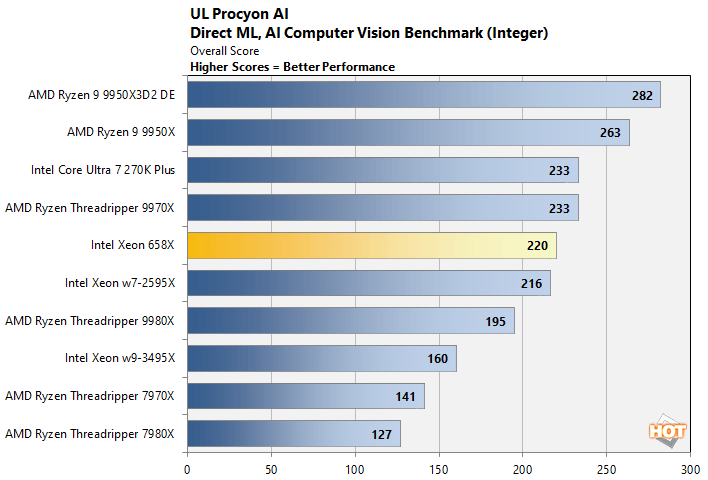
Procyon's Machine Vision benchmark has the Intel Xeon 658X landing right in the middle of the pack, ahead of the previous-gen Xeon W processors and some of the Threadrippers, but behind the higher-clocked desktop chips. This is another lightly threaded benchmark that is heavily influenced by the processor's frequency, latency characteristics and also cache size, hence the Ryzen 9 9950X3D2 performing so well.
Geekbench AI Machine Learning Benchmarks
The Geekbench AI benchmark provides a straightforward look at how well a device handles a variety of AI-assisted tasks. This quick and easy test gives you a numerical snapshot of a CPU, GPU, or NPU's ability to power through real-world machine learning workloads, factoring in both speed and accuracy. The higher the score, the better the device's AI chops, whether it's image recognition, object detection, or natural language processing.Results are presented for three levels of numerical precision: single precision or FP32, half precision or FP16, and quantized or INT8. All results that the benchmark provides are geomean scores from multiple runs of each test workload.
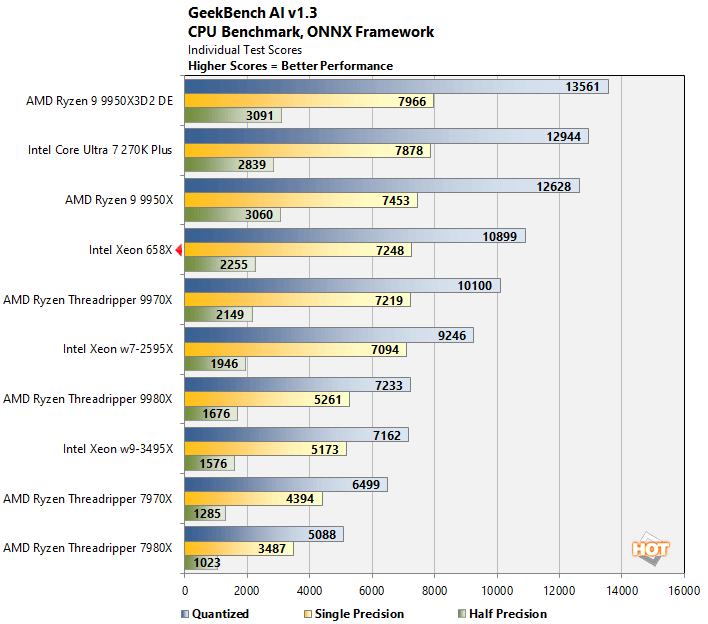
The Intel Xeon 658X performed particularly well in GeekBench AI. Here, the Intel Xeon 658X outpaced all of the other many-core workstation processors and trailed only the higher-clocked desktop chips. Once again, this is a benchmark that cannot make use of all available cores and threads, so other aspects of system performance come into play.
LAME XP Audio Encoding
In our custom LAME XP MP3 encoding test, we convert 24, large uncompressed WAV files to the MP3 format, which is a common use case for many end users, to provide portability and storage of their digital audio content. The LAME engine is an open-source MP3 audio encoder that is used widely in a multitude of third party applications. For this test, we created 24-copies of our own 223MB WAV file (an 11 minute Grateful Dead jam) and converted it to the MP3 format using the multi-thread capable LAME XP tool. Processing times are recorded below, listed in minutes:seconds. Shorter times equate to better performance.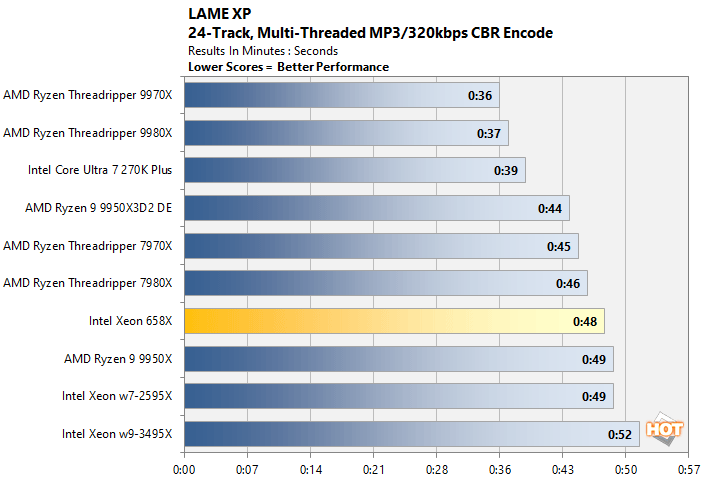
With only 24-tracks to work on simultaneously, this benchmark doesn't fully tax any of the processors represented here. Still, there's a clear performance trend with the Zen 5-based Threadripper 9000 series processors taking the overall lead, followed by the relatively high-clocked mainstream desktop chips. The Intel Xeon 658X ultimately lands just behind the Threadripper 7000 series parts, but ahead of the older Xeons.
Blackmagic RAW Video Processing Speed
The Blackmagic RAW Speed Test is a CPU and GPU benchmarking tool that tests full-resolution Blackmagic RAW video decode performance. The tool can be used to evaluate the performance at various resolutions and bitrates on the CPU or using OpenCL on a GPU. We're reporting two results here, both using 8K resolution, but at differing bitrates and compression levels.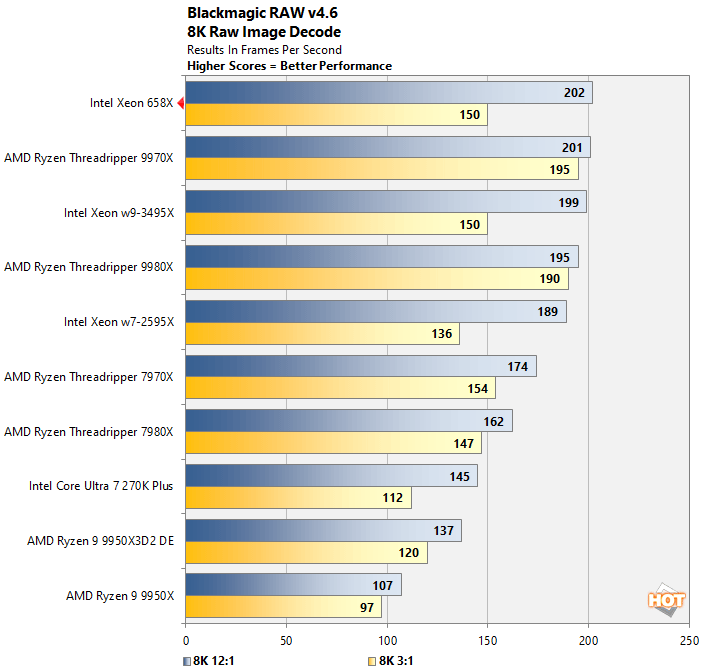
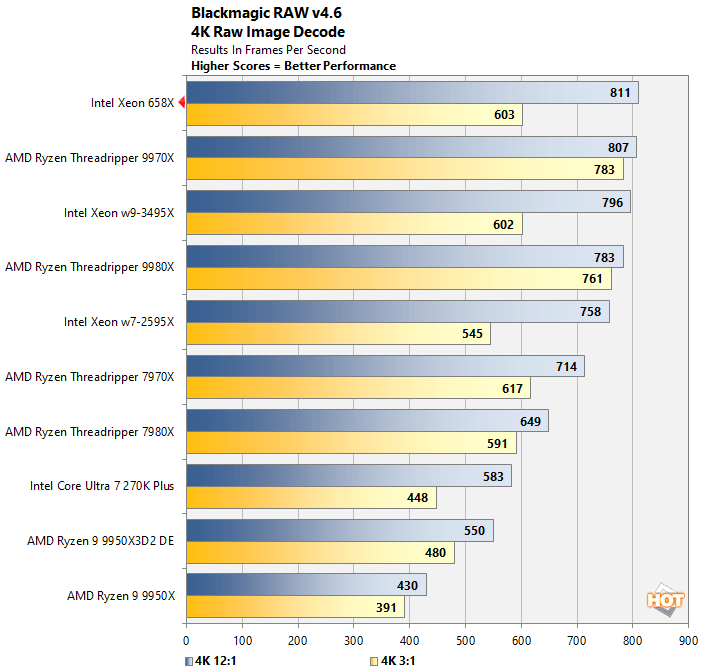
The Blackmagic Speed Test loves compute resources and memory bandwidth. As such, the quad-channels of DDR5-6400 memory in the Intel Xeon 658X system help push it into the lead in the 12:1 tests at both resolutions. With the more taxing 3:1 test, however, the Intel Xeon 658X outruns the previous-gen Xeons and desktop chips and lands in the upper quadrant.
Cinebench 2024 Rendering Benchmark
Cinebench is a 3D rendering performance test based on Cinema 4D from Maxon. Cinema 4D is a 3D rendering and animation tool suite used by animation houses and producers like Sony Animation and many others. It's very demanding of system processor resources and can utilize any number of threads, which makes it an excellent gauge of computational throughput. This is a multi-threaded, multi-processor aware benchmark that renders and animates 3D scenes and tracks the length of the entire process. The rate at which each test system was able to render the entire scene is represented in the graphs below.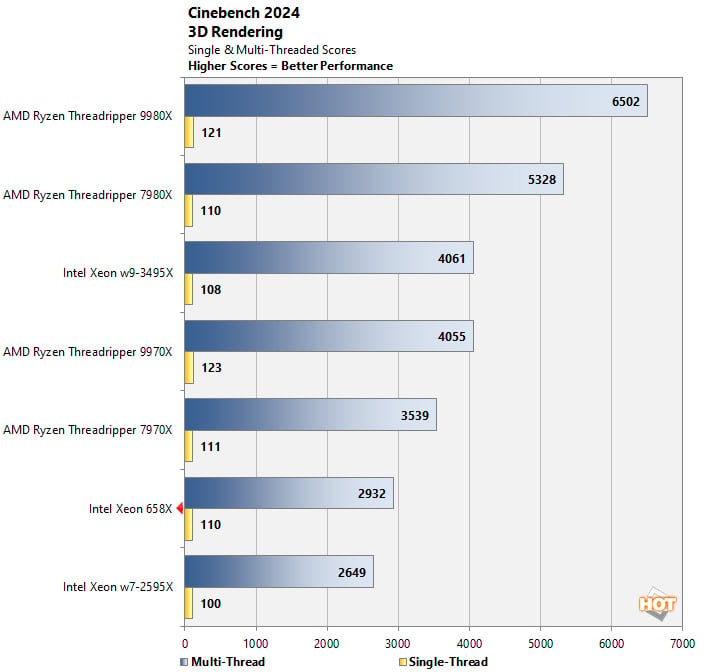
Cinebench 2024 has the Intel Xeon 658X finishing just about where'd you expect--ahead of the previous-gen Xeon w7-2595X, but behind the processors with higher core counts.
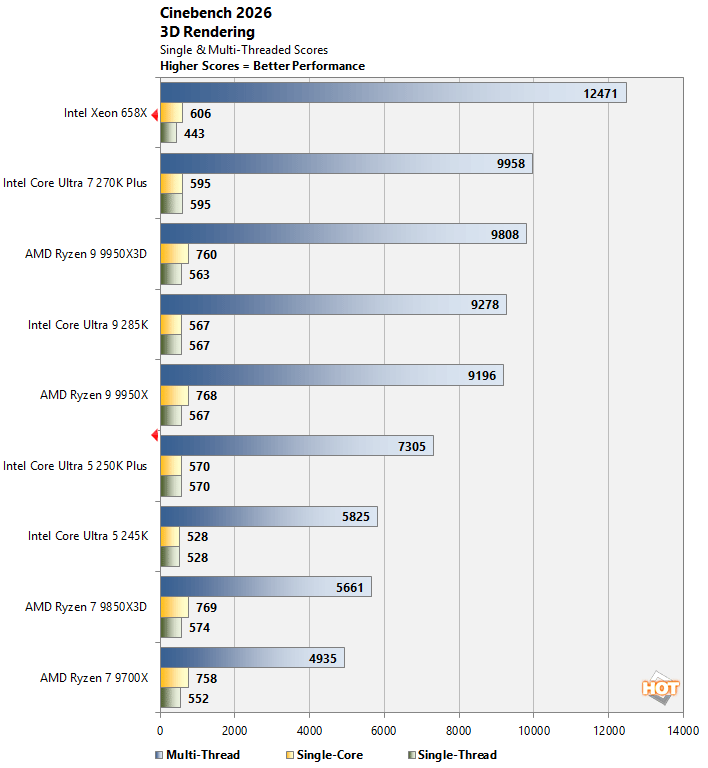
We also ran Cinebench 2026 on the Intel Xeon 658X, but only had reference data handy for mainstream desktop chips. Here, the Intel Xeon 658X lands at the top by a relatively large margin in the multi-threaded test. It's single-thread result is good relative to the other Intel processors, but trails the AMD Ryzen parts.
POV-Ray CPU Ray Tracing Benchmark
POV-Ray, or the Persistence of Vision Ray-Tracer, is an open source tool for creating realistically lit images. We tested with POV-Ray's standard 'one-CPU' and 'all-CPU' benchmarking tools on all of our test machines and recorded the scores reported for each. Results are measured in pixels-per-second throughput; higher scores equate to better performance.POV-Ray
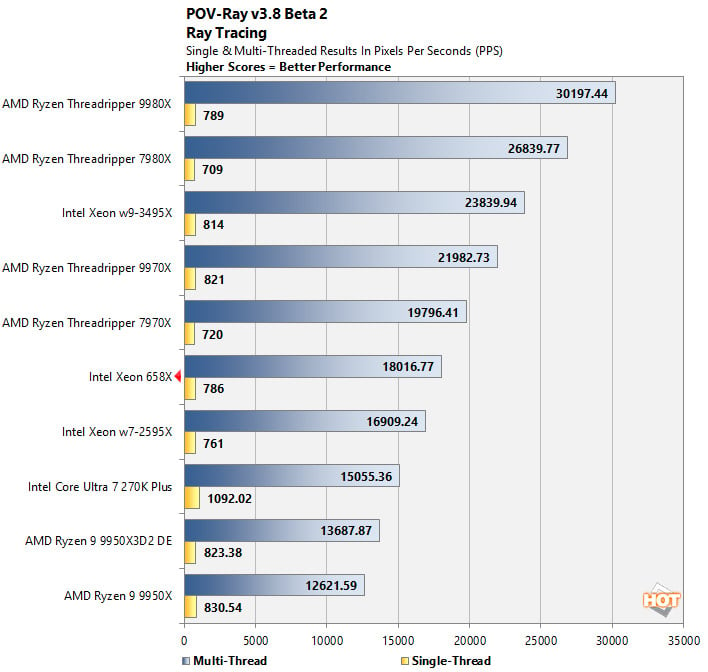
Once again we see the Intel Xeon 658X outpace the lower-core count mainstream desktops CPUs, and it outruns the older Xeon w7, which has a similar core count. There's no catching the higher core count chips, though.
Corona 10 Render Benchmark
The Corona Benchmark is built on the Corona 10 rendering core and assesses system performance by rendering a scene using Corona 10. It determines the color of each pixel by sending rays into the scene and analyzing the materials, lights and other components and then shows a machine's performance in rays per second (rays/s), where higher values equal better performance.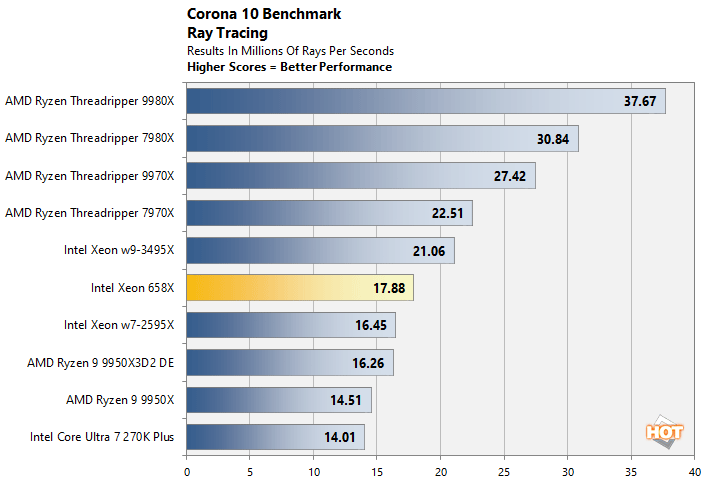
The Intel Xeon 658X performed as expected in this heavily multi-threaded test too, ultimately outpacing all of the mainstream desktop chips and Xeon w7, but trailing the higher core count processors.
Blender Rendering Benchmarks
Blender is a free and open source 3D creation suite that can handle everything from modeling, rigging, and animation to simulation, rendering, compositing and motion tracking. It has a purpose-built benchmarking tool that will track the time it takes to complete rendering a particular model (or models). We used the CPU-focused benchmark with all three models currently available...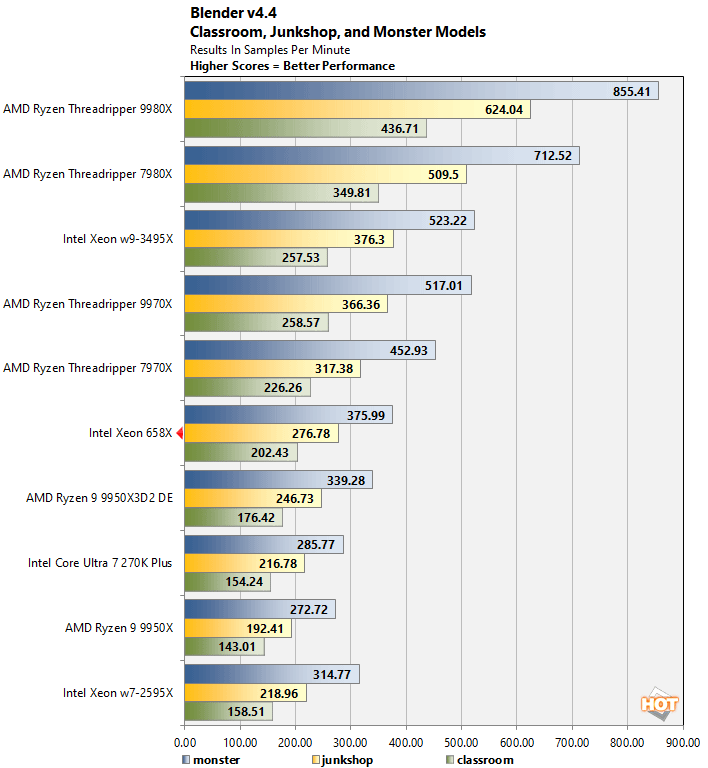
There's not much new to report with the Blender benchmark. Once again, the Intel Xeon 658X outguns the standard desktop chips and Xeon w7, but it simply doesn't have the resources to catch the higher core count processors.
Y-Cruncher Multi-Threaded Pi Calculator
Y-Cruncher is a multi-core-capable tool that calculates the value of pi to a specified number of digits. In this case, we ran the tool on all threads and had the application calculate the value of pi to 1 billion digits. The values below are the time required to perform the calculation expressed in seconds. As a result, lower values indicate better performance.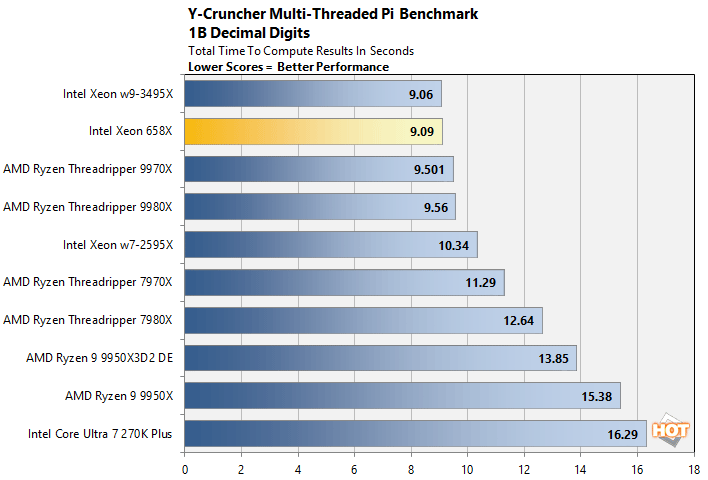
The Intel Xeon 658X punched well above its weight class in the Y-Cruncher benchmark, trailing only the higher core count Xeon w9-3495X in this test. Again, this is a multi-threaded benchmark that doesn't make use of every core or thread, so other factors like memory bandwidth and latency affect the final result as well.