Intel Xeon 658X Review: 24 Cores, Massive Memory Bandwidth Tested


Intel Xeon 658X Power Consumption
Keep in mind, this is total system power consumption being measured at the outlet and not the the individual power being drawn by the CPUs alone.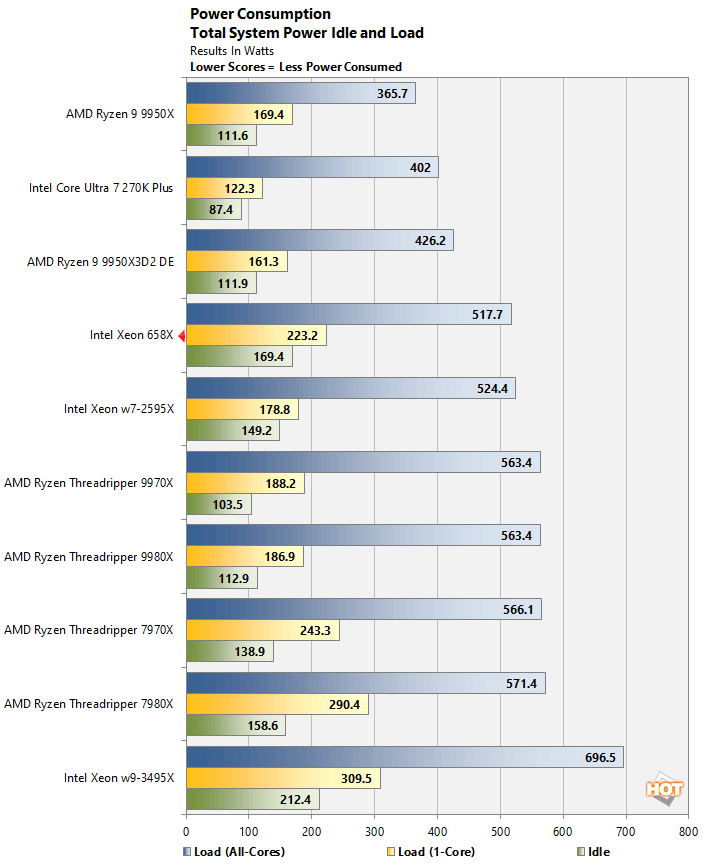
The Intel Xeon 658X proved to be relatively power-friendly, in light of the other workstation-class processors. The Intel Xeon 658X system consumed somewhat more power than expected at idle or with a single-core loaded up, but with a heavy multi-threaded workload, only the lower-core count, standard desktop chips consumed less power. The Intel Xeon 658X is clearly more efficient than its predecessors.
Intel Xeon 658X Hardware Details - PCMark
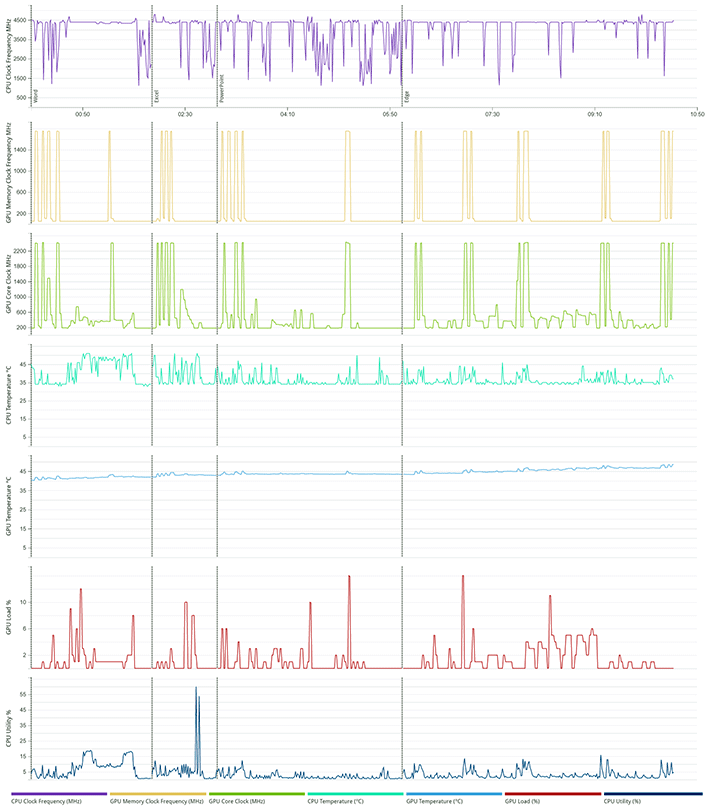
How power, frequencies, and thermals are affected in a variety of workloads with the Intel Xeon 658X is presented in the charts above. What you see here are frequencies, temps, and utilization over the course of a PCMark 10 Applications benchmark run. The Xeon 658X has brief moments where it can turbo up in the 4.8 - 4.9GHz range, but typically spends most of its time at around 4.4GHz. The Xeon 658X also runs relatively cool in our setup, never breaking into the mid 50°C range.
We should note that we're using a 360mm Enemax AIO cooler on the test rig that has no trouble handling the latest Xeon workstation processor's thermal load, even at somewhat high ambient temps in the lab during some warmer than usual mid-80 degree (F) days.
Intel Xeon 685X: Our Deep-Dive Review Verdict
Like other HEDT and many-core pro workstation processors, the Xeon 600 series is not for everyone. Processors like the Xeon 658X we tested don’t excel with every workload, and due to its relatively low clocks in relation to the latest, high-end mainstream desktop platforms, this 24-core processor often trails more affordable CPUs in single or lightly-threaded workloads. Fully load all of the Xeon 385X’s cores and leverage that huge cache and increased memory bandwidth, however, and it will pull away from mainstream desktop processors. With rendering, ray tracing, and encoding workloads (among others), processors like the Xeon 685X can offer much more performance and that doesn’t even take into account the large number PCIe Gen 5 lanes available with the platform. If you’re an AI developer and want tons of fast storage and multiple GPUs or accelerators, a Xeon 600-based workstation makes more sense.With an MSRP of $1,699 for the 658X, along with the price premium currently associated with W890-based motherboards and DDR5 RDIMMs, the cost of a system like the once we tested will also put it out of reach for many. If your use case won’t benefit from the increased connectivity and multi-thread performance, a more mainstream platform is for you. But these high-end platforms will often pay for themselves over time if you’re actually leveraging the immense resources available and some of the platform's enterprise-class resiliency and remote management features. Shaving time off a huge rendering workload or accelerating various highly parallel AI or scientific tasks, are priceless for some users, and those users are the Xeon 600 series intended targets. If that sounds like you, the Xeon 658X is faster and more efficient than its previous-gen counterparts. Although we don’t have a 24-core AMD Threadripper on hand for direct comparison, the Xeon 658X would be competitive with some workloads. Our tests showed it typically trailing the 32-core Threadripper 9970X, but outpacing the 16-core Ryzen 9 9950X, in multi-threaded applications meant for professional platforms at least. In more mainstream applications, the AMD processors typically pulled ahead.

Ultimately though, Intel's new Xeon 600 series is very powerful. If your use case justifies a many-core processor with massive amounts of memory bandwidth and tons of IO, a Xeon 600 ticks a lot of boxes and we’re happy to see that Intel is still focused on the HEDT and pro workstation markets. Intel Xeon 600 series processors are available now, both in the channel and in full systems from partners like Dell, Lenovo and others.