Intel Core Ultra X9 388H Review: Panther Lake Tests Strong


With the Intel Core Ultra 300 (Panther Lake), AMD Ryzen AI 400 (Gorgon Point), and Qualcomm Snapdragon X2 series all due to arrive this quarter, we thought it was a good time to revamp our laptop and notebook benchmarks, to ensure we have the most relevant and accurate benchmark data moving forward. For this article, we rounded up an array of systems we had on-hand, reset and refreshed all of them, and fully updated the systems with the latest UEFIs, firmware, and Windows Updates. We then ran all of the latest versions of each of the benchmarks to gather fresh benchmark data. As such, we don’t have nearly as much reference data available as we’ve historically had in our notebooks reviews, but we did capture data from most of the relevant competitive platforms, with a few caveats. We’re planning to run some numbers on one of the latest MacBooks and will update the charts when we can. We’ve also included some scores from an Intel Arrow Lake-H based gaming notebook and an AMD Strix Halo-based system. Arrow Lake-H offers higher power levels in the larger gaming notebook we tested, but since Intel compared Panther Lake to Arrow Lake-H often throughout its messaging, we’ve included it for comparison in a number of CPU benchmarks. AMD’s Strix Halo targets much higher price points and is focused on AI development, but since it features AMD’s most powerful mobile iGPU, we thought many of you would want to see the comparison.
We’re going to start our tests with something a bit out of the ordinary for a typical laptop review. Because Panther Lake is a new platform, we ran some AIDA64 test to see how cache and memory bandwidth and latency stack up to a few other mobile platforms.
AIDA64 Memory And Cache Bandwidth And Latency
AIDA64's CPU Cache and Memory benchmarks measure memory bandwidth during read, write and copy operations, in addition to memory latency, and cache bandwidth and latency.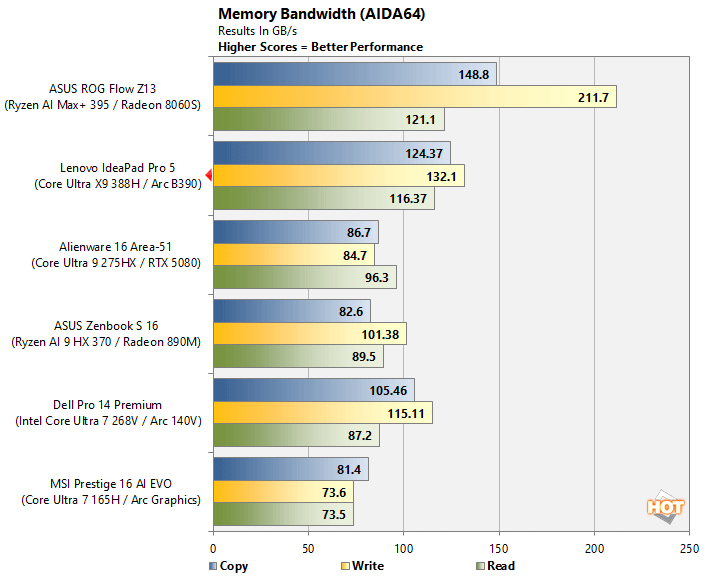
The 16-Core / 12-Xe Core Ultra X9 388H must be paired to fast LPDDR5X-9600 memory, which results in a significant advantage in terms of memory bandwidth versus other mainstream laptop platforms. Strix Halo's tighter integration and wider memory interface results in even higher peak bandwidth, but Panther Lake is a big upgrade over everything else, including the higher-power Arrow Lake-H (Core Ultra 9 275HX).
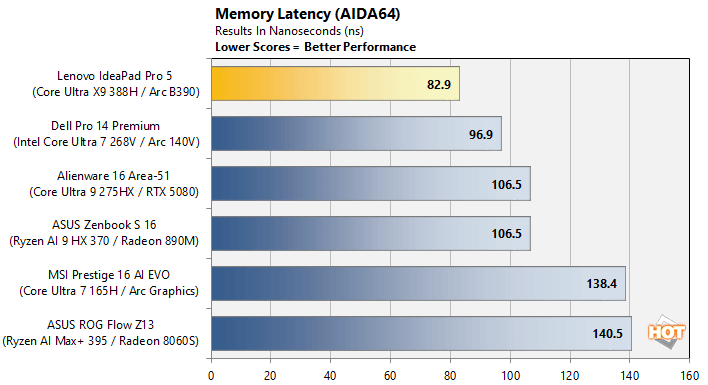
The fast memory on the Core Ultra X9 388H is also relatively low latency. The Core Ultra X9 388H's powered system offered the lowest memory latency of all of the systems we tested.
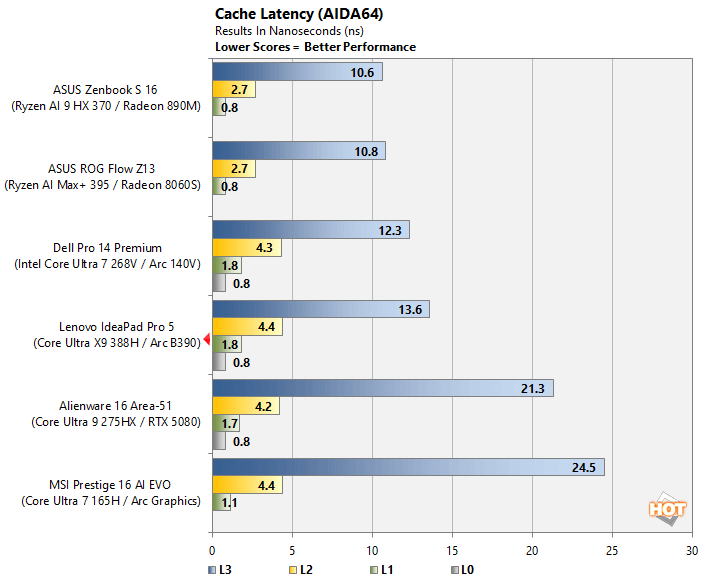
Cache latency is somewhat of a different story. Note that the Intel platforms report four levels of cache to AIDA (L0 - L3), while the AMD platform shows three (L1 - L3). L0 and L1 latency is similar across the platforms, the AMD's Strix Point (Ryzen AI 300) and Strix Halo (Ryzen AI Max+) show much lower L2 and L3 latency.
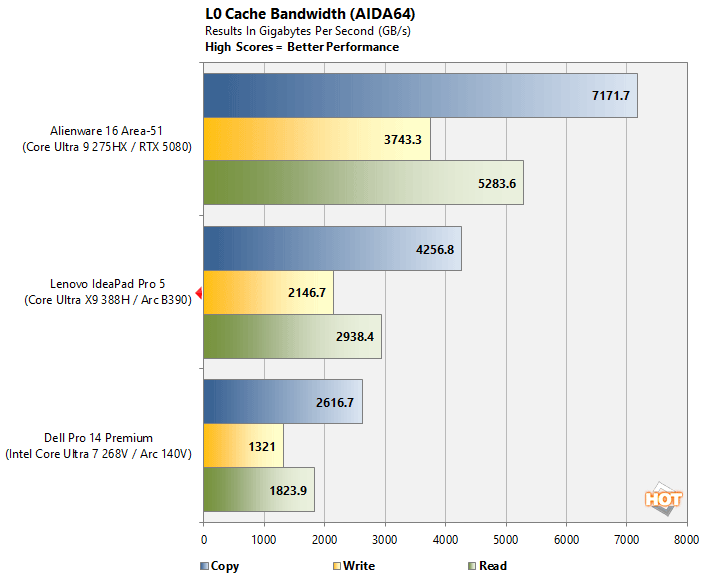
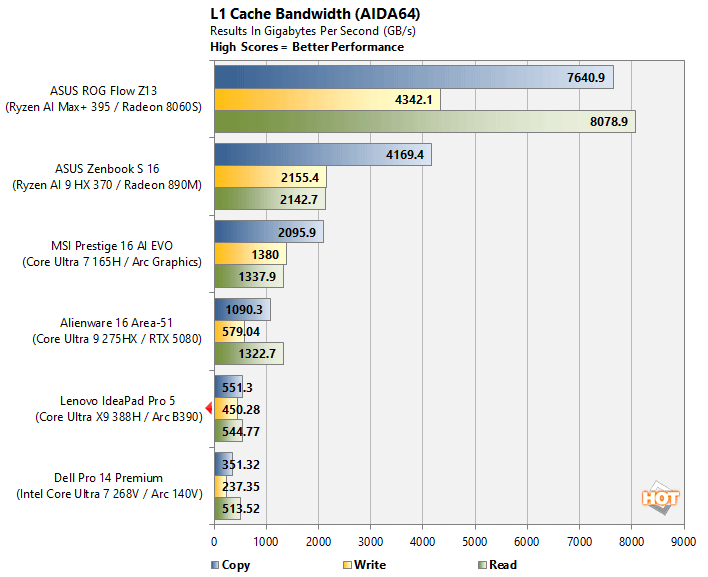
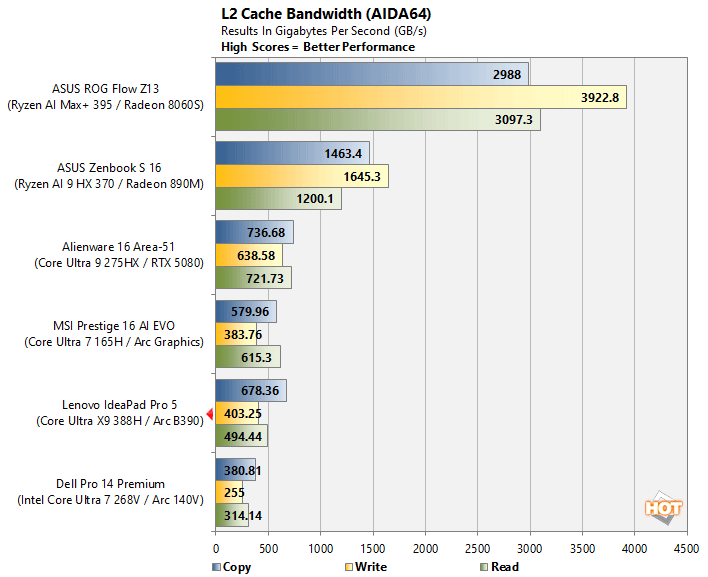
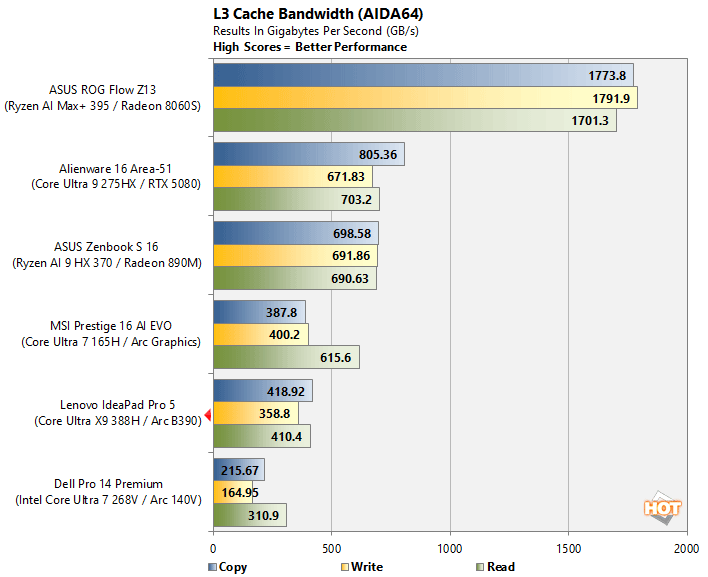
Cache bandwidth also shows big advantages for AMD's platforms and Arrow Lake-H. The Panther Lake-based Core Ultra X9 388H's cache bandwidth typically falls somewhere in between Meteor Lake and Lunar Lake. What does all of that mean in terms of actual application performance? Let's find out...
Speedometer 3.1 Browser Benchmark
We use BrowserBench.org's Speedometer test to take a holistic look at web application performance. This test automatically loads and runs a variety of sample web apps using the most popular web development frameworks around, including React, Angular, Ember.js, and even simple JavaScript. This test is an example of how systems cope with real-world, modern web apps. All tests were performed using the latest version of Chrome.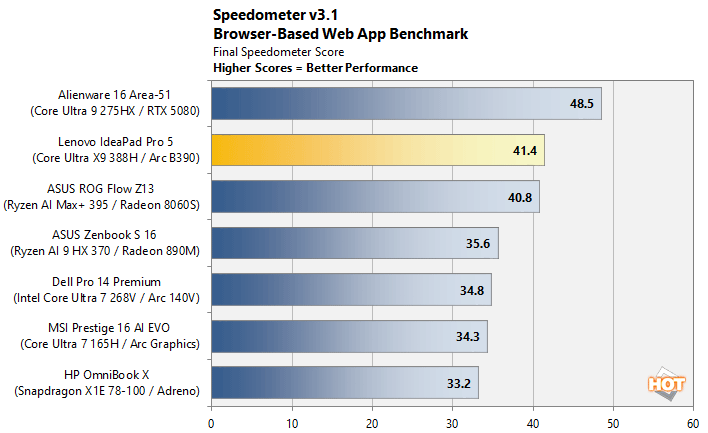
This benchmark is particularly sensitive to single thread performance and latency. The higher-power Arrow Lake-H based Alienware system comes out on top, but the Core Ultra X9 388H-powered Lenovo IdeaPad 5 Pro outruns all of the other mobile platforms, including Strix Point.
Geekbench v6.5 CPU Benchmark
The GeekBench CPU tests stress only the processor cores in a system (not the graphics card/GPU), with both single and multi-threaded workloads. The tests are comprised of encryption processing, image compression, HTML5 parsing, physics calculations and other general purpose compute processing workloads.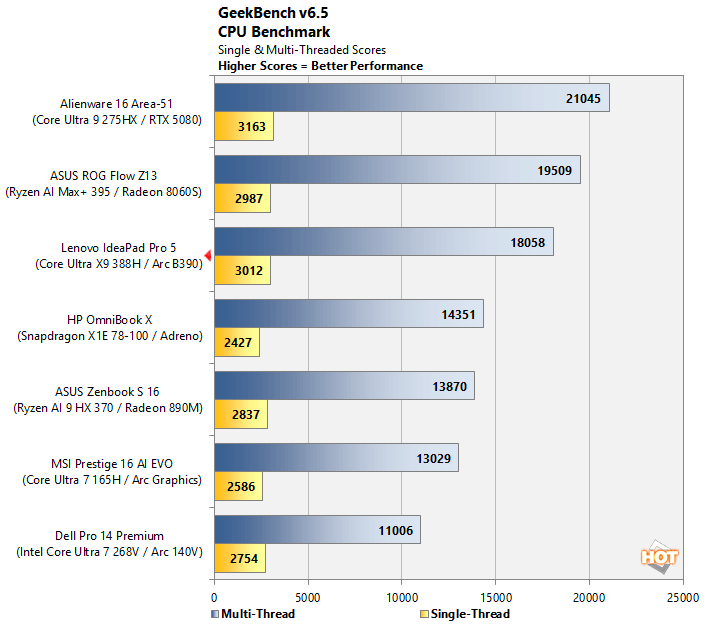
Once again we see the higher-power Arrow Lake-H based system take the pole position, with the best single and multi-thread result, follows by AMD's Strix Point Ryzen AI Max+ 395. The Core Ultra X9 388H offers the best single and multi-threaded results among the mainstream laptop platforms, however, outrunning everything else by a wide margin.
MAXON Cinebench 2026 3D Rendering Benchmark
Next up is the latest-generation 3D rendering Cinebench 26 benchmark from Maxon, based on the Cinema 4D rendering engine. The results featured here are purely CPU-based tests that doesn't make use of the graphics processor or NPU, and it scales very well with additional CPU cores. We ran both single- and multi-threaded tests on all of the machines in the charts.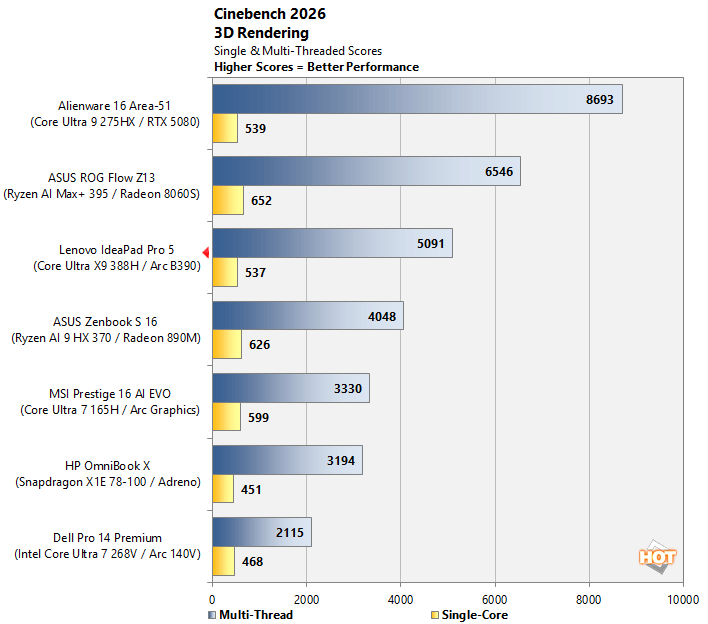
With the latest version of Cinebench, we saw more of the same. The higher powered platforms are able to pull ahead of the Core Ultra X9 388H, but relative to the other mainstream mobile platforms, Panther Lake looks strong. Single thread performance with the Core Ultra X9 388H lands about in the middle of the pack, but multi-thread performance is strong.
UL PCMark 10 Applications Benchmark
The PCMark 10 Applications benchmark measures performance in the Microsoft Office suite, as well as in the Edge browser, offering native instruction set-compatible versions of the apps for optimal performance across a wide variety of workloads in tools office workers, students and home users utilize every day. The following results should show a view of performance with a best foot forward from all systems tested.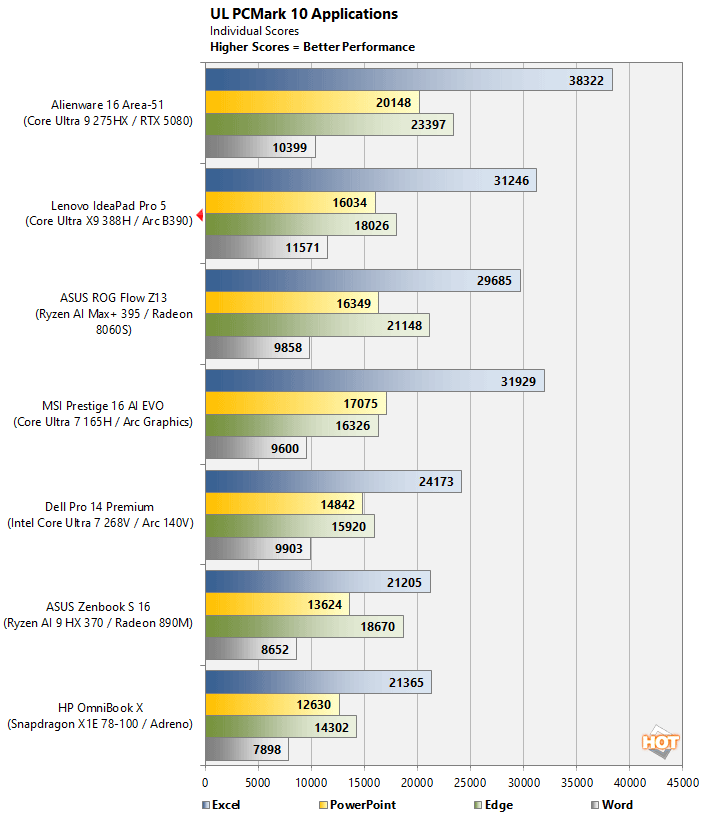
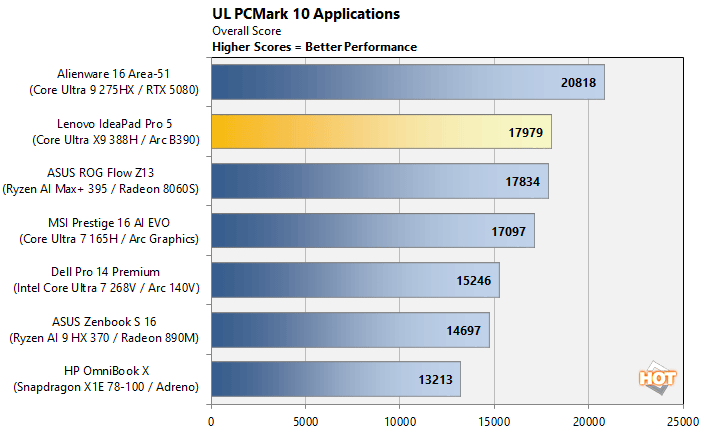
The higher power Arrow Lake-H based Alienware system with discreet NVIDIA GeForce RTX 5080 graphics takes the top spot in PCMark, but the Core Ultra X9 388H-based Lenovo system slots in next, outpacing all of the other systems we tested, including the Strix Halo-based ASUS ROG Flow X13.
Puget Bench For Creators: Davinci Resolve
Next up we have some video editing and encoding using the Puget Bench for Creators and Davinci Resolve. Puget Systems has been developing benchmarks that leverage real-world applications and workloads for a number of years now, which are highly regarded by creators using popular Adobe applications and Davinci Resolve. Here, we used the free version of Davinci Resolve (not the Studio edition) that features less hardware acceleration and relies heavily on CPU, GPU and memory performance.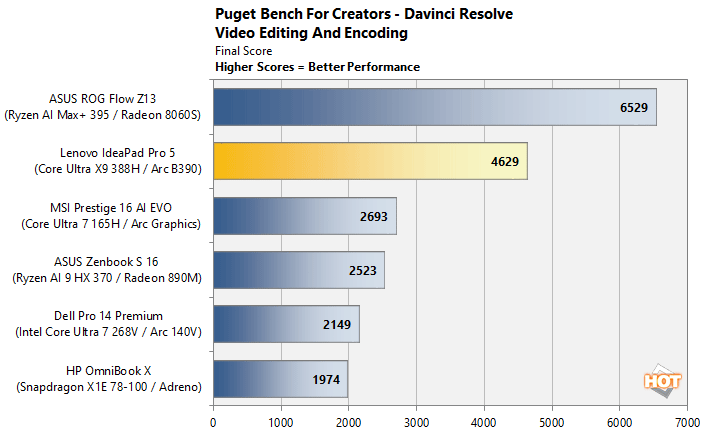
Once again we see the Core Ultra X9 388H powered Lenovo notebook crush all of the mainstream laptops; it is only bested by the Ryzen AI Max+ powered ROG Flow Z13, which is a much more expensive workstation class device.
Geekbench AI v1.6
Geekbench AI runs ten separate tests, eight of which fall into the domain of Computer Vision while the remaining two are Natural Language Processing benchmarks. Scores are based not only on how rapidly the machine or component can iterate on the test but also on how accurate the output is compared to a "ground truth" result obtained using full-precision processing. We tested the CPU and GPU in all of the systems that were supported or compatible with the benchmark.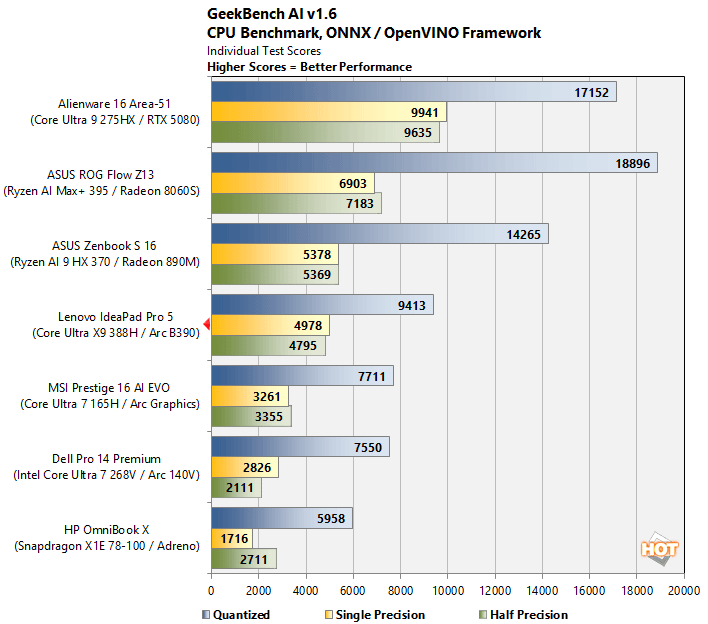
In the CPU portion of the benchmark, the Core Ultra X9 388H lands about in the middle of the pack, well ahead of the Snapdragon X1-based system and previous-gen mainstream Intel systems, but well behind Arrow Lake-H or the AMD-based systems.
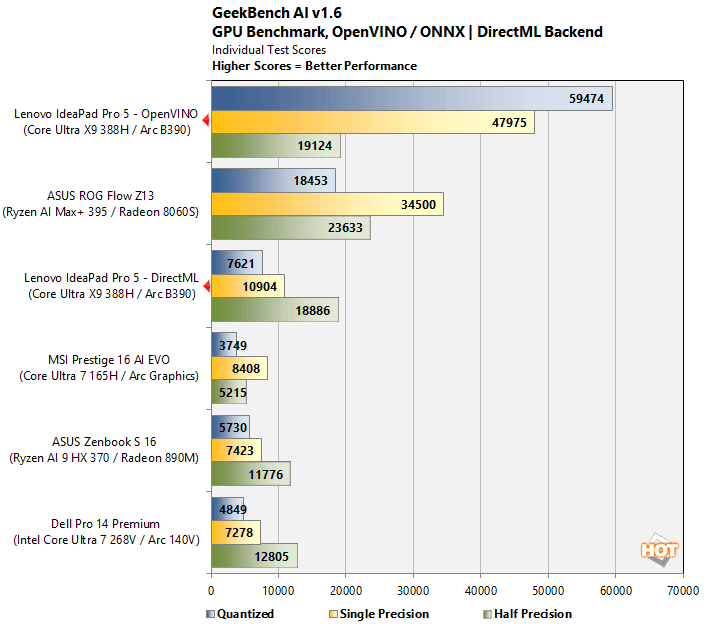
Versus the iGPUs in the other systems when using the ONNX framework, it's only the Strix Halo Ryzen AI Max+ 395 that's able to pull ahead of the Arc B390 in Panther Lake. When using Intel's OpenVINO framework, however, the B390 blows past Strix Halo in the Single Precision and Quantized tests, and trails slightly only at Half Precision. Versus the Radeon 890M (Ryzen AI 300) or previous-gen Arc graphics iGPUs, the Arc B390 in the Core Ultra X9 388H pulls well ahead in these AI workloads.
UL Procyon AI Computer Vision Benchmark
The idea of "edge AI", or running AI workloads natively on your local devices versus the cloud, is slowly but steadily gaining acceptance on mainstream PCs. As such, benchmarks for these workloads aren't exactly prolific. Fortunately, UL has already built a few into its Procyon benchmark suite. The following is a look at how a few machines do in this benchmark suite's AI Computer Vision benchmark, which exercises the test subject's ability to handle machine vision workloads, which you'll find in everyday tasks like webcam background blur, subject tracking, eye gaze correction and other effects, for example.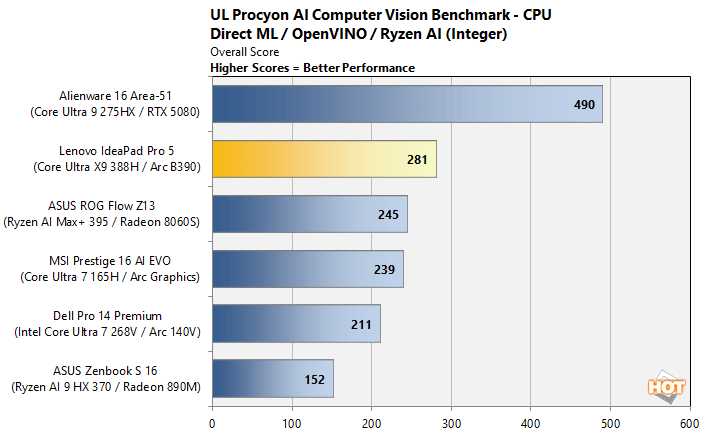
With the CPU-focused version of this benchmark, the Core Ultra X9 388H trails the higher powered Arrow Lake-H based Alienware system, but pulls well ahead of the others.
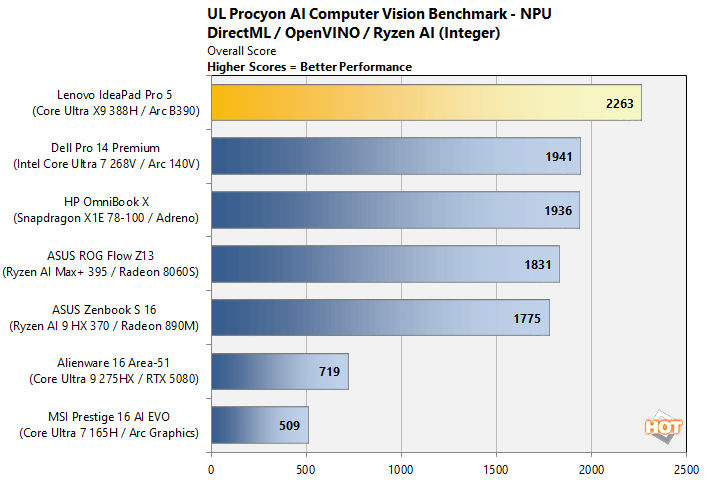
If we focus on NPU performance, Panther Lake looks particularly strong. The neural processing unit in Panther Lake is dubbed NPU 5. In terms of its peak TOPS versus NPU 4 in Lunar Lake, it doesn’t seem like a big upgrade. NPU 5 is rated for up to 50 TOPS, versus NPU 4’s (Lunar Lake's) 45 TOPs. NPU 5, however, is optimized for efficiency and has been re-tuned to better handle the latest workloads. As you can see, the Core Ultra X9 388H finished well ahead here; its NPU is much better tuned for current AI workloads than its predecessors, despite its modest bump in peak TOPS.
UL 3DMark Gaming Benchmarks
3DMark has a wide variety of graphics and gaming related tests available. In these tests, we chose to run 3DMark CPU Profile benchmark, which runs through an array of physics calculations with a varying number of threads, and Steel Nomad Lite, a modern DirectX 12 test specifically designed for lower-power GPUs and integrated graphics.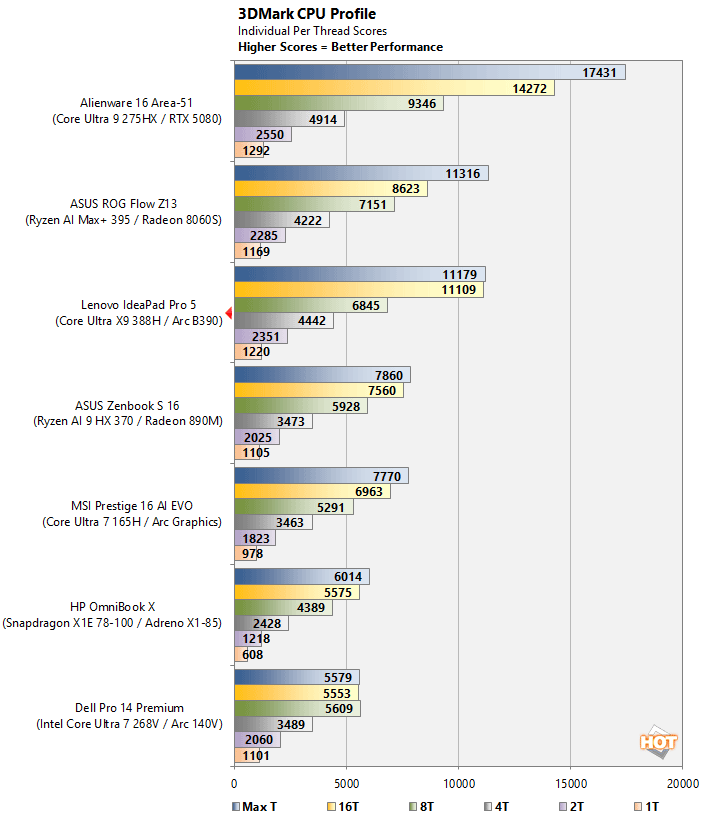
Once again, we see the Core Ultra X9 388H compete favorable with the higher power or more expensive platforms like Arrow Lake-H or Strix Halo. In fact, when testing with 4 or 16-threads, the Core Ultra X9 388H is able to outrun the Ryzen AI Max+ 395. Because the Ryzen processor support SMT, however, it pulls ahead when the maximum number of threads are utilized. The Ryzen AI Max+ 395 is a 16-core / 32-thread processor, whereas the Core Ultra X9 388H is a 16-core / 16-thread part.
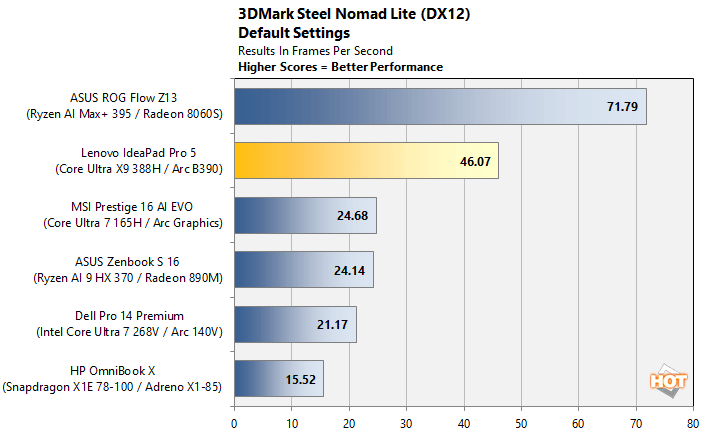
With its massive memory bandwidth advantage, there's no catching the Ryzen AI Max+ 395's Radeon 8060S in this graphics benchmark, but relative to the other mainstream notebook platforms, Panther Lake's 12-Xe configuration rocks. the Core Ultra X9 388H crushes all of the other notebooks platforms and nearly doubles the performance of the Radeon 890M.
Game Benchmarks With F1 25 & The Talos Principle II
We also ran some fairly taxing gaming workloads on the laptops with F1 25 and The Talos Principle II at a 1080p resolution. With F1 25 we used the game's "High" image quality preset, which uses high-quality graphics settings, without ray tracing. And for The Talos Principle II, we used the game's "Medium" quality preset. Resolution scaling was disabled in both games, to show the native framerate across all platforms and iGPUs.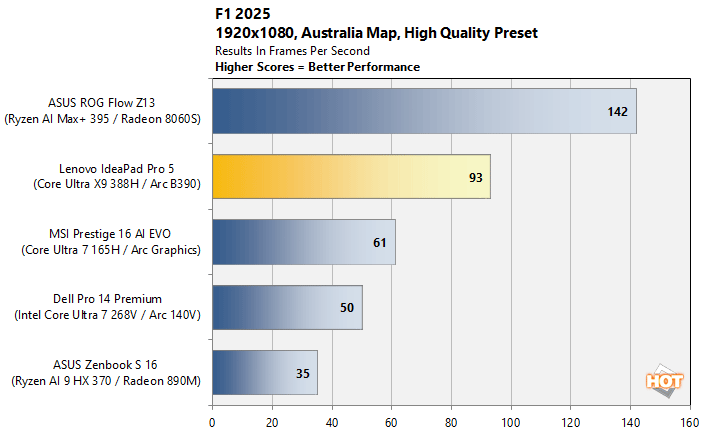
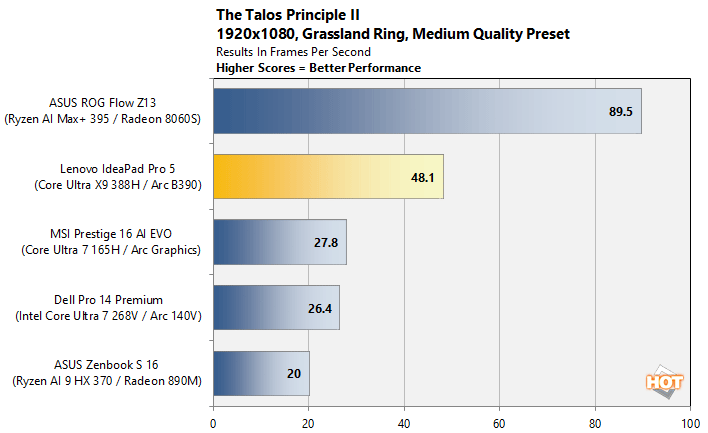
In our real-world game tests, the Core Ultra X9 388H and its 12-Xe GPU also look very strong. Again, the Strix Halo Ryzen AI Max+ 395's Radeon 8060S takes the pole position, but versus the other mainstream laptops -- which is the more apropos comparison -- the Panther Lake-based Core Ultra X9 388H dominates.