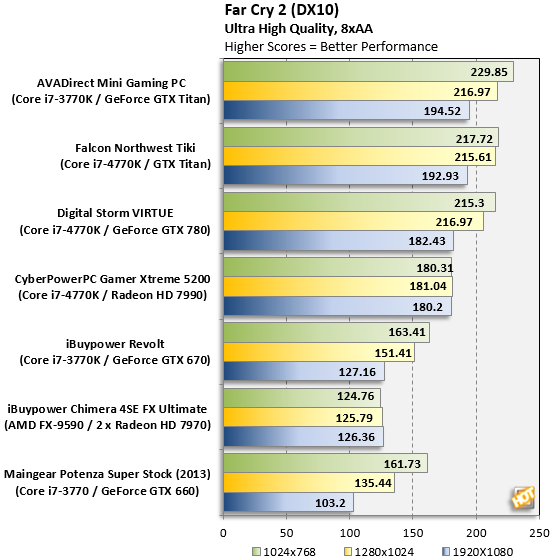
With the synthetic benchmarks completed, we dove into some real-world in-game testing. We started with Far Cry 2, which won’t strain a modern system, but will give us a look at the rig’s DX10 capabilities. Then we took a look at Lost Planet 2, which boasts DX11 support, tessellation, and some stunning water effects.
 |
| Far Cry 2 |
| DX10 Gaming Performance |
|

Far Cry 2
|
When it comes to lush vegetation in a steaming, sinister jungle, no one pulls it off quite like Ubisoft does in its Far Cry series. Far Cry 2 uses high quality textures, complex shaders, and dynamic lighting to create a realistic environment. The benchmark demo runs you through multiple areas of the map and from several different angles, while explosions and other events take place. |
The iBuypower Chimera 4SE FX Ultimate didn’t give us the kinds of frame rates we expected in our DX10 test. In fact, the system fell even behind the iBuypower Revolt. The system couldn’t shake the mid-120s in any our standard display resolutions, due to CPU limitiations.
|
| Lost Planet 2 |
| DX11 Gaming Performance |
|
Lost Planet 2
|
We used Lost Planet 2 to test the system’s DX11 performance. This game’s benchmark features soldiers attempting to take down a massive beast that seems to shrug off their firepower. There is a ton of action in the five or so minutes that the benchmark runs, and we’ve seen the test stutter when being run by lesser systems. We used Test B and set all graphics settings to High Quality. We also boosted the Anti-Aliasing setting to 4x before we ran the benchmark. |
The Chimera’s scores in Lost Planet 2 made sense, considering the performance of the Maingear SHIFT, which boasted three Radeon HD 7970s to the Chimera's two 7970 cards. Both of these systems pulled well ahead of the competition; Lost Planet 2 clearly benefits from multiple graphics cards.