HP ZGX Nano G1n Review: GB10 Mini PC Runs Local Qwen Coding Agent


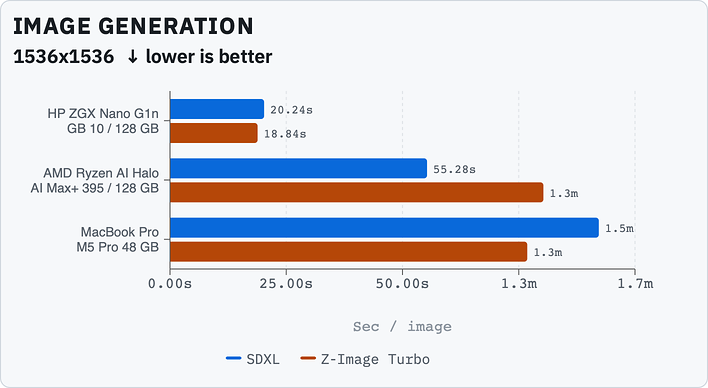
One correction from our Ryzen AI Halo review is that you'll notice these times are quite a bit longer than what we previously recorded. With a little outside help, I was able to determine that the actual reported speeds of the earlier version of Local AI Bench were generating images from cache. The warmup run that ensured the model was loaded swallowed the un-cached results without reporting the time. So the previous one-second generation time was not realistic, and that just didn't get caught before publication. We have updated numbers for both architectures, however.
Local AI Image Generation Benchmarks Tell The Story Well

No matter the image resolution, the ZGX Nano G1n trounces the competition. Image - HotHardware
With AI, Quality And Accuracy Matters, Especially With Images
Let's take a moment to look at how these images turned out, shall we? First up, since this system has plenty of memory, we skipped the results from Stable Diffusion 1.5 and went straight for Stable Diffusion XL and Z-Image-Turbo. The smaller model produced some comical results for this prompt: "A photorealistic high-end gaming PC build with RGB lighting, multiple GPUs, custom water cooling, shot in a dark room, highly detailed, 8k resolution." It doesn't actually generate 8k images, but they're meant to be detailed.

The results from Stable Diffusion have long been kind of suspect, and this result is no different. But Z-Image-Turbo actually has a pretty good view of what exactly a high-end PC looks like, even if the text on some components is gibberish. These image generation models may not hold a candle to frontier models that cost money per token, but they may do in a pinch. You won't confuse these for photos, but then again, that's not the point.
Also, these images and their relative lack of realism isn't some sort of judgment of the ZGX Nano G1n or even the GB10 chip itself; this is more or less what these models produce in ComfyUI on any local setup. But when you judge how long it takes to generate an image, you need to know how the end result might look.
Let's dig into some power-related statistics, shall we?
HP ZGX Nano G1n Power, Thermals, and Acoustics
Part of the enhancements to Local AI Bench is to measure the actual power draw of the chip while the machine is at work, so we can see exactly how much power it's pulling while running these local AI models. The interface to talk to the GB10 is through nvidia-smi on Linux, much like on AMD it's through rocm-info and on macOS it's done through powermetrics. The thing is, each of those things is different and measures power draw differently so it's not helpful to have comparison numbers. Instead, we'll look at the GB10 in isolation and we can do some math to figure out how much local AI will cost in terms of electricity.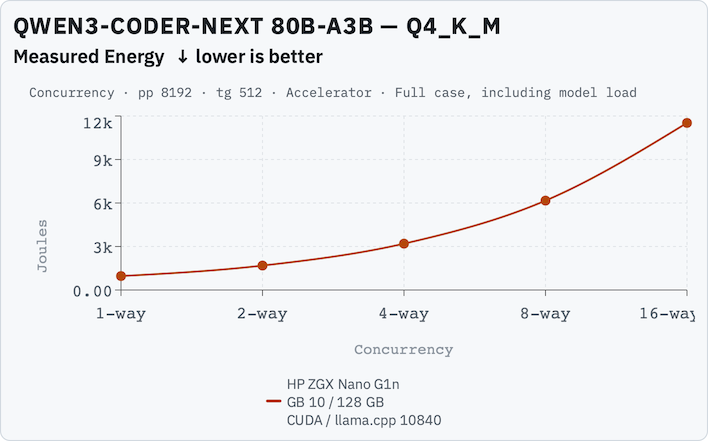
Unsurprisingly, as the batch size grows, overall energy use rises. The decode speed is limited by moving the weights through memory, not the actual compute, so more concurrent requests increases compute requirements until the GPU is maxed out. That's why on previous pages, batched total decode speeds measured in tokens per second rose a bit at each concurrency level, even if tps per request declined. Move the weights through memory once and decode for each concurrent request, then move through again and again.
But what's making energy spike in the 8-way and 16-way tests isn't the GPU; it's that the tokens per second per request slows down so the total task energy measured in joules rises. However, the number of tokens being generated ALSO rises since we're running multiple requests at the same time. Let's break it down a bit more.
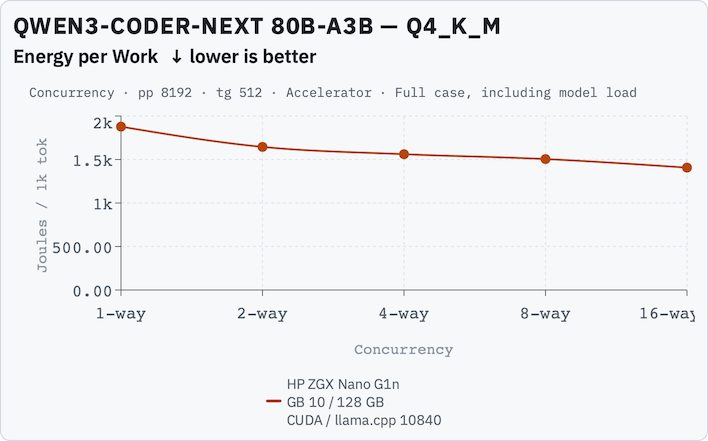
The efficiency as measured as joules per 1k tokens improves over time. That's how it should be when you're maxing out the GPU and its memory bandwidth. It's not a huge shift going down, but we get from ~1900 joules per 1k tokens down to more like ~1450 joules.
To translate this into watt-hours, we have to divide by 3,600 because a joule per second for an hour is a watt-hour. It's easier to read if we do joules per 10k tokens, which means 1,900 or 1,450 per 1k is 19,000 and 14,500 per 10k. Divide those numbers by 3600 and you get 19,000/3,600 = 5.278 watt-hours per 10,000 tokens. That means you're generating at worst 1.894 million tokens per kilowatt-hour. If you're paying 16 cents per kW/h then that's 16 cents for around 1.9 million tokens, or 120k tokens per penny for a concurrency of 1.
Of course, that's just for one model. Each model runs at a different speed and therefore has a higher or lower joules per 1k token count. I could do endless math using the power metrics reported by Local AI Bench, but more importantly, so can you. It's important to remember that's just GB10's energy usage, not wall energy, so you have to account for things like AC/DC conversion over the bundled USB-C adapter.
HP ZGX Nano G1n AI Station Conclusions
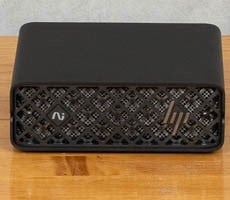
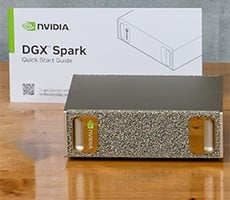
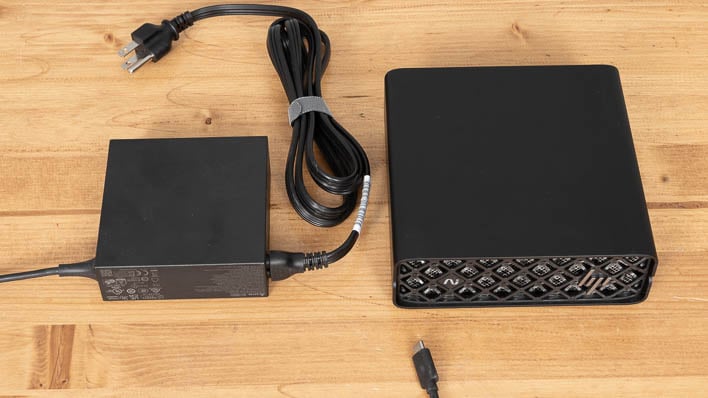
The HP ZGX Nano G1n is my favorite GB10 system to date, and it really comes down to the big open grate on the front that doesn't obstruct air. The design of the chassis makes it the coolest-running of these systems we've tested. It's hard to differentiate one product based on the GB10 from another, and that's got to be especially frustrating for partners when NVIDIA's own DGX Spark sells for less than any partner-made GB10 system. That said, in our view, HP has done a pretty solid job of doing just that with the ZGX Nano G1n.Stacked against similar small form factor systems in its class, built with competing silicon, NVIDIA systems like the ZGX Nano G1n come out on top. For our specific coding agent case, it is much faster than either the Ryzen AI Halo or the MacBook Pro M5 Pro. It's also so much faster at prompt processing than the M5 Pro that we're pretty sure an M5 Max would have a hard time keeping up, although the higher bandwidth probably means the ZGX Nano would lose in a straight decode-phase test. But based on our experience with the M5 Pro and M4 Max, we'd still have a hard time recommending an M5 Max Mac Studio when prompt processing is important. NVIDIA just kind of wins across the board with local AI at this time.
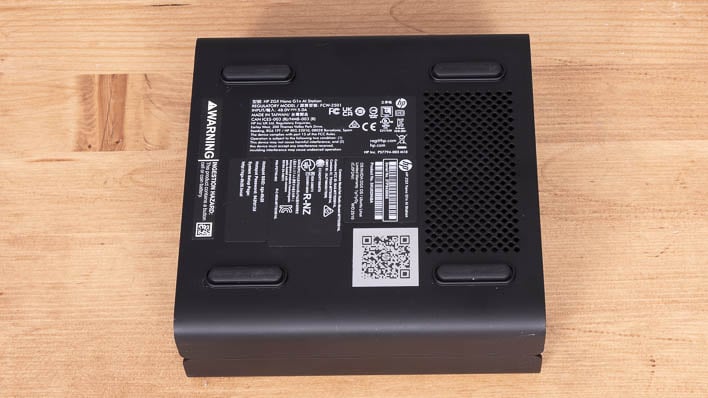
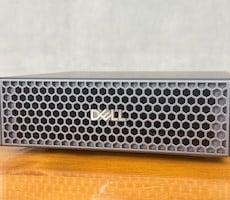
No GB10-based system is cheap in the current climate. What was originally envisioned as a $4,000 AI appliance quickly morphed into a $5,649 AI appliance over time, and the memory and NAND manufacturers seem helpless (or perhaps not inclined) to remedy the issue at this time. This model shipped with a 2 TB NVMe SSD, which is half that of the lower-priced DGX Spark, though competitive with most partner systems, including the Dell Pro Max with GB10. For those who seek more storage, an upgrade to 4 TB is available but that pushes the price to $6,700.
There's a lot to like about the HP ZGX Nano G1n. It runs cool and quiet, and anything that is designed to run on the DGX Spark runs here without any issues. If you compare the cost for a system like this to paying for a cloud subscription, the price can seem daunting. However, local AI has inherent benefits over the cloud, including data privacy and the user's total control over what runs and how. Smaller models well suited for local AI are also getting progressively better over time--what they're capable of today will quickly be eclipsed by tomorrow's models. If you're looking to build a home lab and leverage local AI, the HP ZGX Nano should be high up on your list of considerations.