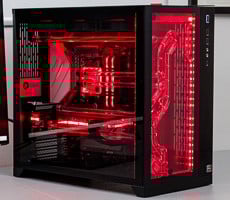
Ultimate DIY Performance PC: EVGA & Intel Infused


Test System Configuration Notes: When configuring our test systems for this article, we first entered their respective system BIOSes and set each board to its "Optimized" or "High performance Defaults". We then saved the settings, re-entered the BIOS and set memory timings manually, enabled AHCI, and disabled any proprietary auto-overclocking features. The hard drives were then formatted, and Windows 7 Ultimate x64 was installed. When the Windows installation was complete, we updated the OS, and installed the drivers necessary for our components. Auto-Updating and Windows Defender were then disabled, finally, we installed all of our benchmarking software, performed a disk clean-up, defragged the hard drives, and ran all of the tests.
 |
|
| System 1: Intel Xeon 5680 (3.33GHz Six-Core x 2) EVGA Classified SR-2 (Intel 5520 Chipset) 6x2GB G.SKILL DDR3-2000 (@ 1333MHz, CAS 6) GeForce GTX 280 On-Board Ethernet On-board Audio WD150 "Raptor" HD 10,000 RPM SATA Windows 7 x64 |
System 2: Core i7 980X (3.33GHz - Six-Core) Gigabyte EX58A-UD5 (X58 Express Chipset) 3x2GB OCZ DDR3-1333 (@ 1333MHz, CAS 8) GeForce GTX 280 On-Board Ethernet On-board Audio WD150 "Raptor" HD 10,000 RPM SATA Windows 7 x64 |
System 3: Phenom II X6 1090T (3.2GHz Six-Core) MSI 890FXA-GD70 (890FX Chipset) 2x2GB OCZ DDR3-1333 (@ 1333MHz, CAS 8) GeForce GTX 280 On-Board Ethernet On-board Audio WD150 "Raptor" HD 10,000 RPM SATA Windows 7 x64 |
System 4: Core 2 Extreme QX9775 (3.2GHz - Quad-Core x 2) Intel D5400XS (5400 Series Chipset) 4x2GB Kingston FBDIMM CL 5-5-5 - DDR2-800 GeForce GTX 280 On-Board Ethernet On-board Audio WD150 "Raptor" HD 10,000 RPM SATA Windows 7 x64 |
 |
|
We began our testing with SiSoftware's SANDRA 2010 SP1, the System ANalyzer, Diagnostic and Reporting Assistant. We ran three of the built-in subsystem tests that partially comprise the SANDRA suite with the SR-2 and a pair of Intel Xeon 5680s (CPU Arithmetic, Multimedia, and Memory Bandwidth). All of the scores reported below were taken with the processors running at their default clock speeds of 3.33GHz but with Turbo Mode enabled.
;)
;)
;)
SiSoft SANDRA CPU Arithmetic > Multimedia > Memory Bandwidth
The numbers put up in SANDRA by the EVGA Classified SR-2 when paired to a duo of Intel's flagship Xeons are nothing short of spectacular. The dual-Xeon 5680s outpace even a quartet of Opterons in aggregate arithmetic performance, with a score of 258.37 GOPS. Aggregate multi-media performance for the platform exceeded 488MPix/s, and total memory bandwidth was just shy of 36GB/s.