ATI Radeon X1900 XTX And CrossFire: R580 Is Here

Performance Comparisons with Doom 3
Details: http://www.doom3.com/

Doom 3
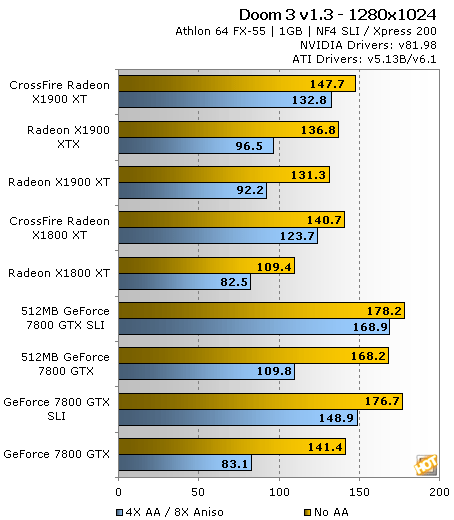
id Software's games have long been pushing the limits of 3D graphics. Quake, Quake 2, and Quake 3 were all instrumental in the success of 3D accelerators on the PC. Now, many years later, with virtually every new desktop computer shipping with some sort of 3D accelerator, id is at it again with the visually stunning Doom 3. Like most of id's previous titles, Doom 3 is an OpenGL game that uses extremely high-detailed textures and a ton of dynamic lighting and shadows. We ran this batch of Doom 3 single player benchmarks using a custom demo with the game set to its "High-Quality" mode, at resolutions of 1,280 x 1,024 and 1,600 x 1,200 without anti-aliasing enabled and then again with 4X AA and 8X aniso enabled simultaneously.


By now you all know that Doom 3 performance has been a strong point for NVIDIA ever since the game was originally released. Today, NVIDIA still holds onto the overall lead in performance for this game, but only because we tested 512MB GeForce 7800 GTXs alongside their 256MB counterparts. The 512MB GeForce 7800 GTXs were about 10% and 25% faster than the Radeon X1900 XTX or X1900 CrossFire. But the 512MB GeForce 7800 GTX is also nearly impossible for end-users to get ahold of at the moment.  Remove it from the equation, and the X1900 pulls ahead of the 256MB GeForce 7800 GTX by a few percentage points when anti-aliasing and anisotropic filtering are used.


Marco Chiappetta

Marco Chiappetta

Marco's interest in computing and technology dates all the way back to his early childhood. Even before being exposed to the Commodore P.E.T. and later the Commodore 64 in the early ‘80s, he was interested in electricity and electronics, and he still has the modded AFX cars and shop-worn soldering irons to prove it. Once he got his hands on his own Commodore 64, however, computing became Marco's passion. Throughout his academic and professional lives, Marco has worked with virtually every major platform from the TRS-80 and Amiga, to today's high end, multi-core servers. Over the years, he has worked in many fields related to technology and computing, including system design, assembly and sales, professional quality assurance testing, and technical writing. In addition to being the Managing Editor here at HotHardware for close to 15 years, Marco is also a freelance writer whose work has been published in a number of PC and technology related print publications and he is a regular fixture on HotHardware’s own Two and a Half Geeks webcast. - Contact: marco(at)hothardware(dot)com

Related content