



SK Hynix Reveals When Memory Crisis Could End And It's Not Soon


Have you looked at the price of RAM lately? Retail prices for desktop DDR5 memory kits are three to five times what they were just a month ago. Building a PC has gone from "your GPU should be the most expensive component" to "make sure to budget for enough RAM." In fact, the shortage reminds us of the GPU shortage just a few short years ago. It's a miserable situation for PC enthusiasts, but it's apparently not going to improve anytime soon, at least according to purported internal analysis from SK hynix.
This news actually comes from BullsLab Jay, who is one of the guys behind the Korean-language BullsLab YouTube channel. BullsLab (and likely Jay) is based out of Korea, so it's perfectly plausible that they'd have a man on the inside who can leak them SK hynix internal data. What does that data show? A bright future for the memory industry, yet nothing but doom and gloom for the future of the PC enthusiast market.
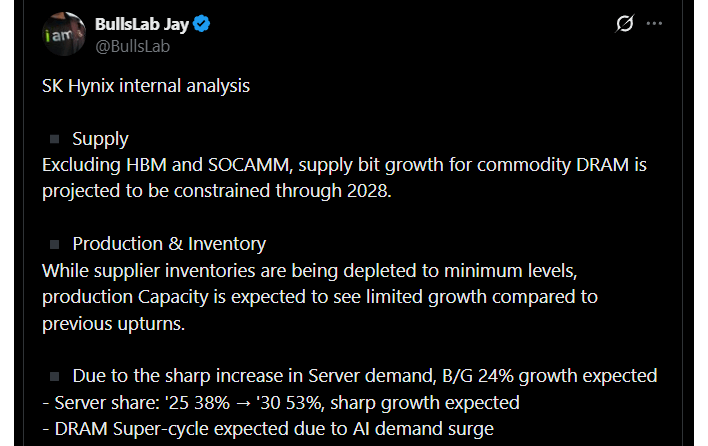
The core problem isn't a sudden spike in PC demand, but a structural shift in where memory is going. Server DRAM consumption is expected to continue its explosive growth over the rest of the decade, driven almost entirely by memory-hungry AI workloads. SK hynix reportedly expects servers to account for just under 40% of all DRAM demand in 2025, ballooning to more than half of the entire market by 2030. That's critically important, because servers don't just use more memory than PCs—they're also willing to pay almost any price for it.
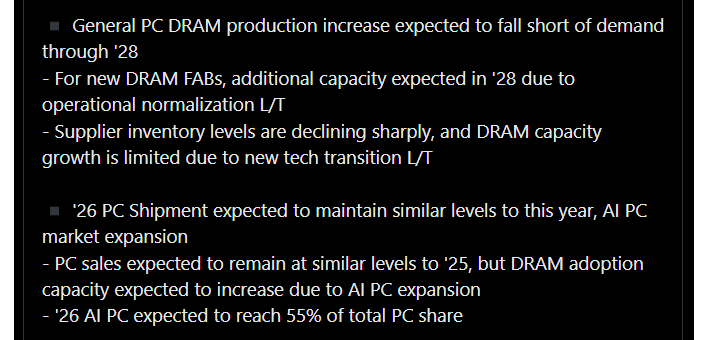
Worse, this isn't a typical memory boom where manufacturers rush to build capacity and flood the market a year later. Reportedly, supplier inventories are already drawn down to historically low levels, and production capacity is expected to grow far more slowly than in previous upcycles, specifically because memory vendors want to avoid a major oversupply situation in case of an abrupt demand downturn (caused by, say, a massive market bubble popping). New DRAM fabs take years to come online, and even then they don't ramp to full output immediately. SK hynix's own outlook suggests meaningful relief may not arrive until 2028, assuming nothing else breaks in the meantime.
For PC builders, the outlook is especially grim. PC shipments are expected to remain mostly flat through 2026, but memory demand per system is rising anyway thanks to AI PCs becoming mainstream. SK hynix reportedly expects AI-capable PCs to make up more than half of all PC shipments next year, which translates directly into higher baseline RAM configurations. In other words, even without a surge in PC sales, the industry still needs far more DRAM, and it's competing directly with hyperscale data centers that can outbid consumers without blinking.
If you're planning a new PC build, the message is clear: buy now before there's nothing at all left to buy. Of course, China's CXMT just announced that it is capable of producing DDR5 at up to 8000 MT/s, and LPDDR5X chips at up to 10.67 Gbps; imagine if the memory crunch convinced President Trump's administration to loosen Section 1260H restrictions and 301 tariffs on the mainland manufacturer. After all, SK hynix, Samsung, and Micron seem reluctant to increase production. Well, a gamer can dream.





